
开颅术后疼痛的阿片类药物节省型多模式镇痛:一项随机、双盲、安慰剂对照试验
Opioid-sparing multimodal analgesia for post-craniotomy pain: a randomized, double-blind, placebo-controlled trial.
作者信息
Negm Essamedin M, Younus Mohammed A, Morsy Ahmed A, El Gammal Sahar M S, El-Harrisi Mona A, Sameaa Fayrouz A Abdel, Rashad Rawan A M, Elserafy Tamer S, Gouda Ahmed M
机构信息
Department of Anaesthesia, ICU and Pain Management, Faculty of Medicine, Zagazig University, Zagazig, Egypt.
Department of Anaesthesia, ICU and Pain Management, Almogarif Hospital, Tripoli, Libya.
出版信息
BMC Anesthesiol. 2025 Aug 29;25(1):437. doi: 10.1186/s12871-025-03306-5.
BACKGROUND
Postoperative pain control in neurosurgical patients particularly after elective craniotomy remains clinically challenging due to the need for early neurological assessment and the adverse effects associated with opioid use. This study aimed to compare the efficacy and safety of an opioid-sparing multimodal analgesia (MMA) protocol versus a conventional opioid-based regimen for managing post-craniotomy pain.
METHODOLOGY
This prospective, randomized controlled trial was conducted over 12 months at Zagazig University Hospitals and included 60 adult patients (aged 18–65 years, American Society of Anesthesiologists )ASA( physical status I–II) scheduled for elective supratentorial craniotomy with planned postoperative intensive care unit (ICU) admission. Patients were randomly assigned in a 1:1 ratio to either a multimodal opioid-sparing analgesia group (Group M, = 30) or a conventional opioid-based analgesia group (Group O, = 30) using simple randomization. The MMA protocol included preoperative oral gabapentin, intraoperative dexmedetomidine infusion, a postoperative scalp block with bupivacaine, and scheduled intravenous (IV) acetaminophen and ketorolac. The opioid group received scheduled IV morphine according to institutional practice. The primary outcome was the Visual Analog Scale (VAS) score at 2 h postoperatively. Secondary outcomes included time to first rescue analgesia, total opioid consumption, sedation scores, oxygen saturation, postoperative nausea and vomiting (PONV), and patient satisfaction.
RESULTS
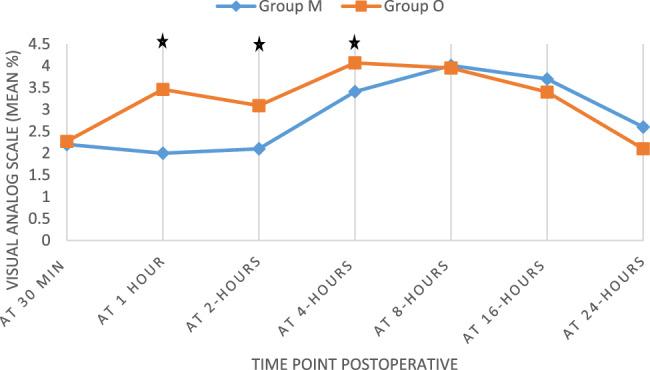
VAS scores were significantly lower in Group M at 1, 2, and 4 h postoperatively ( = 0.046, 0.039, and 0.045, respectively). A highly significant difference in sedation scores was observed between the groups at 30 min, 1 h, and 4 h ( < 0.001). Additionally, Group M had a significantly lower frequency of vomiting ( = 0.034); however, excellent satisfaction scores were more frequently reported in Group O, despite the objectively superior analgesic and safety profile observed in Group M.
CONCLUSION
In this randomized controlled trial, opioid-sparing MMA provided superior postoperative pain control after elective craniotomy, with fewer adverse effects compared to conventional opioid-based regimens. These results support the incorporation of MMA into standard postoperative protocols and align with the principles of Enhanced Recovery After Surgery (ERAS) in neurosurgical care.
TRIAL REGISTRATION
This trial is registered with ClinicalTrials.gov under the identifier NCT05474040, with the initial registration on 26 July 2022, and retrospective registration available at ClinicalTrials.gov.
SUPPLEMENTARY INFORMATION
The online version contains supplementary material available at 10.1186/s12871-025-03306-5.
背景
神经外科患者术后疼痛控制,尤其是择期开颅术后,由于需要早期进行神经功能评估以及与使用阿片类药物相关的不良反应,在临床上仍然具有挑战性。本研究旨在比较阿片类药物节俭多模式镇痛(MMA)方案与传统阿片类药物为主的方案在处理开颅术后疼痛方面的疗效和安全性。
方法
这项前瞻性随机对照试验在扎加齐格大学医院进行了12个月,纳入了60例成年患者(年龄18 - 65岁,美国麻醉医师协会[ASA]身体状况I - II级),计划进行择期幕上开颅手术并术后入住重症监护病房(ICU)。患者采用简单随机化方法以1:1的比例随机分配到多模式阿片类药物节俭镇痛组(M组,n = 30)或传统阿片类药物为主的镇痛组(O组,n = 30)。MMA方案包括术前口服加巴喷丁、术中输注右美托咪定、术后用布比卡因进行头皮阻滞,以及定期静脉注射(IV)对乙酰氨基酚和酮咯酸。阿片类药物组根据机构惯例接受定期IV吗啡。主要结局是术后2小时的视觉模拟评分(VAS)。次要结局包括首次补救镇痛时间、阿片类药物总消耗量、镇静评分、血氧饱和度、术后恶心呕吐(PONV)以及患者满意度。
结果
术后1、2和4小时,M组的VAS评分显著更低(分别为P = 0.046、0.039和0.045)。两组在30分钟、1小时和4小时的镇静评分存在高度显著差异(P < 0.001)。此外,M组呕吐频率显著更低(P = 0.034);然而,尽管M组在客观上具有更好的镇痛和安全性,但O组更频繁地报告了优秀的满意度评分。
结论
在这项随机对照试验中,与传统阿片类药物为主的方案相比,阿片类药物节俭MMA在择期开颅术后提供了更好的术后疼痛控制,且不良反应更少。这些结果支持将MMA纳入标准术后方案,并与神经外科护理中加速康复外科(ERAS)的原则相一致。
试验注册
本试验在ClinicalTrials.gov上注册,标识符为NCT05474040,于2022年7月26日首次注册,可在ClinicalTrials.gov上进行回顾性注册。
补充信息
在线版本包含可在10.1186/s12871 - 025 - 03306 - 5获取的补充材料。




 Zotero 插件