
用于多模态物体识别中超高灵敏度压离子机械感受器的仿生微结构设计
Biomimetic microstructure design for ultrasensitive piezoionic mechanoreceptors in multimodal object recognition.
作者信息
Ding Mingqi, Xie Pengshan, Wang Jingwen, Guo Wu, Li Haifan, Hu Siliang, Li Dengji, Li Bowen, Wang Nan, Wong Chun-Yuen, Sun Jia, Ho Johnny C
机构信息
Department of Materials Science and Engineering, City University of Hong Kong, Kowloon, Hong Kong, China.
Hunan Key Laboratory for Super-microstructure and Ultrafast Process, School of Physics, Central South University, Changsha, Hunan, China.
出版信息
Nat Commun. 2025 Aug 30;16(1):8129. doi: 10.1038/s41467-025-63115-9.
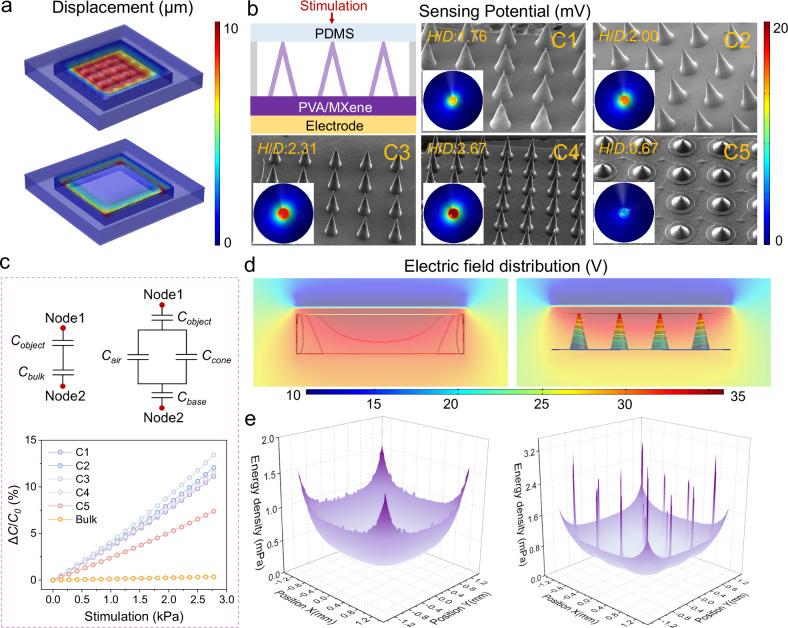
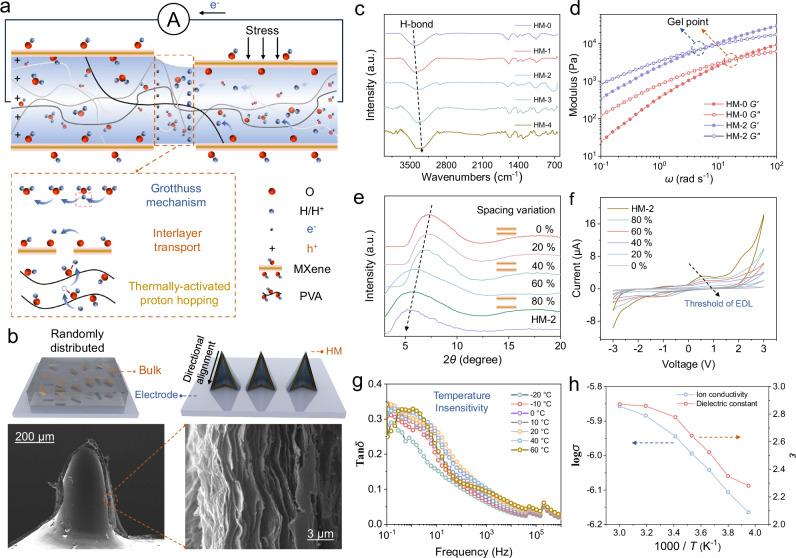
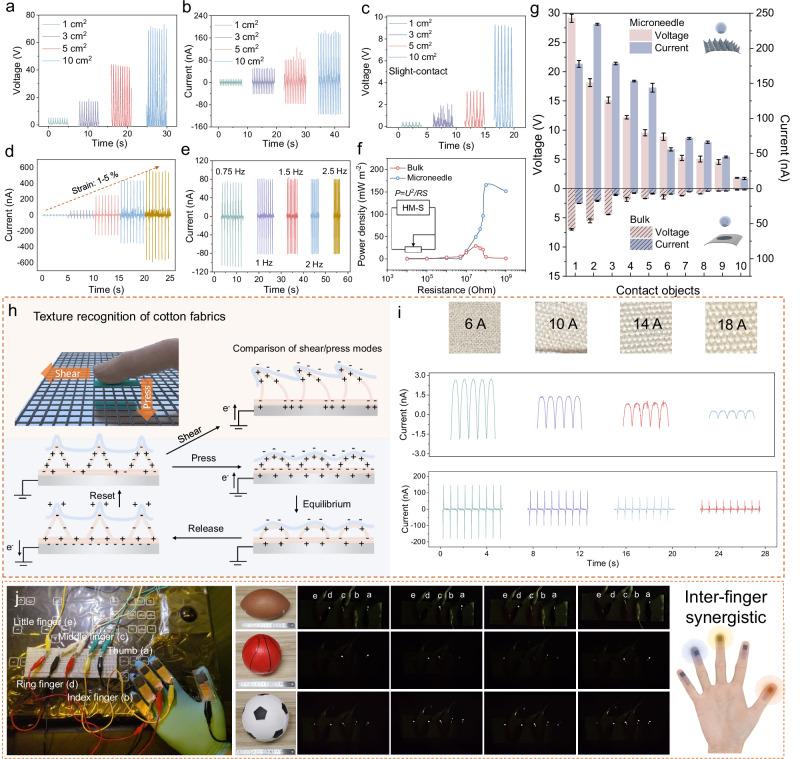
The challenge of achieving high recognition accuracy in artificial mechanoreceptors arises from the trade-off between sensitivity and stability in the sensing unit. Inspired by human skin, we developed a biomimetic approach that involves structural and engineering enhancements for ionic-conducting polyvinyl alcohol/TiCT (PVA/MXene) composite hydrogel microneedles (HM) to enhance the sensitivity. By integrating the HM with a polyethylene terephthalate/indium tin oxide (PET/ITO) film, we create a non-faradaic junction that ensures stable electrical output without transmission loss under stimulation. Furthermore, the significant alteration in nanosheet spacing facilitates proton transport along the MXene microchannels, increasing the plasmonic gradient between the junction and the hydrogel's center, thereby boosting piezoionic efficiency. Consequently, the biomimetic sensing unit achieves a high power density of 165.6 mW m and exceptional sensing stability over 10,000 cycles. When combined with vertical memristor units, this system effectively captures and transforms characteristic signals from various objects, achieving a recognition accuracy of 90%.
在人工机械感受器中实现高识别准确率的挑战源于传感单元中灵敏度和稳定性之间的权衡。受人类皮肤启发,我们开发了一种仿生方法,该方法涉及对离子导电聚乙烯醇/碳化钛(PVA/MXene)复合水凝胶微针(HM)进行结构和工程改进,以提高灵敏度。通过将HM与聚对苯二甲酸乙二醇酯/氧化铟锡(PET/ITO)薄膜集成,我们创建了一个非法拉第结,可确保在刺激下稳定的电输出且无传输损耗。此外,纳米片间距的显著变化促进了质子沿MXene微通道的传输,增加了结与水凝胶中心之间的等离子体梯度,从而提高了压离子效率。因此,仿生传感单元实现了165.6 mW m的高功率密度以及超过10000次循环的卓越传感稳定性。当与垂直忆阻器单元结合时,该系统有效地捕获并转换来自各种物体的特征信号,识别准确率达到90%。


 Zotero 插件