
富血小板血浆和高渗葡萄糖注射改善早中期膝骨关节炎患者的预后:一项多中心回顾性研究
PRP and hypertonic glucose injections improve outcomes in patients with early- to middle-stage knee osteoarthritis: a multicenter retrospective study.
作者信息
Shang Xiang, Meng De-Hong, Yang Qi-Qi, Luan Guo-Rui, Geng Kai, Li Fei, Yang Yong-Hui, Fang Hou-Shan
机构信息
Department of the First Clinical Medical College, Anhui University of Chinese Medicine, No. 117 Meishan Road, HeFei, 230031, China.
Department of Orthopedics, The Second Affiliated Hospital of Anhui University of Chinese Medicine, No. 300 Shouchun Road, HeFei, China.
出版信息
BMC Musculoskelet Disord. 2025 Sep 1;26(1):832. doi: 10.1186/s12891-025-09077-x.
BACKGROUND
Platelet-rich plasma (PRP) injection therapy and hyperosmotic glucose hyperplasia therapy are commonly used methods for treating knee osteoarthritis (KOA). This study evaluates the differences in efficacy and cost-effectiveness between the two therapies.
METHODS
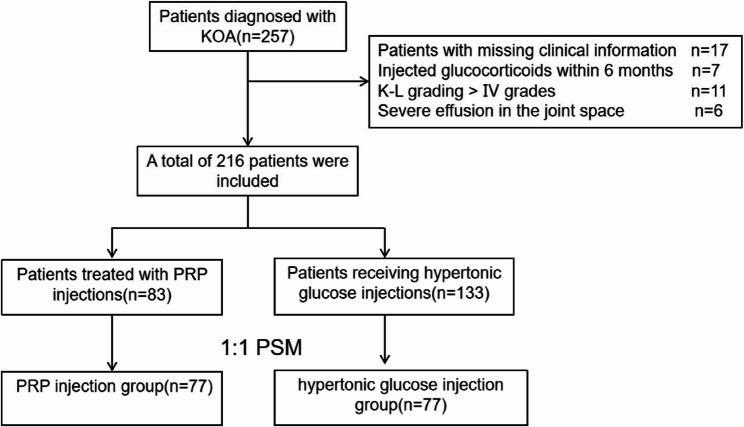
This study retrospectively analyzed 257 patients with knee osteoarthritis from October 2021 to November 2023, and divided them into PRP injection group and hypertonic glucose injection group according to their different treatment methods. All patients underwent a 4-week treatment. The Western Ontario and McMaster Universities Osteoarthritis Index (WOMAC) and Visual Analog Scale (VAS) scores were compared at baseline and 2, 4, 8, 16, and 32 weeks after treatment. Additionally, differences in the 36-Item Short Form Health Survey (SF-36) scores and total expenses during the treatment period were assessed between the two groups at the same time points.
RESULTS
At 2 and 4 weeks post-treatment, the VAS and WOMAC scores of the hypertonic glucose injection group were lower than those of the PRP injection group. Conversely, at 16 and 32 weeks post-treatment, the PRP injection group demonstrated lower VAS and WOMAC scores than the hypertonic glucose injection group. Similarly, SF-36 scores at 2 and 4 weeks post-treatment were higher in the hypertonic glucose injection group, whereas at 16 and 32 weeks, the PRP injection group achieved higher SF-36 scores. Regarding cost-effectiveness, the total cost for the PRP injection group was 362.4, while for the hypertonic glucose injection group, it was 87.4, making the latter more economical.
CONCLUSION
Both PRP and hypertonic glucose injections significantly alleviate knee pain and improve joint function, enhancing patients’ quality of life. However, hypertonic glucose injections demonstrate superior short-term efficacy and lower costs. PRP injections, in contrast, provide better medium- to long-term outcomes.
SUPPLEMENTARY INFORMATION
The online version contains supplementary material available at 10.1186/s12891-025-09077-x.
背景
富血小板血浆(PRP)注射疗法和高渗葡萄糖增殖疗法是治疗膝关节骨关节炎(KOA)的常用方法。本研究评估了两种疗法在疗效和成本效益方面的差异。
方法
本研究回顾性分析了2021年10月至2023年11月期间的257例膝关节骨关节炎患者,并根据其不同的治疗方法将他们分为PRP注射组和高渗葡萄糖注射组。所有患者均接受了为期4周的治疗。比较了治疗前及治疗后2、4、8、16和32周时的西安大略和麦克马斯特大学骨关节炎指数(WOMAC)及视觉模拟量表(VAS)评分。此外,在相同时间点评估了两组之间36项简明健康调查(SF-36)评分及治疗期间总费用的差异。
结果
治疗后2周和4周时,高渗葡萄糖注射组的VAS和WOMAC评分低于PRP注射组。相反,治疗后16周和32周时,PRP注射组的VAS和WOMAC评分低于高渗葡萄糖注射组。同样,治疗后2周和4周时高渗葡萄糖注射组的SF-36评分较高,而在16周和32周时,PRP注射组的SF-36评分较高。在成本效益方面,PRP注射组的总费用为362.4,而高渗葡萄糖注射组为87.4,后者更经济。
结论
PRP和高渗葡萄糖注射均能显著减轻膝关节疼痛并改善关节功能,提高患者生活质量。然而,高渗葡萄糖注射显示出更好的短期疗效和更低的成本。相比之下,PRP注射提供更好的中长期效果。
补充信息
在线版本包含可在10.1186/s12891-025-09077-x获取的补充材料。




 Zotero 插件