
咖啡酸苯乙酯通过促进草鱼脂肪细胞增生来提高高碳水化合物饮食利用率。
Caffeic acid phenethyl ester improves high-carbohydrate diet utilization by promoting adipocyte hyperplasia in grass carp ().
作者信息
Ji Shanghong, Song Lei, Tian Zhiqi, Wei Mingkui, Ji Hong, Sun Jian
机构信息
College of Animal Science and Technology, Northwest A&F University, Yangling 712100, China.
出版信息
Anim Nutr. 2025 May 31;22:154-164. doi: 10.1016/j.aninu.2025.03.009. eCollection 2025 Sep.
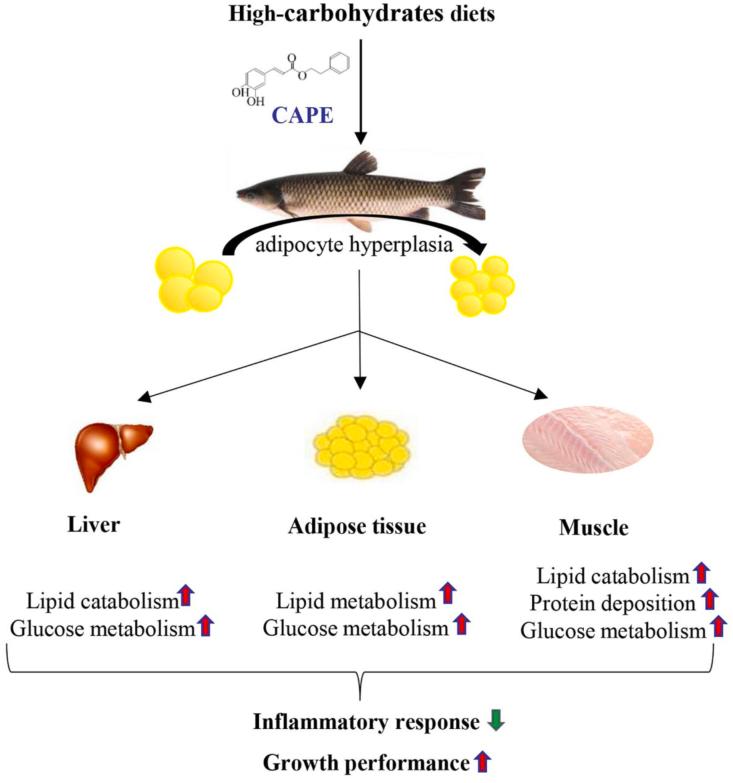
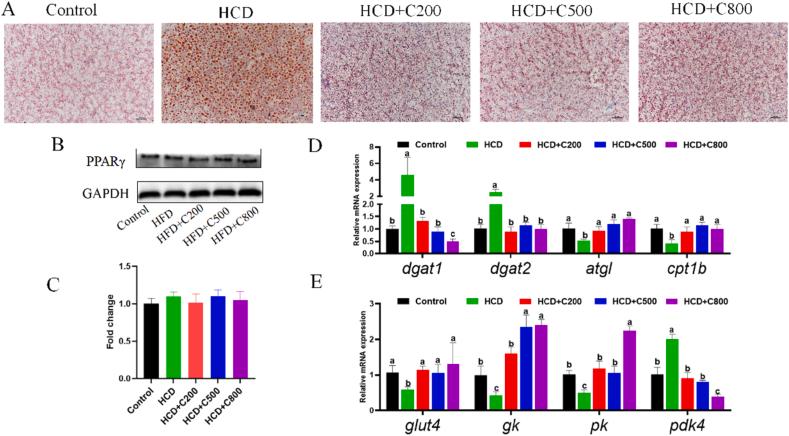
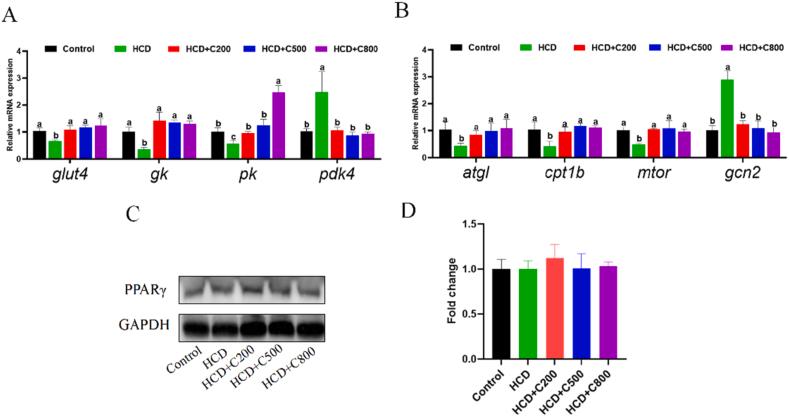
Enhancing the ability of fish to consume a high-carbohydrate diet (HCD) is a key focus of aquaculture research. The propolis extract, caffeic acid phenethyl ester (CAPE) has anti-inflammatory, hepatoprotective, and glycolytic-promoting properties, but its potential to mitigate metabolic disorders in fish fed a HCD remains uncertain. This study investigated the effects of CAPE on the adaptability and utilization of a HCD in the herbivorous grass carp (), focusing on growth performance, tissue and organ health, and nutrient metabolism. A total of 270 grass carp with an initial body weight of 12.69 ± 0.05 g were divided into five groups (Control, HCD, HCD + C200 [200 mg/kg CAPE], HCD + C500 [500 mg/kg CAPE], and HCD + C800 [800 mg/kg CAPE], respectively) with three replicates per group and fed for 8 weeks. Compared with Control group, the HCD reduced the final body weight, weight gain rate, specific growth rate, protein deposition rate, and crude protein in whole body and muscle ( < 0.05), and increased the feed conversion ratio, intraperitoneal fat index, and hepatosomatic index of grass carp ( < 0.05), whereas the addition of CAPE reduced these adverse effects ( < 0.05). Peroxisome proliferator-activated receptor γ (PPARγ) was activated by CAPE in adipose tissue ( < 0.05), but not in the hepatopancreas or muscle. These changes resulted in adipocyte hyperplasia (a smaller and more uniform distribution of adipocytes) and decreased immune cell penetration and inflammation. CAPE promoted the lipolysis and fatty acid β-oxidation in the adipose tissue, hepatopancreas, and muscle. CAPE improved glucose uptake and utilization-related gene expression in the hepatopancreas and muscle, alleviated hepatic steatosis, and promoted mammalian target of rapamycin () gene expression in muscle for grass carp on the HCD ( = 0.034). The addition of CAPE to the HCD inhibited inflammatory response in the adipose tissue, hepatopancreas, and muscle, and reduced the levels of alanine aminotransferase, aspartate aminotransferase, glucose, lactic dehydrogenase, low-density lipoprotein cholesterol, and triglycerides in the serum ( < 0.05). In summary, CAPE altered the pattern of adipose tissue expansion by promoting adipocyte hyperplasia, thereby promoting glucose and lipid metabolism, and ameliorated the adverse effects of a HCD on inflammation and growth performance in grass carp.
提高鱼类对高碳水化合物饲料(HCD)的摄取能力是水产养殖研究的一个关键重点。蜂胶提取物咖啡酸苯乙酯(CAPE)具有抗炎、保肝和促进糖酵解的特性,但其减轻食用HCD的鱼类代谢紊乱的潜力仍不确定。本研究调查了CAPE对草食性草鱼适应和利用HCD的影响,重点关注生长性能、组织和器官健康以及营养代谢。将270尾初始体重为12.69±0.05克的草鱼分为五组(分别为对照组、HCD组、HCD + C200 [200毫克/千克CAPE]组、HCD + C500 [500毫克/千克CAPE]组和HCD + C800 [800毫克/千克CAPE]组),每组三个重复,饲养8周。与对照组相比,HCD降低了草鱼的终末体重、增重率、特定生长率、蛋白质沉积率以及全鱼和肌肉中的粗蛋白含量(P < 0.05),并提高了饲料转化率、腹腔脂肪指数和肝体指数(P < 0.05),而添加CAPE减轻了这些不利影响(P < 0.05)。CAPE在脂肪组织中激活了过氧化物酶体增殖物激活受体γ(PPARγ)(P < 0.05),但在肝胰脏或肌肉中未激活。这些变化导致脂肪细胞增生(脂肪细胞分布更小且更均匀),并减少免疫细胞浸润和炎症。CAPE促进了脂肪组织、肝胰脏和肌肉中的脂肪分解和脂肪酸β氧化。CAPE改善了肝胰脏和肌肉中葡萄糖摄取和利用相关基因的表达,减轻了肝脏脂肪变性,并促进了HCD喂养的草鱼肌肉中雷帕霉素靶蛋白(mTOR)基因的表达(P = 0.034)。向HCD中添加CAPE可抑制脂肪组织、肝胰脏和肌肉中的炎症反应,并降低血清中谷丙转氨酶、谷草转氨酶、葡萄糖、乳酸脱氢酶、低密度脂蛋白胆固醇和甘油三酯的水平(P < 0.05)。总之,CAPE通过促进脂肪细胞增生改变了脂肪组织扩张模式,从而促进了葡萄糖和脂质代谢,并改善了HCD对草鱼炎症和生长性能的不利影响。


 Zotero 插件