
重新利用阿利沙坦(沙库巴曲/缬沙坦),揭示其在大鼠溃疡性结肠炎中的抗炎和纤维蛋白溶解特性。
Repurposing Artrestan (Sacubitril/Valsartan), unveiling its anti-inflammatory and fibrinolytic properties in ulcerative colitis in rats.
作者信息
Kharazmi Khatereh, Nazari Seyedeh Elnaz, Eskandari Moein, Asgharzadeh Fereshteh, Aminian Akram, Avan Amir, Hassanian Seyed Mahdi, Khazaei Majid
机构信息
Department of Medical Physiology, Faculty of Medicine, Mashhad University of Medical Sciences, Mashhad, Iran.
Metabolic Syndrome Research Center, Mashhad University of Medical Sciences, Mashhad, Iran.
出版信息
Iran J Basic Med Sci. 2025;28(10):1428-1437. doi: 10.22038/ijbms.2025.87771.18964.
OBJECTIVES
Ulcerative colitis (UC) is an inflammatory disorder that is managed with various treatments, which have varying degrees of effectiveness and side effects, highlighting the need for new and more effective alternatives. In this study, we applied Artrestan (Sacubitrol/Valsartan), which has potent anti-inflammatory properties, alone or in combination with mesalazine, in the treatment of UC animal models.
MATERIALS AND METHODS
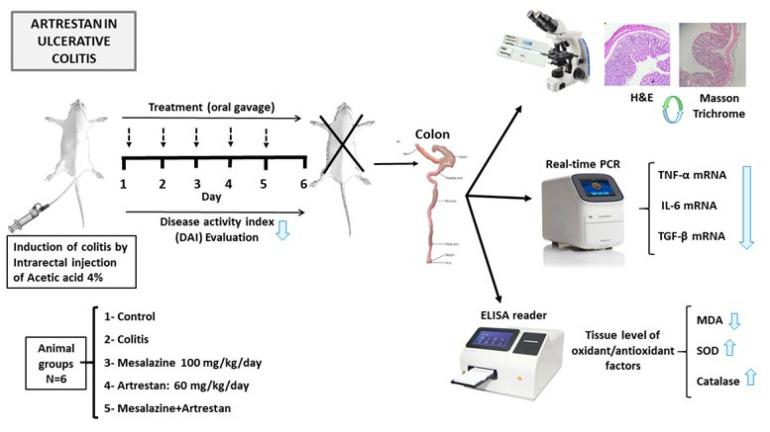
Thirty male rats were randomly divided into control, colitis, Artrestan (60 mg/kg/day), mesalazine (100 mg/kg/day), and Artrestan plus mesalazine groups. UC was induced by intrarectal administration of acetic acid, followed by a 5-day course of oral medication, during which the disease activity index (DAI), including diarrhea, weight loss, and rectal bleeding, was assessed daily. Macroscopic and microscopic examinations, as well as assessments of oxidant-anti-oxidant, pro-inflammatory, and pro-fibrotic factors, were performed on colonic tissue.
RESULTS
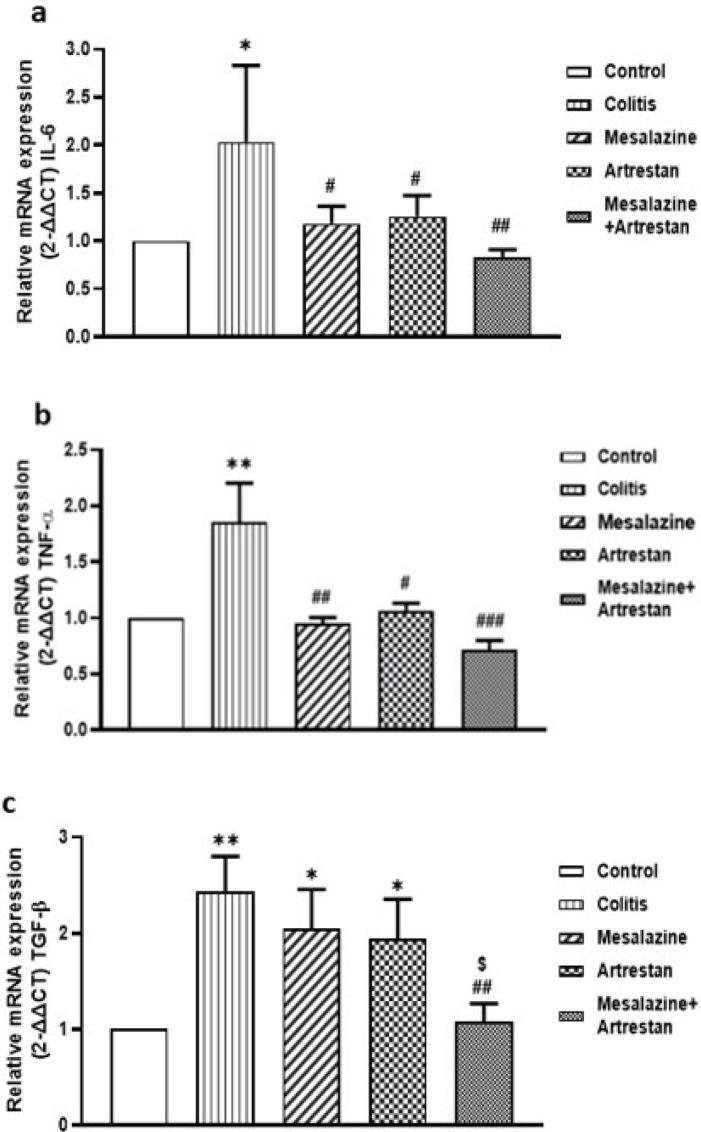
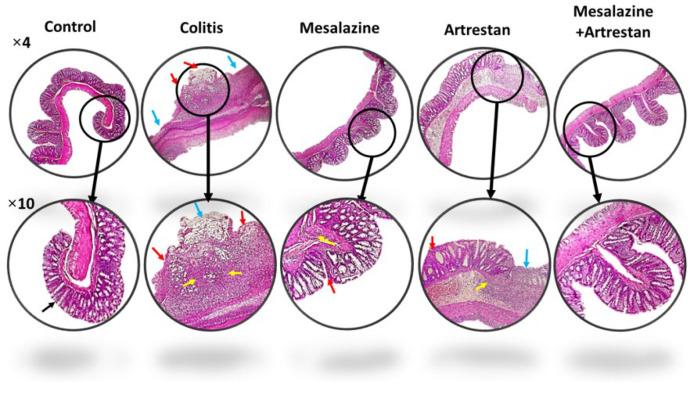
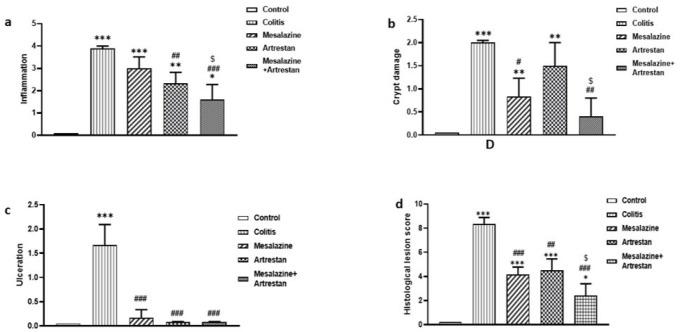
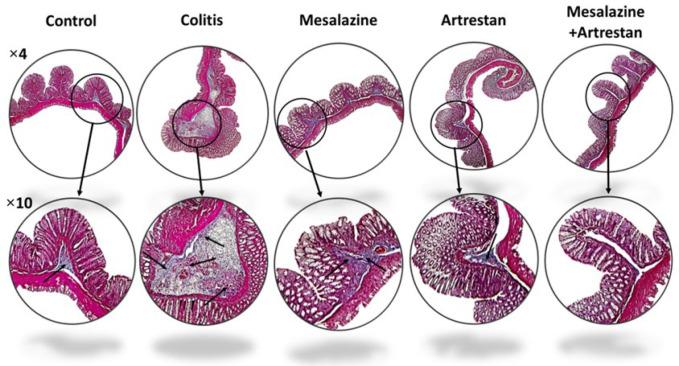
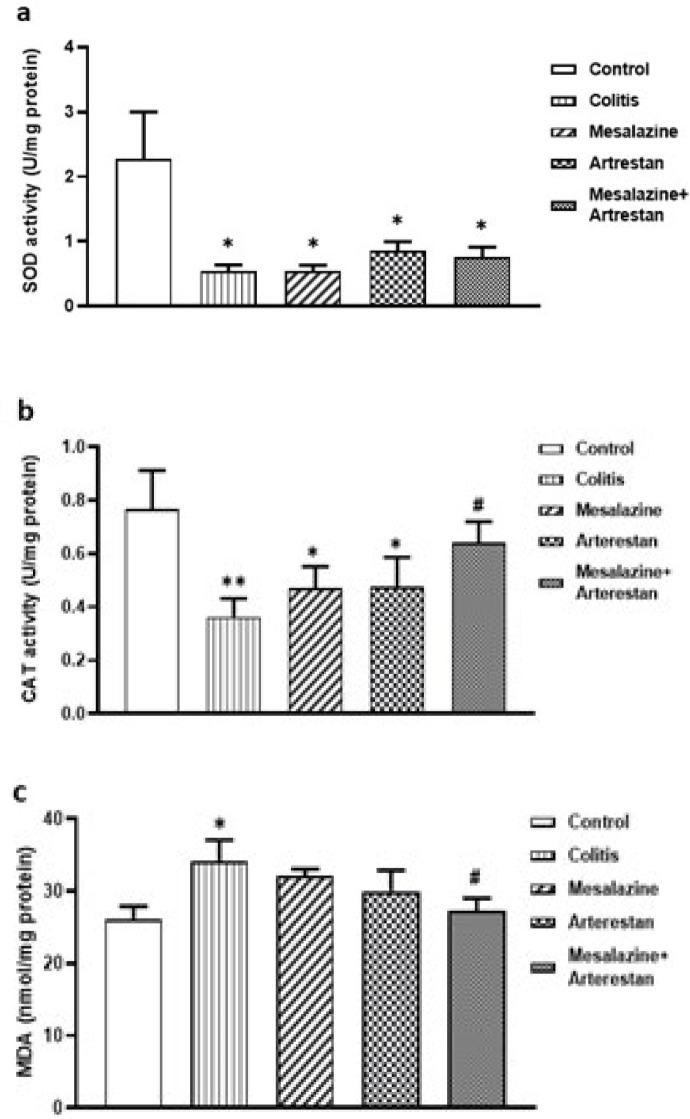
Administration of Artrestan, especially in combination with mesalazine, significantly decreased DAI and histological lesion scores in the microscopic assessment. Moreover, Artrestan modulated oxidant-anti-oxidant balance by increasing the activities of superoxide dismutase (SOD) and catalase (CAT) and reducing malondialdehyde (MDA) in colon tissue. Expression of inflammatory markers, including Interleukin 6 (IL-6) and Tumor necrosis factor-alpha (TNF-α), was decreased in the treated groups compared to the untreated group. Artrestan also attenuated fibrosis and collagen deposition in colon tissues, which was accompanied by a reduction in the expression of Transforming growth factor beta (TGF-β).
CONCLUSION
Our findings suggest the therapeutic potential of Artrestan in combination with mesalazine for the treatment of UC, as it modulates clinical symptoms, improves the oxidant-anti-oxidant balance, and reduces pro-inflammatory and pro-fibrotic factors, supporting further investigations in the clinical phase.
目的
溃疡性结肠炎(UC)是一种炎症性疾病,采用多种治疗方法进行管理,这些治疗方法的有效性和副作用程度各不相同,这凸显了对新的更有效替代方案的需求。在本研究中,我们应用具有强大抗炎特性的阿利沙坦(沙库巴曲/缬沙坦)单独或与美沙拉嗪联合,用于治疗UC动物模型。
材料和方法
将30只雄性大鼠随机分为对照组、结肠炎组、阿利沙坦(60毫克/千克/天)组、美沙拉嗪(100毫克/千克/天)组和阿利沙坦加美沙拉嗪组。通过直肠内注射乙酸诱导UC,随后进行为期5天的口服给药疗程,在此期间每天评估疾病活动指数(DAI),包括腹泻、体重减轻和直肠出血。对结肠组织进行宏观和微观检查,以及氧化-抗氧化、促炎和促纤维化因子的评估。
结果
阿利沙坦的给药,尤其是与美沙拉嗪联合使用时,在微观评估中显著降低了DAI和组织学病变评分。此外,阿利沙坦通过增加结肠组织中超氧化物歧化酶(SOD)和过氧化氢酶(CAT)的活性并降低丙二醛(MDA)来调节氧化-抗氧化平衡。与未治疗组相比,治疗组中包括白细胞介素6(IL-6)和肿瘤坏死因子-α(TNF-α)在内的炎症标志物表达降低。阿利沙坦还减轻了结肠组织中的纤维化和胶原沉积,这伴随着转化生长因子β(TGF-β)表达的减少。
结论
我们的研究结果表明,阿利沙坦与美沙拉嗪联合用于治疗UC具有治疗潜力,因为它可调节临床症状,改善氧化-抗氧化平衡,并减少促炎和促纤维化因子,支持在临床阶段进行进一步研究。



 Zotero 插件