
一项关于荷兰系统性红斑狼疮(SLE)患者工作参与情况及相关因素的6年前瞻性研究。
A 6-year prospective study on work participation and the associated factors in Dutch patients with systemic lupus erythematosus (SLE).
作者信息
Blomjous Birgit S, Ter Wee Marieke M, Tsang-A-Sjoe Michel W P, Boot Cecile R L, Voskuyl Alexandre E, Bultink Irene E M
机构信息
Department of Rheumatology and Clinical Immunology, Amsterdam UMC, Meibergdreef 9, Amsterdam, The Netherlands.
Department of Rheumatology and Clinical Immunology, Amsterdam Rheumatology and immunology Center, Amsterdam, The Netherlands.
出版信息
Arthritis Res Ther. 2025 Sep 2;27(1):174. doi: 10.1186/s13075-025-03631-7.
BACKGROUND
Previous studies showed that many patients with SLE do not have paid work. However, having paid work is important for self-esteem, social contacts and income. It is therefore important to understand the characteristics contributing to work status and in particular identifying modifiable variables to help patients with SLE and their employers to maintain work. The objective of this study is to investigate associations of demographic, disease-related and work characteristics with having and maintaining paid work for ≥ 5 years in patients with SLE over a six-year period.
METHODS
All patients diagnosed with SLE, independent of disease duration and under treatment in Amsterdam UMC location VUmc or Reade were invited to participate in the longitudinal Amsterdam SLE cohort (2007-2018). Demographic, disease-related and work characteristics of these patients were analysed. Baseline was defined as the time of study entrance. Generalized Estimating Equations with logit link function were used to identify associations between these characteristics on having paid work. Logistic regression was used to study associations with maintenance of work and work disability.
RESULTS
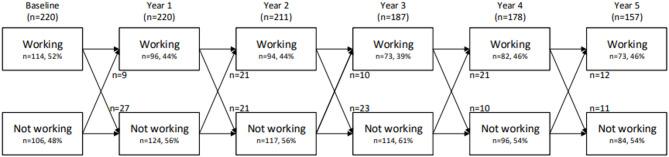
At baseline, 52% of patients (114/220) were employed, which decreased to 46% (73/157) after six years. The main reported reason for unemployment was because of SLE-related symptoms (63%). Among the 106 patients who were unemployed at baseline, 16% (17/106) gained work during follow-up of whom 47% (8/17) also maintained work. Of the 114 patients employed at baseline, 29% (33/114) remained employed throughout the entire six-year follow-up period. Having paid work over time was associated with younger age, higher level of education, shorter disease duration, lower organ damage and supervisor support. Maintaining employment for ≥ 5 years during follow-up was associated with regular working hours, skill discretion, decision authority and decision latitude. A longer disease duration was associated with work disability at baseline.
CONCLUSIONS
This study shows that alongside demographic and disease-related characteristics, also work characteristics are associated with having and maintaining paid work in SLE patients. These characteristics should be taken into consideration when developing interventions to improve sustainable employability in patients with SLE.
背景
既往研究表明,许多系统性红斑狼疮(SLE)患者没有带薪工作。然而,拥有带薪工作对于自尊、社交和收入都很重要。因此,了解影响工作状态的特征,特别是识别可改变的变量,以帮助SLE患者及其雇主维持工作,这一点很重要。本研究的目的是调查在六年期间,SLE患者的人口统计学、疾病相关和工作特征与拥有并维持≥5年带薪工作之间的关联。
方法
所有在阿姆斯特丹大学医学中心VUmc或Reade分院被诊断为SLE的患者,无论疾病病程长短及是否正在接受治疗,均受邀参加纵向阿姆斯特丹SLE队列研究(2007 - 2018年)。分析了这些患者的人口统计学、疾病相关和工作特征。基线定义为研究入组时间。使用具有logit链接函数的广义估计方程来确定这些特征与拥有带薪工作之间的关联。使用逻辑回归研究与工作维持和工作残疾的关联。
结果
在基线时,52%的患者(114/220)有工作,六年后这一比例降至46%(73/157)。报告的失业主要原因是与SLE相关的症状(63%)。在基线时失业的106名患者中,16%(17/106)在随访期间找到了工作,其中47%(8/17)还维持了工作。在基线时有工作的114名患者中,29%(33/114)在整个六年随访期间一直有工作。随着时间推移拥有带薪工作与年龄较小、教育水平较高、疾病病程较短、器官损伤较轻以及上级支持有关。在随访期间维持就业≥5年与固定工作时间、技能自主性、决策权和决策自由度有关。疾病病程较长与基线时的工作残疾有关。
结论
本研究表明,除了人口统计学和疾病相关特征外,工作特征也与SLE患者拥有和维持带薪工作有关。在制定改善SLE患者可持续就业能力的干预措施时,应考虑这些特征。

 Zotero 插件