
严重血脂异常对肾功能的影响:一项横断面研究。
Impact of severe dyslipidemia on renal function: A cross-sectional study.
作者信息
Lewandowski Nicole, Reinhardt Walter, Spitthöver Ralf, Kribben Andreas, Boss Kristina, Mülling Nils
机构信息
Department of Nephrology, University Hospital Essen, University of Duisburg-Essen, Essen, Germany.
Dialyse- und Lipidzentrum Nordrhein, Essen, Germany.
出版信息
Medicine (Baltimore). 2025 Aug 29;104(35):e44131. doi: 10.1097/MD.0000000000044131.
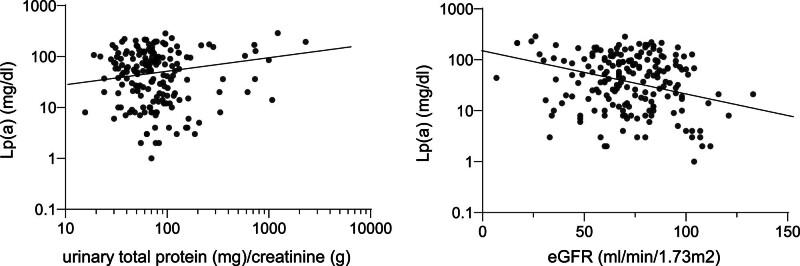
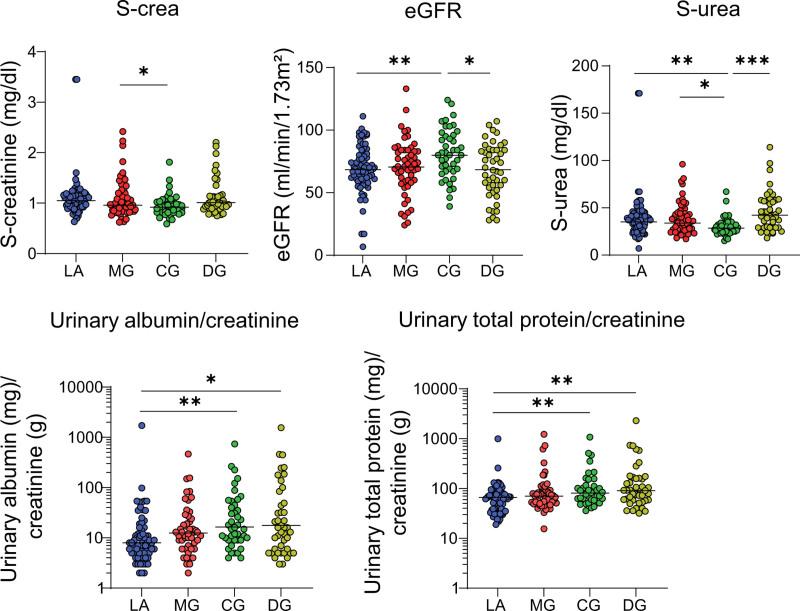
Renal dysfunction causes dyslipidemia, and the progression of kidney disease is associated with treatment-requiring lipid disorders. However, there is little data on the association between the severity of dyslipidemia and various treatment modalities with renal function. A total of n = 214 prevalent patients from a lipidology and nephrology practice were investigated in an unicentric cross-sectional study and divided into 4 groups based on the severity and therapeutic regimen of an existing lipid metabolism disorder: a lipid apheresis-treated group (LA), a drug-treated group (MG), a control group (CG) that included patients with lipid disorder not needing any treatment, and a diabetes group that comprised all diabetes patients. We examined fat metabolism parameters, renal parameters and urinary protein excretion, and compared these between study groups. Lipid apheresis therapy leads to the effective lowering of low density lipoprotein-concentration and to a reduction in the presumably protective high density lipoprotein-concentration. We found that S-crea was significantly higher in the LA, MG, and diabetes group than in the CG, while electronic glomerular filtration rate (eGFR) was correspondingly lower. On the other hand, proteinuria was not elevated in the LA- and MG-groups compared to CG. Multiple regression analysis revealed lipoprotein (a) values as a predictor for eGFR decline and increased proteinuria. Elevated lipoprotein (a) levels are associated with decreased eGFR and worse proteinuria, highlighting that regular monitoring and effective treatment, to date especially lipid apheresis, are of utmost importance to mitigate detrimental effects on renal function.
肾功能不全可导致血脂异常,而肾脏疾病的进展与需要治疗的脂质紊乱有关。然而,关于血脂异常的严重程度与各种治疗方式和肾功能之间的关联数据很少。在一项单中心横断面研究中,对来自脂质学和肾脏病科门诊的总共n = 214例患者进行了调查,并根据现有脂质代谢紊乱的严重程度和治疗方案将其分为4组:脂质吸附治疗组(LA)、药物治疗组(MG)、包括不需要任何治疗的脂质紊乱患者的对照组(CG)以及包含所有糖尿病患者的糖尿病组。我们检查了脂肪代谢参数、肾脏参数和尿蛋白排泄,并在各研究组之间进行了比较。脂质吸附疗法可有效降低低密度脂蛋白浓度,并降低可能具有保护作用的高密度脂蛋白浓度。我们发现,LA组、MG组和糖尿病组的血清肌酐(S-crea)显著高于CG组,而电子肾小球滤过率(eGFR)相应较低。另一方面,与CG组相比,LA组和MG组的蛋白尿并未升高。多元回归分析显示,脂蛋白(a)值是eGFR下降和蛋白尿增加的预测指标。脂蛋白(a)水平升高与eGFR降低和蛋白尿加重有关,这突出表明定期监测和有效治疗(迄今为止尤其是脂质吸附疗法)对于减轻对肾功能的有害影响至关重要。

 Zotero 插件