
一种用于提高定量荧光显微镜信噪比的框架。
A framework to enhance the signal-to-noise ratio for quantitative fluorescence microscopy.
作者信息
Kaur Suhavi, Tang Zhe F, McMillen David R
机构信息
Department of Physical and Chemical Sciences, University of Toronto, Mississauga, Ontario, Canada.
出版信息
PLoS One. 2025 Sep 4;20(9):e0330718. doi: 10.1371/journal.pone.0330718. eCollection 2025.
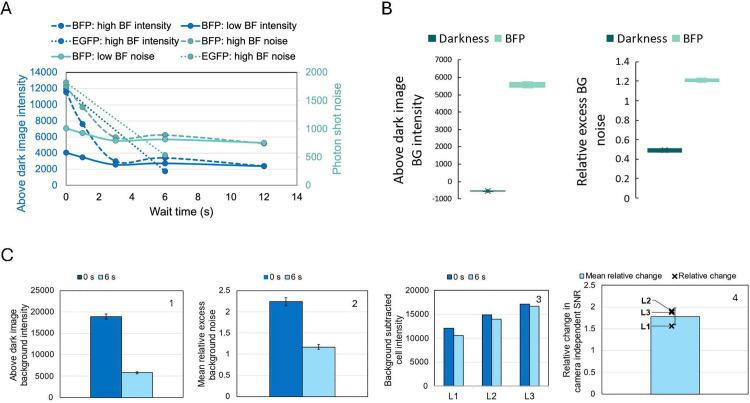
Single-cell fluorescence characterization has gained much attention for studying the dynamics of individual cells in human diseases such as cancer. Despite the abundance of literature on quantitative fluorescence microscopy and its advantages in measuring cell-to-cell variation and spatial variation over other high-throughput instruments, there lacks a concise model that one can follow to maximize the quality of images. Here, we used the signal-to-noise ratio (SNR) model to verify marketed camera parameters and optimize microscope settings to maximize SNR for quantitative single cell fluorescence microscopy (QSFM). We determined the microscope camera's readout noise, dark current, photon shot noise, the clock-induced charge, and validated the additive noise model for each noise source. The dark current and the clock-induced charge were both higher than reported in literature, compromising camera sensitivity. We also reduced excess background noise and improved SNR by 3-fold, by adding secondary emission and excitation filters as well as by introducing wait time in the dark before fluorescence acquisition. Additionally, our work opens new avenues for enhancing superresolution microscopy techniques such as single-molecule localization microscopy (SMLM).
单细胞荧光表征在研究诸如癌症等人类疾病中单个细胞的动态变化方面备受关注。尽管关于定量荧光显微镜的文献丰富,且其在测量细胞间差异和空间差异方面比其他高通量仪器具有优势,但缺乏一个可供遵循的简洁模型来最大化图像质量。在此,我们使用信噪比(SNR)模型来验证市售相机参数并优化显微镜设置,以最大化定量单细胞荧光显微镜(QSFM)的SNR。我们确定了显微镜相机的读出噪声、暗电流、光子散粒噪声、时钟诱导电荷,并验证了每个噪声源的加性噪声模型。暗电流和时钟诱导电荷均高于文献报道,降低了相机灵敏度。我们还通过添加二次发射和激发滤光片以及在荧光采集前在黑暗中引入等待时间,减少了过量背景噪声并将SNR提高了3倍。此外,我们的工作为增强诸如单分子定位显微镜(SMLM)等超分辨率显微镜技术开辟了新途径。
 Zotero 插件