
1999 - 2019年美国成年人中癌症负担上升以及与心房颤动相关的死亡率
Rising burden of cancer and atrial fibrillation-related mortality among adults in the United States, 1999-2019.
作者信息
Saad Muhammad, Shaikh Reyan Hussain, Sohail Muhammad Umer, Waqas Saad Ahmed, Jamshed Mian Muinuddin, Ahsan Syed Ibad, Arshad Muhammad Sameer, Hassan Azeem, Mactaggart Sebastian, Ahmed Raheel
机构信息
Department of Medicine, Dow University of Health Sciences, Karachi, Pakistan.
Medical College, Aga Khan University, Karachi, Pakistan.
出版信息
Heart Rhythm O2. 2025 May 13;6(8):1130-1138. doi: 10.1016/j.hroo.2025.05.006. eCollection 2025 Aug.
BACKGROUND
Atrial fibrillation (AF) is the most common cardiac arrhythmia, whereas cancer remains the second leading cause of death in the United States. Both conditions share several risk factors and may compound mortality risk. However, national trends in AF and cancer-related mortality remain underexplored.
OBJECTIVE
To assess trends in mortality related to AF and cancer among US adults from 1999 to 2019, using demographic and geographic stratifications.
METHODS
Data were obtained from the CDC WONDER Multiple Cause of Death data set. We identified individuals aged 25 years and older with AF (I48) and cancer (C00-C97) as an underlying or contributing cause of death. Age-adjusted mortality rates (AAMRs) per 100,000 population, average annual percentage change, and annual percentage change were calculated.
RESULTS
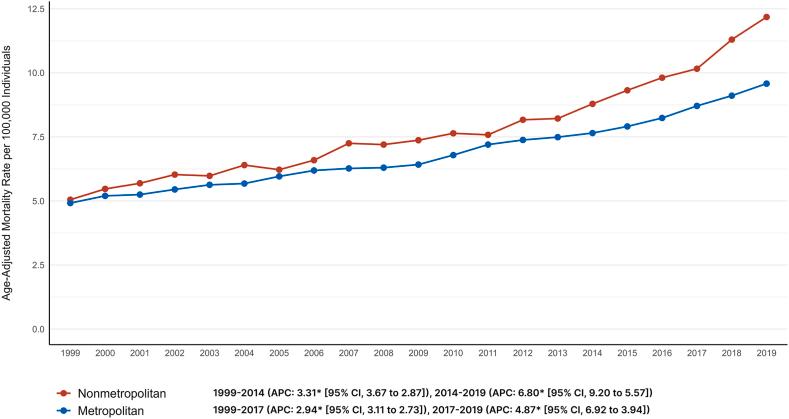
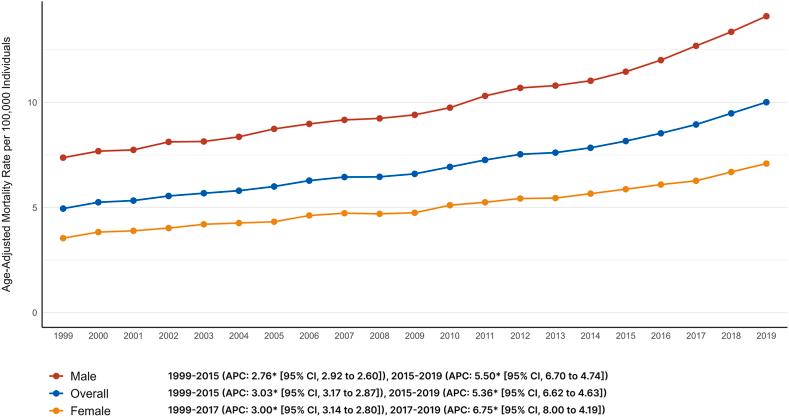
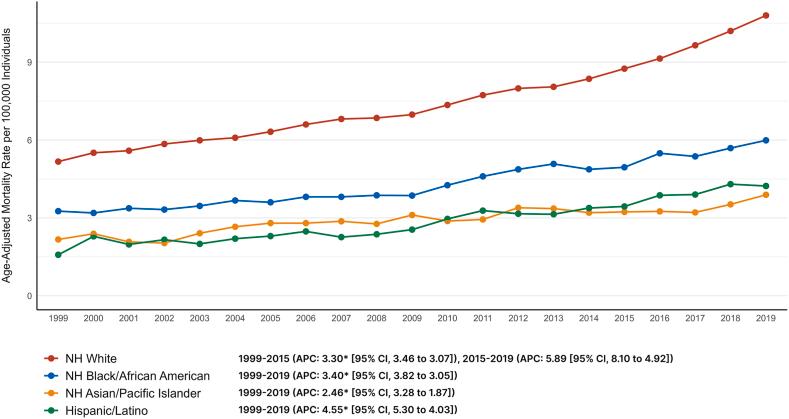
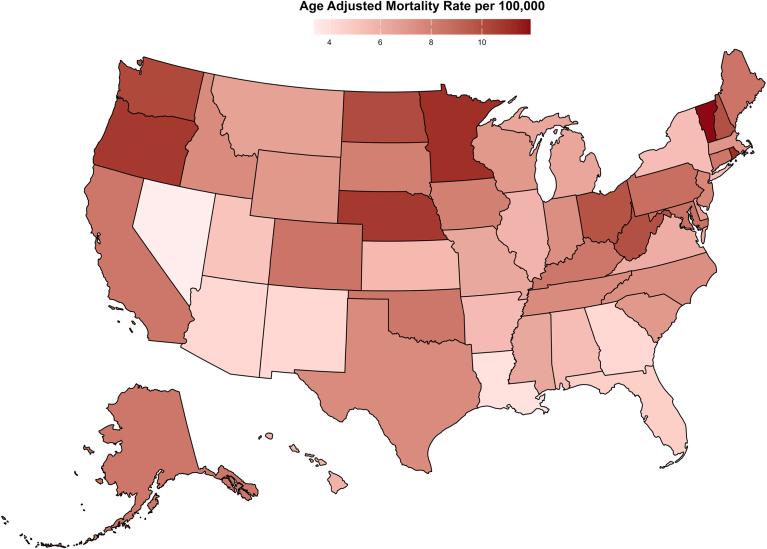
The AAMR for cancer and AF-related deaths increased from 4.95 (95% confidence interval [CI]: 4.84, 5.05) in 1999 to 10.01 (95% CI: 9.88, 10.13) in 2019 (average annual percentage change: 3.49 [95% CI: 3.39, 3.60]). Males had higher AAMRs than females (10.24 vs 5.13). Non-Hispanic Whites had the highest AAMRs (7.89), followed by non-Hispanic Blacks (4.53) and Hispanics (3.11). The Western region had the highest AAMR, and nonmetropolitan areas exhibited greater mortality rates than metropolitan areas. Individuals with lung cancer exhibited the highest AAMRs (1.65), followed by gastrointestinal cancer (1.52) and hematologic cancer (1.00). The lowest AAMRs were observed in prostate cancer (0.90) and breast cancer (0.65).
CONCLUSION
Mortality from cancer and AF has increased over time, with significant disparities across sex, race, and geography. Targeted interventions are required to mitigate these disparities.
背景
心房颤动(AF)是最常见的心律失常,而癌症仍是美国第二大死因。这两种疾病有若干共同的风险因素,可能会增加死亡风险。然而,AF和癌症相关死亡率的全国趋势仍未得到充分研究。
目的
利用人口统计学和地理分层方法,评估1999年至2019年美国成年人中与AF和癌症相关的死亡率趋势。
方法
数据来自美国疾病控制与预防中心(CDC)的多死因数据集。我们确定年龄在25岁及以上、将AF(I48)和癌症(C00 - C97)作为潜在或促成死因的个体。计算了每10万人口的年龄调整死亡率(AAMR)、年均百分比变化和年度百分比变化。
结果
癌症和AF相关死亡的AAMR从1999年的4.95(95%置信区间[CI]:4.84,5.05)增至2019年的10.01(95%CI:9.88,10.13)(年均百分比变化:3.49[95%CI:3.39,3.60])。男性的AAMR高于女性(10.24对5.13)。非西班牙裔白人的AAMR最高(7.89),其次是非西班牙裔黑人(4.53)和西班牙裔(3.11)。西部地区的AAMR最高,非都市地区的死亡率高于都市地区。肺癌患者的AAMR最高(1.65),其次是胃肠道癌症(1.52)和血液系统癌症(1.00)。前列腺癌(0.90)和乳腺癌(0.65)的AAMR最低。
结论
随着时间推移,癌症和AF导致的死亡率有所上升,在性别、种族和地域方面存在显著差异。需要采取有针对性的干预措施来减轻这些差异。

 Zotero 插件