
使用拉曼显微镜和微型计算机断层扫描相结合的方法有效检测人体骨组织中的葡萄球菌感染
Effective detection of staphylococcal infections in human bone tissue using combined raman microscopy and micro-computed tomography.
作者信息
Lindtner Richard Andreas, Kampik Lukas, Noack Larissa, Putzer David, Arora Rohit, Coraça-Huber Débora Cristina, Schirmer Michael, Degenhart Gerald, Lackner Michaela, Popp Jürgen, Badzoka Jovan, Kappacher Christoph, Huck Christian Wolfgang, Pallua Johannes Dominikus
机构信息
Department of Orthopaedics and Traumatology, Medical University of Innsbruck, Innsbruck, Austria.
Department of Internal Medicine, Clinic II, Medical University of Innsbruck, Innsbruck, Austria.
出版信息
Front Bioeng Biotechnol. 2025 Aug 21;13:1617285. doi: 10.3389/fbioe.2025.1617285. eCollection 2025.
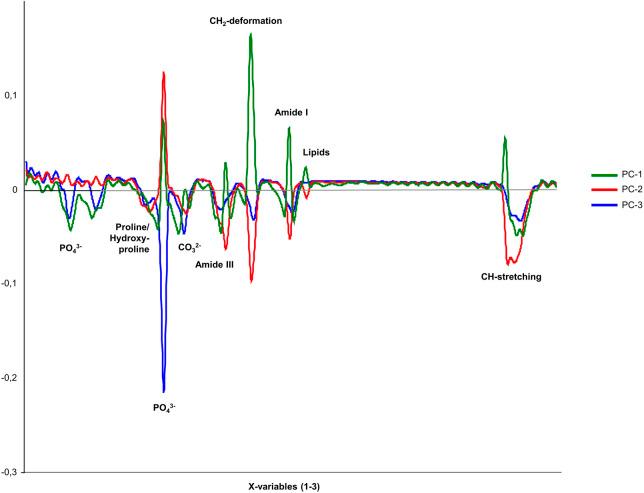
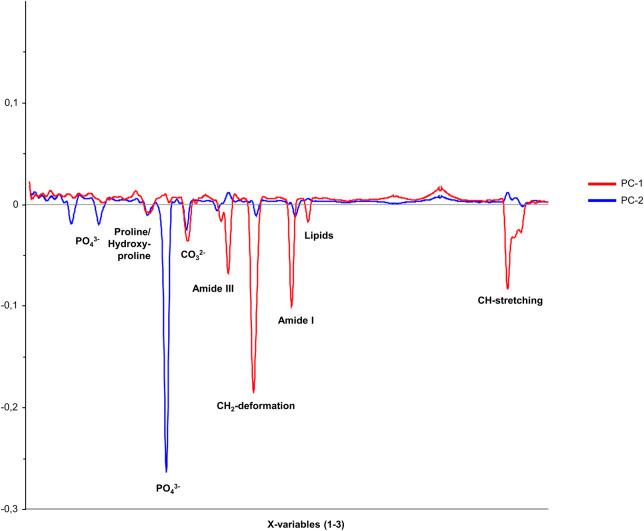
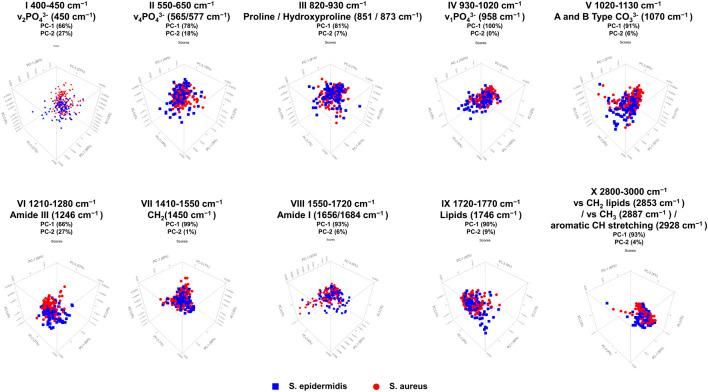
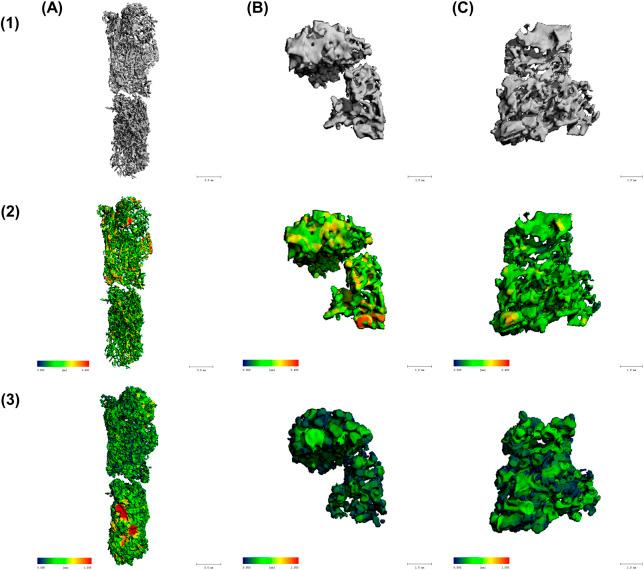
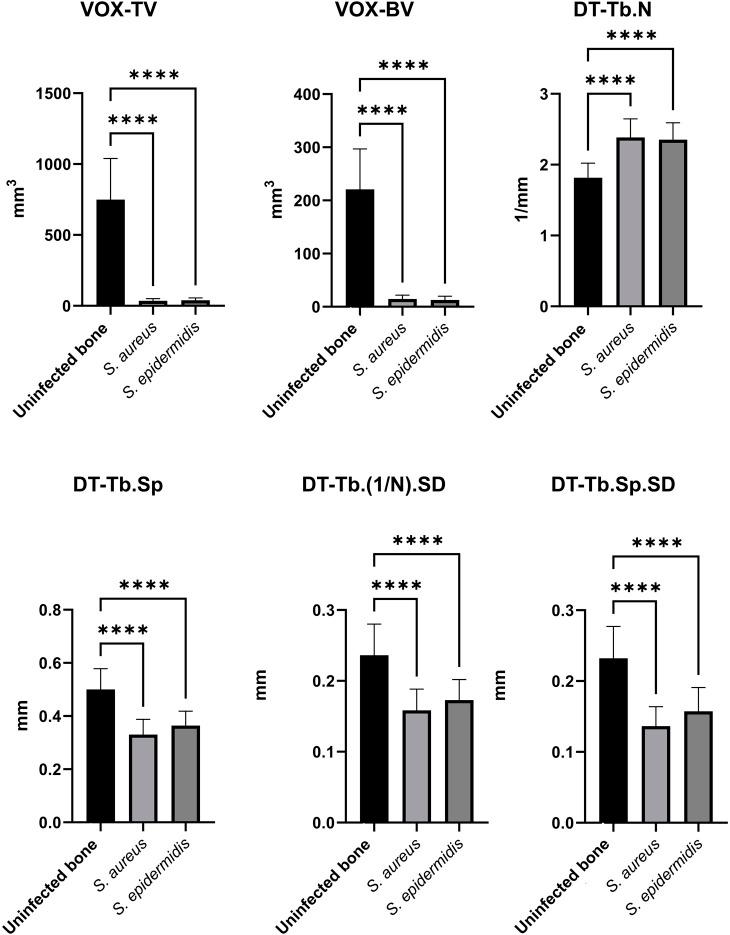
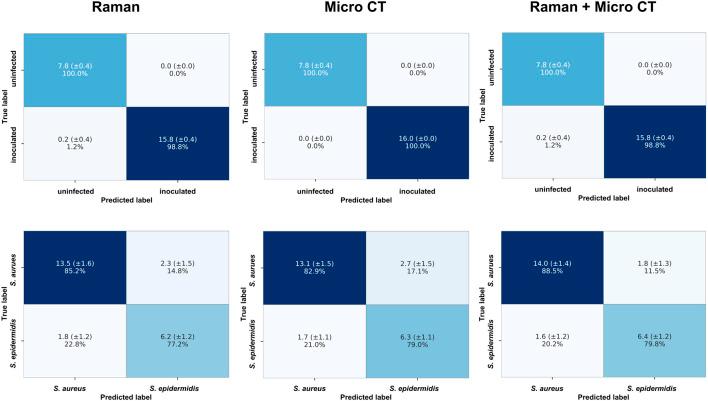
Bone infections caused by and are serious complications in orthopedic surgery. These infections commonly occur in joint replacements, fracture management, and bone grafting procedures. Rapid and accurate pathogen-specific diagnostic methods are urgently needed to support early clinical decisions. Current culture-based methods are slow and delay effective treatment. This study evaluated the diagnostic value of combining Raman microscopy with high-resolution micro-computed tomography (micro-CT). Human bone samples, either uninfected or inoculated with or , were analyzed. Raman spectroscopy detected distinct spectral changes in inoculated bones, including reduced intensity of phosphate (vPO ), Amide III, and CH deformation bands. A single principal component explained 96%-98% of the variance in these infection-related markers. Specifically, the vPO and CH deformation bands effectively differentiated between and infections, capturing 99%-100% variance. Micro-CT analysis showed significant structural changes in inoculated bones. Trabecular volume, number, and spacing were particularly affected. Among these, VOX-BV/TV and Mean1 best differentiated between and infections (both p < 0.0001). Support vector machine (SVM) classification repeated stratified k-folg cross-validation accurately detected inoculation status. Combining Raman and micro-CT features yielded moderately improved classification performance in pathogen-specific discrimination. These findings demonstrate that combining molecular (Raman spectroscopy) and structural (micro-CT) methods allows rapid, non-destructive diagnosis of bone infections. This multimodal approach may improve diagnostic precision, supports timely clinical decisions, and ultimately improves patient outcomes in orthopedic and trauma surgery.
由[病原体名称1]和[病原体名称2]引起的骨感染是骨科手术中的严重并发症。这些感染常见于关节置换、骨折处理和骨移植手术中。迫切需要快速准确的病原体特异性诊断方法来支持早期临床决策。目前基于培养的方法速度慢且会延误有效治疗。本研究评估了拉曼显微镜与高分辨率微计算机断层扫描(micro-CT)相结合的诊断价值。对未感染或接种了[病原体名称1]或[病原体名称2]的人骨样本进行了分析。拉曼光谱检测到接种骨中有明显的光谱变化,包括磷酸盐(vPO₄)、酰胺III和CH变形带强度降低。单个主成分解释了这些感染相关标志物中96%-98%的方差。具体而言,vPO₄和CH变形带能有效区分[病原体名称1]和[病原体名称2]感染,捕获99%-100%的方差。Micro-CT分析显示接种骨有显著的结构变化。骨小梁体积、数量和间距受影响尤为明显。其中,VOX-BV/TV和Mean1在区分[病原体名称1]和[病原体名称2]感染方面表现最佳(均p<0.0001)。支持向量机(SVM)分类重复分层k折交叉验证准确检测出接种状态。结合拉曼和micro-CT特征在病原体特异性鉴别中产生了适度提高的分类性能。这些发现表明,将分子(拉曼光谱)和结构(micro-CT)方法相结合可实现骨感染的快速、无损诊断。这种多模态方法可能提高诊断精度,支持及时的临床决策,并最终改善骨科和创伤手术患者的预后。






 Zotero 插件