
使用7T同心环轨迹采样对人体肾脏进行高分辨率氘代谢成像的可行性。
Feasibility of High-Resolution Deuterium Metabolic Imaging of the Human Kidney Using Concentric Ring Trajectory Sampling at 7T.
作者信息
Niess Fabian, Strasser Bernhard, Hingerl Lukas, Kovarik Johannes J, Bader Viola, Frese Sabina, Duguid Anna, Osburg Aaron, Niess Eva, Motyka Stanislav, Krššák Martin, Scherer Thomas, Bogner Wolfgang
机构信息
High-Field MR Center, Department of Biomedical Imaging and Image-Guided Therapy, Medical University of Vienna, Vienna, Austria.
Clinical Division of Internal Medicine III Department of Nephrology and Dialysis, Medical University of Vienna, Vienna, Austria.
出版信息
NMR Biomed. 2025 Oct;38(10):e70139. doi: 10.1002/nbm.70139.
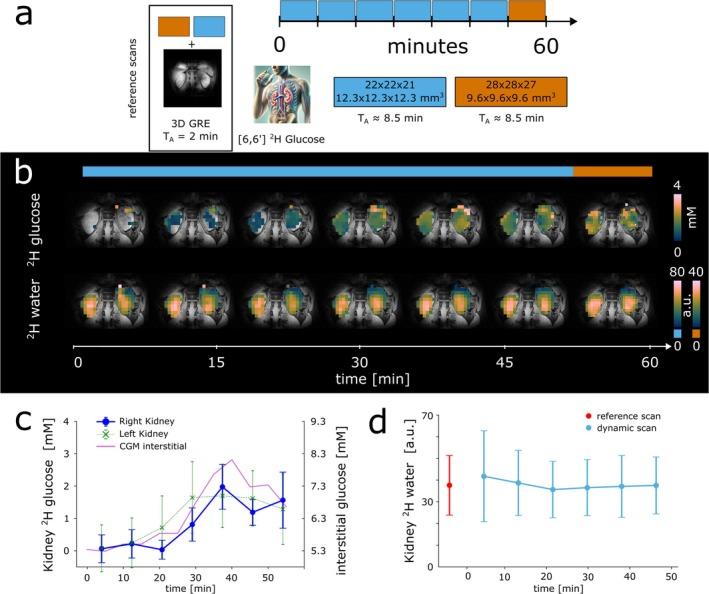
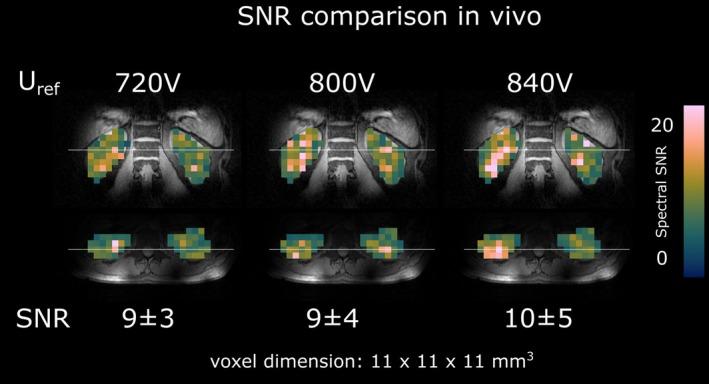
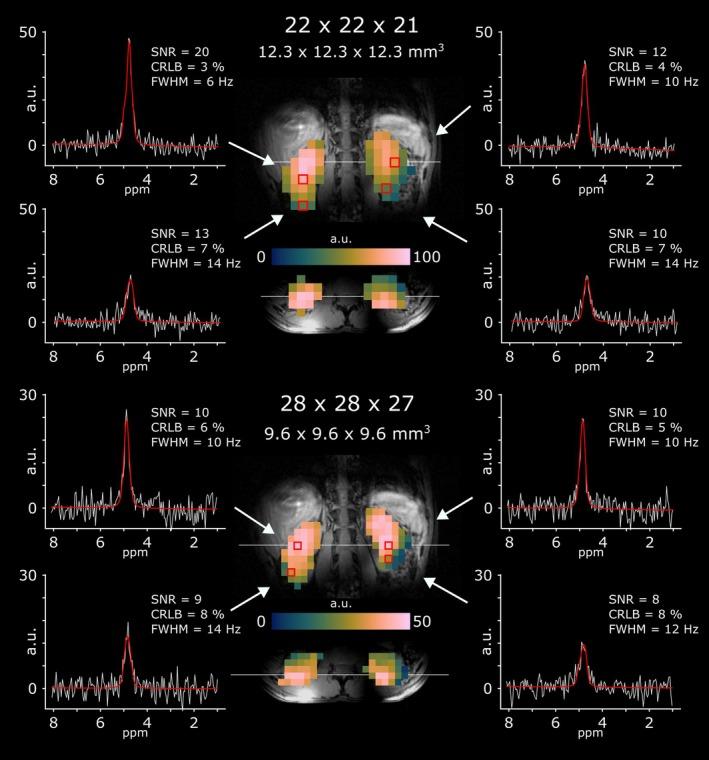
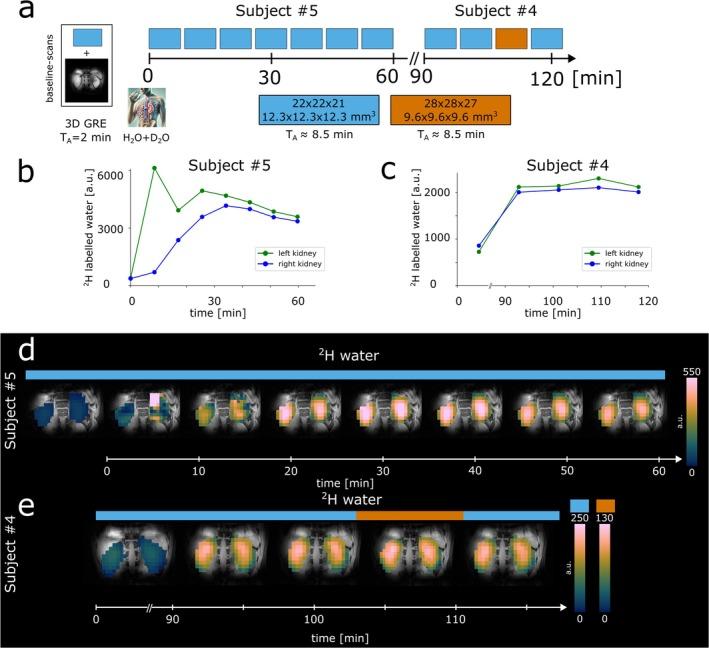
The human kidneys play a pivotal role in regulating blood pressure, water, and salt homeostasis, but assessment of renal function typically requires invasive methods. Deuterium metabolic imaging (DMI) is a novel, noninvasive technique for mapping tissue-specific uptake and metabolism of deuterium-labeled tracers. This study evaluates the feasibility of renal DMI at 7-Tesla (7T) to track deuterium-labeled tracers with high spatial and temporal resolution, aiming to establish a foundation for potential clinical applications in the noninvasive investigation of renal physiology and pathophysiology. Five healthy participants (3 m/2f) underwent renal DMI at 7T using MR spectroscopic imaging with concentric ring trajectory sampling. Two subjects participated in dynamic DMI experiments after oral administration of deuterium-labeled water (DO, 0.25, and 0.5 mL/kg) or glucose ([6,6'-H]-Glc, 0.5 g/kg) following 12 h overnight fasting. Continuous glucose monitoring (CGM) was performed using FreeStyle Libre 3 and compared to renal H-glucose levels. Three-dimensional maps of H-water and H-glucose were acquired every ∼8.5 min at isotropic resolutions of ∼1.8 and ∼0.9 mL, respectively. Tensor Marchenko-Pastur Principal Component Analysis (tMPPCA) was used for spectral denoising. Renal DMI successfully generated dynamic 3D maps of H-water and H-glucose with improved spatial resolution compared to previous studies. Following DO ingestion, H-water dynamics (0-60 min) and steady-state levels (> 90 min) were assessed. Following H-glucose ingestion, renal H-Glc concentrations peaked at 1.8 ± 1.0 mM on average over both kidneys, and overall dynamics aligned with interstitial glucose levels simultaneously assessed using CGM sensor. This study demonstrates the feasibility of dynamic renal DMI with improved spatial resolution to noninvasively map multiple H-labeled tracers in the human kidney at 7T. Future improvements in signal mitigation and intravenous tracer administration could enhance its clinical utility, potentially aiding in the evaluation of metabolic effects of novel therapies like SGLT-2 inhibitors for personalized treatment strategies.
人类肾脏在调节血压、水和盐的稳态方面发挥着关键作用,但肾功能评估通常需要采用侵入性方法。氘代谢成像(DMI)是一种新型的非侵入性技术,用于绘制氘标记示踪剂的组织特异性摄取和代谢情况。本研究评估了7特斯拉(7T)下肾脏DMI追踪具有高空间和时间分辨率的氘标记示踪剂的可行性,旨在为肾脏生理和病理生理的非侵入性研究的潜在临床应用奠定基础。五名健康参与者(3名男性/2名女性)在7T下使用具有同心环轨迹采样的磁共振波谱成像进行肾脏DMI。两名受试者在禁食12小时过夜后口服氘标记水(DO,0.25和0.5 mL/kg)或葡萄糖([6,6'-H]-Glc,0.5 g/kg)后参与动态DMI实验。使用FreeStyle Libre 3进行连续血糖监测(CGM),并与肾脏H-葡萄糖水平进行比较。分别以约1.8和约0.9 mL的各向同性分辨率每隔约8.5分钟获取H-水和H-葡萄糖的三维图谱。张量马尔琴科-帕斯特尔主成分分析(tMPPCA)用于光谱去噪。与先前的研究相比,肾脏DMI成功生成了具有更高空间分辨率的H-水和H-葡萄糖动态三维图谱。摄入DO后,评估了H-水动力学(0至60分钟)和稳态水平(> 90分钟)。摄入H-葡萄糖后,双肾平均H-Glc浓度峰值为1.8±1.0 mM,总体动力学与使用CGM传感器同时评估的间质葡萄糖水平一致。本研究证明了具有更高空间分辨率的动态肾脏DMI在7T下非侵入性绘制人肾中多种H标记示踪剂的可行性。未来在信号减弱和静脉内示踪剂给药方面的改进可能会提高其临床实用性,潜在地有助于评估新型疗法(如SGLT-2抑制剂)的代谢效应,以制定个性化治疗策略。

 Zotero 插件