
中老年人身体活动变化与肌肉减少症风险之间的关联。
Association between changes in physical activity and sarcopenia risk in middle-aged and older adults.
作者信息
Shen Xiaoxiang, Zhao Xiaoguang
机构信息
School of Sports and Technology, Guangzhou College of Applied Science and Technology, Zhaoqing, Guangdong, 526072, China.
Faculty of Sports Science, Ningbo University, Ningbo, Zhejiang, 315211, China.
出版信息
J Exerc Sci Fit. 2025 Jul;23(3):190-196. doi: 10.1016/j.jesf.2025.100383. Epub 2025 Apr 8.
OBJECTIVES
This study aimed to determine the longitudinal relationship between the changes in physical activity in middle-aged and older persons and sarcopenia risk utilizing data from a nationally representative population in China.
METHODS
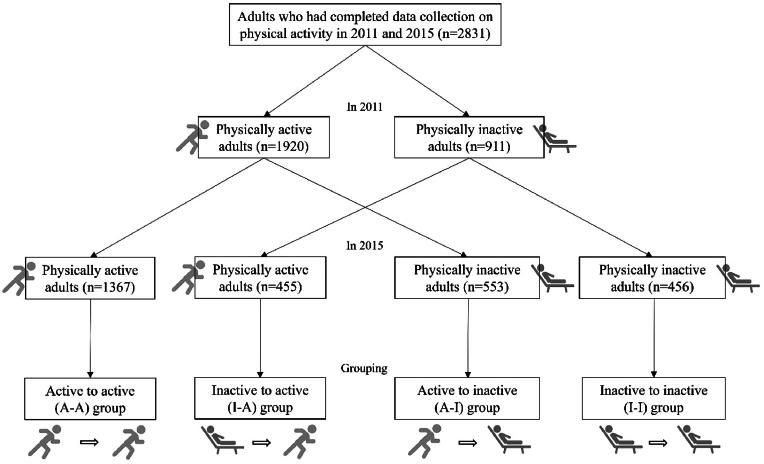
This study included 2831 participants (44.5 % men, 55.5 % women, mean age 61.86 ± 9.33 years). Participants were divided into active to active (A-A, n = 1367), inactive to active (I-A, n = 455), active to inactive (A-I, n = 553), and inactive to inactive (I-I, n = 456) groups based on changes in physical activity between 2011 and 2015. Sarcopenia and sarcopenia risk indicators were determined using the Asian Working Group for Sarcopenia 2019 consensus. One-way analysis of variance, analysis of covariance, and logistic regression analyses were used to determine the association between the changes in physical activity and sarcopenia risk.
RESULTS
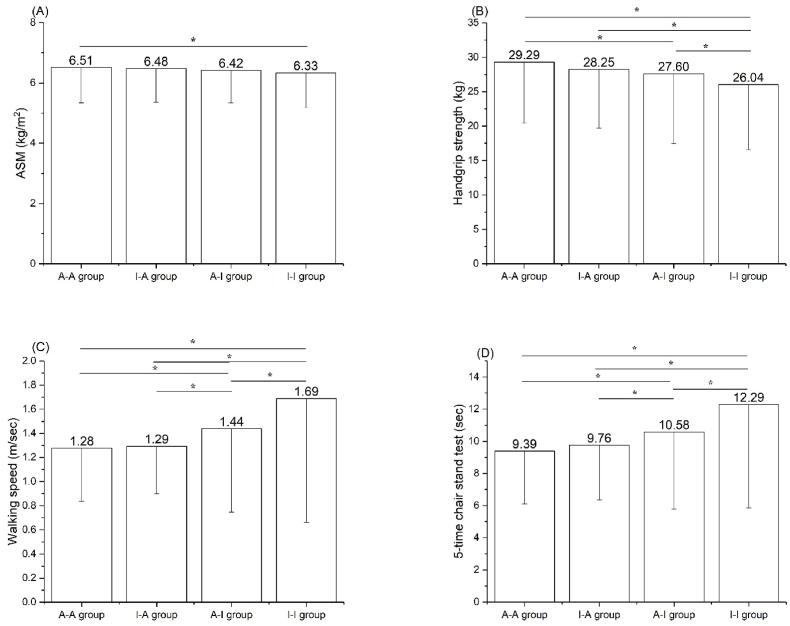
Handgrip strength tended to have a significant difference, and walking speed and 5-time chair stand test had significant differences among the A-A, I-A, A-I, and I-I groups (all p < 0.05). Compared to the I-I group, the likelihood of sarcopenia was lower in the A-A (OR: 0.65, 95 % CI: 0.52-0.81) and I-A (OR: 0.67, 95 % CI: 0.51-0.87) groups, the likelihood of poor muscle strength was lower in the A-A (OR: 0.61, 95 % CI: 0.50-0.76) and I-A (OR: 0.65, 95 % CI: 0.50-0.83) groups, and the rate of low physical performance was lower in the A-A (OR: 0.33, 95 % CI: 0.26-0.41), I-A (OR: 0.38, 95 % CI: 0.29-0.50) and A-I (OR: 0.55, 95 % CI: 0.43-0.71) groups after controlling for covariates.
CONCLUSIONS
Middle-aged and older people who remain or become physically active have a lower risk of sarcopenia, poor muscle strength, and low physical performance. Conversely, those who stop being physically active have a higher risk of sarcopenia, poor muscle strength, and low physical performance.
目的
本研究旨在利用来自中国具有全国代表性人群的数据,确定中老年人身体活动变化与肌肉减少症风险之间的纵向关系。
方法
本研究纳入了2831名参与者(男性占44.5%,女性占55.5%,平均年龄61.86±9.33岁)。根据2011年至2015年期间身体活动的变化,将参与者分为从活跃到活跃(A-A,n = 1367)、从不活跃到活跃(I-A,n = 455)、从活跃到不活跃(A-I,n = 553)和从不活跃到不活跃(I-I,n = 456)组。使用2019年亚洲肌肉减少症工作组共识确定肌肉减少症和肌肉减少症风险指标。采用单因素方差分析、协方差分析和逻辑回归分析来确定身体活动变化与肌肉减少症风险之间的关联。
结果
握力在A-A、I-A、A-I和I-I组之间存在显著差异趋势,步行速度和5次起坐试验在这些组之间存在显著差异(所有p < 0.05)。与I-I组相比,A-A组(OR:0.65,95%CI:0.52 - 0.81)和I-A组(OR:0.67,95%CI:0.51 - 0.87)肌肉减少症的可能性较低,A-A组(OR:0.61,95%CI:0.50 - 0.76)和I-A组(OR:0.65,95%CI:0.50 - 0.83)肌肉力量差的可能性较低,在控制协变量后,A-A组(OR:0.33,95%CI:0.26 - 0.41)、I-A组(OR:0.38,95%CI:0.29 - 0.50)和A-I组(OR:0.55,95%CI:0.43 - 0.71)身体表现低下的发生率较低。
结论
保持或变得身体活跃的中老年人患肌肉减少症、肌肉力量差和身体表现低下的风险较低。相反,停止身体活动的人患肌肉减少症、肌肉力量差和身体表现低下的风险较高。
 Zotero 插件