
老年人群中消化性溃疡与心血管疾病的关系:一项关于死亡率和疾病发展的研究。
The relationship between peptic ulcer and cardiovascular disease in elderly population: a study on mortality and disease development.
作者信息
He Lin, Wang Qianlei, Qiu Yang, Shen Nan, Pu Peimin, Wang Ruiqing, Miao Hongyu, Zhang Haiyan, Yu Xiao, Xiao Dinghong, Xing Lianjun, Liu Zhidong
机构信息
Longhua Hospital Shanghai University of Traditional Chinese Medicine, Shanghai, China.
Shanghai University of Traditional Chinese Medicine, Shanghai, China.
出版信息
Front Med (Lausanne). 2025 Aug 26;12:1610867. doi: 10.3389/fmed.2025.1610867. eCollection 2025.
BACKGROUND
Peptic ulcer (PU) and cardiovascular disease (CVD) are significant chronic illnesses, particularly in the elderly. This study investigates the relationship between PU and CVD in older adults and the impact on mortality risk.
METHODS
This study was conducted utilizing data from a nationwide health survey of the elderly in China. Kaplan-Meier curves and log-rank tests were applied in survival analysis to evaluate mortality differences between the groups. Stratified models were applied to evaluate the effects of factors.
RESULTS
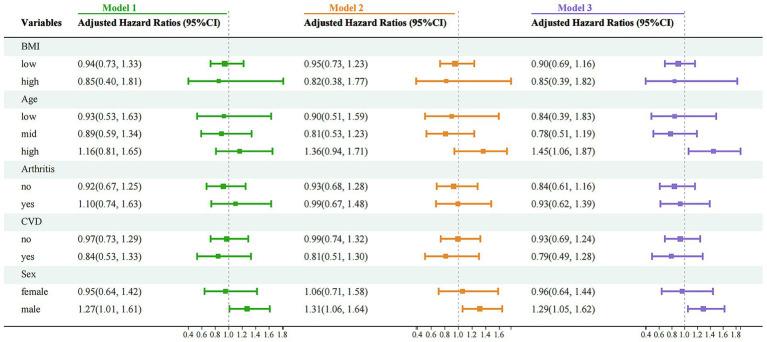
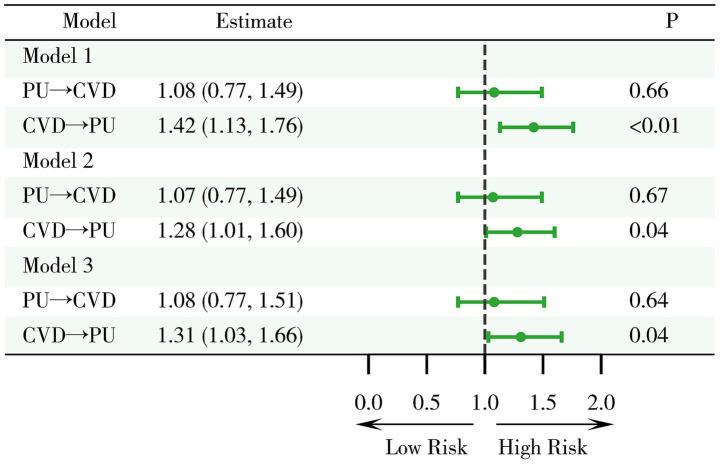
This study included 3,636 participants. CVD was significantly associated with an increased PU risk (OR = 1.31, 95%CI 1.03-1.66, = 0.04), while PU had no significant effect on CVD incidence (OR = 1.08, 95%CI 0.77-1.51, = 0.64). Mortality risk was significantly higher in the CVD group (HR = 1.22, 95%CI 1.03-1.45, = 0.02) compared to the non-comorbid group. No significant difference in mortality was observed between the PU-only and combined PU-CVD groups. Stratified analysis identified advanced age (≥75 years) (HR = 1.45, 95%CI 1.06-1.87, < 0.01) and male gender (HR = 1.29, 95%CI 1.05-1.62, < 0.01) as significant mortality risk factors among PU patients.
CONCLUSION
PU does not have a significant impact on overall mortality or the prognosis of CVD patients. CVD was a risk factor for PU, but PU did not significantly increase CVD risk. A higher mortality risk was observed in older and male PU patients. These findings suggest the need for gender-sensitive and age-stratified management strategies for PU in high-risk groups.
背景
消化性溃疡(PU)和心血管疾病(CVD)是重要的慢性疾病,在老年人中尤为如此。本研究调查了老年人中PU与CVD之间的关系以及对死亡风险的影响。
方法
本研究利用中国全国性老年人健康调查的数据进行。生存分析中应用Kaplan-Meier曲线和对数秩检验来评估组间死亡率差异。应用分层模型评估各因素的影响。
结果
本研究纳入3636名参与者。CVD与PU风险增加显著相关(OR = 1.31,95%CI 1.03 - 1.66,P = 0.04),而PU对CVD发病率无显著影响(OR = 1.08,95%CI 0.77 - 1.51,P = 0.64)。与无合并症组相比,CVD组的死亡风险显著更高(HR = 1.22,95%CI 1.03 - 1.45,P = 0.02)。单纯PU组和PU - CVD合并组之间的死亡率无显著差异。分层分析确定高龄(≥75岁)(HR = 1.45,95%CI 1.06 - 1.87,P < 0.01)和男性(HR = 1.29,95%CI 1.05 - 1.62,P < 0.01)是PU患者中显著的死亡风险因素。
结论
PU对CVD患者的总体死亡率或预后没有显著影响。CVD是PU的一个风险因素,但PU并未显著增加CVD风险。在老年和男性PU患者中观察到更高的死亡风险。这些发现表明,对于高危人群中的PU,需要采用对性别敏感和按年龄分层的管理策略。



 Zotero 插件