
蚊子对日本脑炎病毒的转录组反应及其潜在进入因子的鉴定。
Transcriptomic response of mosquitoes to Japanese encephalitis virus and identification of its potential entry factors.
作者信息
Hussain Mazhar, Etebari Kayvan, Parry Rhys H, Khromykh Alexander A, Hugo Leon E, Asgari Sassan
机构信息
School of the Environment, The University of Queensland, Brisbane, QLD, Australia.
School of Agriculture and Food Sustainability, The University of Queensland, Brisbane, QLD, Australia.
出版信息
Npj Viruses. 2025 Sep 11;3(1):68. doi: 10.1038/s44298-025-00151-8.
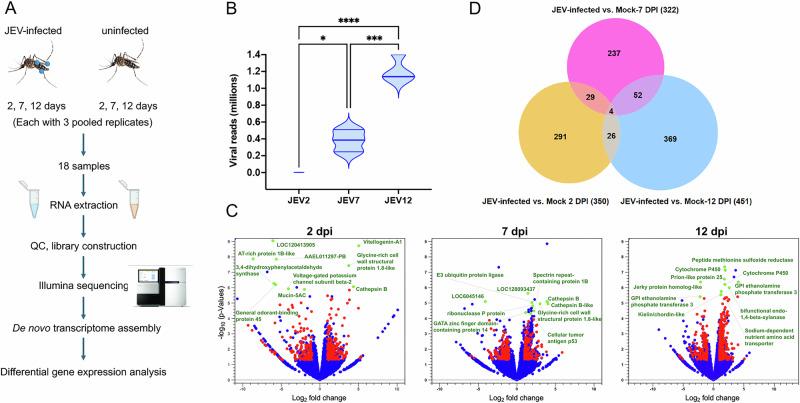
Japanese encephalitis virus (JEV), an Orthoflavivirus transmitted by mosquitoes, can cause severe disease in humans, yet its interactions with mosquito vectors remain poorly understood. This study presents the first de novo assembled transcriptome of Culex annulirostris, a major Australian JEV vector, and examines its transcriptional response to infection with JEV. A total of 350, 322, and 451 genes were differentially expressed at 2, 7, and 12 days post-infection, respectively, involving functions related to membrane-bounded organelles, protein metabolic processes, and catalytic activity. To identify potential viral entry factors, JEV Envelope protein was incubated with lysates from Culex quinquefasciatus Hsu cells. Co-immunoprecipitation and mass spectrometry revealed prohibitin, annexin, and 14-3-3ε as interacting proteins. Silencing these genes reduced JEV infection, and anti-prohibitin antibodies further suppressed viral replication. These findings highlight mosquito transcriptomic responses to JEV and identify annexin, 14-3-3ε, and prohibitin-especially prohibitin-as pro-viral factors and potential targets for blocking JEV entry.
日本脑炎病毒(JEV)是一种由蚊子传播的正黄病毒,可导致人类患上严重疾病,但其与蚊子媒介的相互作用仍知之甚少。本研究展示了澳大利亚主要的JEV媒介环喙库蚊的首个从头组装转录组,并研究了其对JEV感染的转录反应。在感染后第2天、第7天和第12天,分别有350、322和451个基因差异表达,这些基因涉及与膜结合细胞器、蛋白质代谢过程和催化活性相关的功能。为了鉴定潜在的病毒进入因子,将JEV包膜蛋白与致倦库蚊许氏细胞的裂解物一起孵育。免疫共沉淀和质谱分析显示,抗增殖蛋白、膜联蛋白和14-3-3ε为相互作用蛋白。沉默这些基因可减少JEV感染,抗增殖蛋白抗体进一步抑制病毒复制。这些发现突出了蚊子对JEV的转录组反应,并确定膜联蛋白、14-3-3ε和抗增殖蛋白——尤其是抗增殖蛋白——作为病毒促进因子以及阻断JEV进入的潜在靶点。




 Zotero 插件