
高敏C反应蛋白水平与代谢功能障碍相关脂肪性肝病及肝纤维化风险的关联:一项基于美国国家健康与营养检查调查(NHANES)数据的研究
Association Between High-Sensitivity C-Reactive Protein Levels and Metabolic Dysfunction-Associated Steatotic Liver Disease and Liver Fibrosis Risk: A Study Based on NHANES Data.
作者信息
Xu Chaolong, Wang Kai, Peng Zhiming, Chen Peng, Zhang Chengchen, Zeng Xianyi, Tan Chenghao, Huang Yunchen
机构信息
Department of Hepatobiliary Surgery, People's Hospital of Yicheng City, Yicheng, China.
出版信息
Turk J Gastroenterol. 2025 Jun 23;36(9):590-599. doi: 10.5152/tjg.2025.24251.
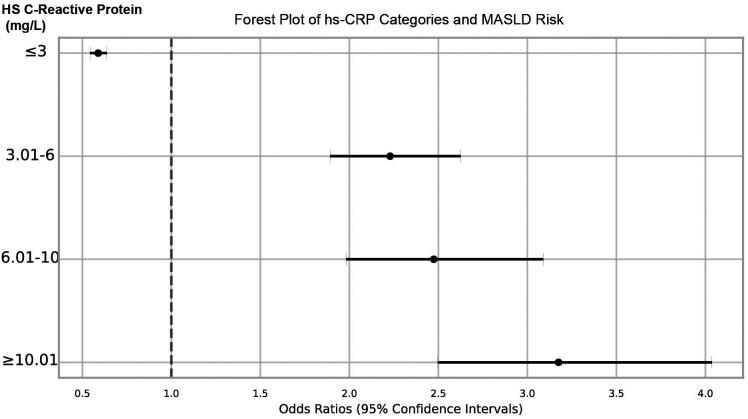
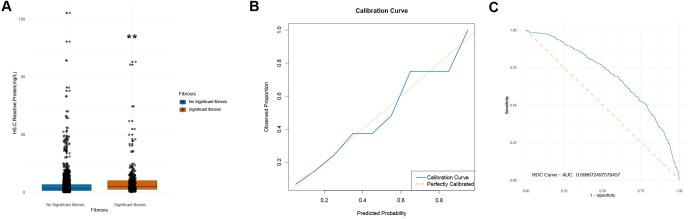
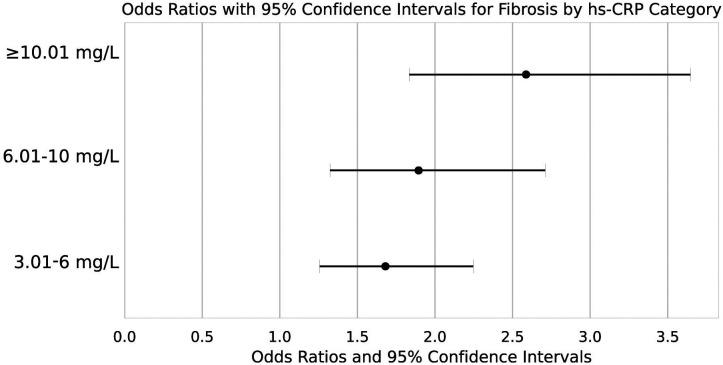
Background/Aims: High-sensitivity C-reactive protein (hs-CRP) is a known inflammatory biomarker linked to various metabolic disorders. This study sought to examine the association between hs-CRP levels and the risk of metabolic dysfunction-associated steatotic liver disease (MASLD) and liver fibrosis (LF). Materials and Methods: Data from 2787 participants of the 2017-2020 National Health and Nutrition Examination Survey were analyzed. The evaluation of liver steatosis and fibrosis was performed using transient elastography. Furthermore, logistic regression models were applied to examine the correlation between 4 categorized levels of hs-CRP and the risks of MASLD and LF. Results: Compared to individuals with hs-CRP ≤3 mg/L, those with hs-CRP levels of 3.01-6 mg/L, 6.01-10 mg/L, and ≥10.01 mg/L exhibited markedly increased risks of MASLD, with odds ratios and 95% CI of 2.229 (1.892-2.625), 2.474 (1.982-3.090), and 3.175 (2.497-4.037), respectively. The receiver operating characteristic and calibration curves of the model validated the significant association of higher hs-CRP levels with increased MASLD and LF risk. Conclusion: Elevated hs-CRP levels are prominently associated with increased risks of MASLD and LF. High-sensitivity C-reactive protein could serve as a potential biomarker for identifying and managing MASLD and related fibrosis risks.
背景/目的:高敏C反应蛋白(hs-CRP)是一种已知的炎症生物标志物,与多种代谢紊乱有关。本研究旨在探讨hs-CRP水平与代谢功能障碍相关脂肪性肝病(MASLD)及肝纤维化(LF)风险之间的关联。材料与方法:分析了2017 - 2020年国家健康与营养检查调查中2787名参与者的数据。使用瞬时弹性成像技术评估肝脏脂肪变性和纤维化。此外,应用逻辑回归模型来检验hs-CRP的4个分类水平与MASLD和LF风险之间的相关性。结果:与hs-CRP≤3mg/L的个体相比,hs-CRP水平为3.01 - 6mg/L、6.01 - 10mg/L和≥10.01mg/L的个体发生MASLD的风险显著增加,比值比和95%置信区间分别为2.229(1.892 - 2.625)、2.474(1.982 - 3.090)和3.175(2.497 - 4.037)。模型的受试者工作特征曲线和校准曲线验证了较高的hs-CRP水平与增加的MASLD和LF风险之间存在显著关联。结论:hs-CRP水平升高与MASLD和LF风险增加显著相关。高敏C反应蛋白可作为识别和管理MASLD及相关纤维化风险的潜在生物标志物。


 Zotero 插件