
基于透射的微波成像系统用于肿瘤检测的可行性。
Feasibility of tumor detection with a transmission-based microwave imaging system.
作者信息
Mojabi Pedram, Tsang Roger Y, Docktor Bobbie, Deutscher Danielle, Garland Anita, Mahsin Md, Bourqui Jeremie, Fear Elise
机构信息
Electrical and Software Engineering, University of Calgary, Calgary, Alberta, Canada.
Department of Medical Oncology, University of Calgary, Calgary, Alberta, Canada.
出版信息
Med Phys. 2025 Sep;52(9):e18080. doi: 10.1002/mp.18080.
BACKGROUND
Microwave imaging has been proposed for breast cancer detection, relying on differences between the microwave frequency properties of healthy and cancerous tissues. Specifically, localized increases in permittivity and/or conductivity may be identified in images of the breast created with microwave tomography. In radar-based images, responses may be noted where property changes occur. Our team has developed a microwave imaging approach that creates maps of permittivity by analyzing the characteristics of signals transmitted through the tissues, scanning the breast in views similar to mammography.
PURPOSE
This study aims to assess the feasibility of tumor detection with a transmission-based microwave imaging system. Specifically, both breasts of a control group and a group of women with a cancer diagnosis are scanned in both cranial-caudal (CC) and medial-lateral oblique (MLO) orientations to facilitate comparison with mammography.
METHODS
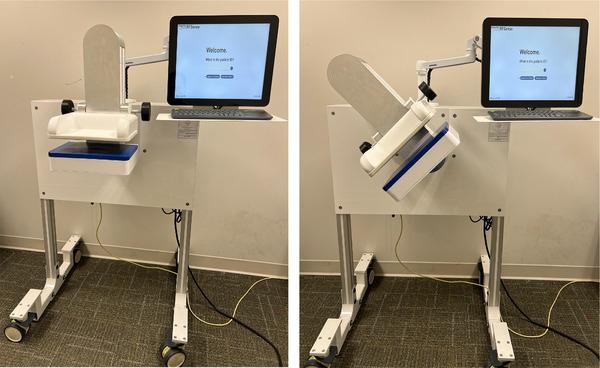
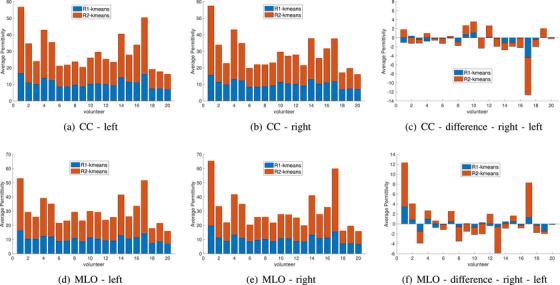
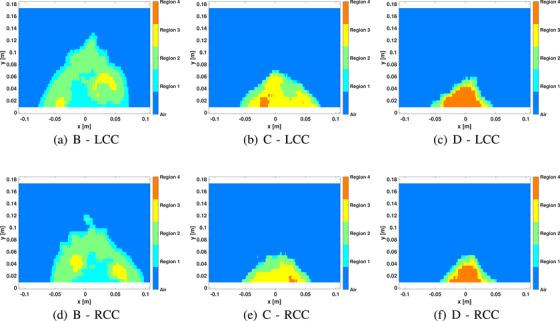
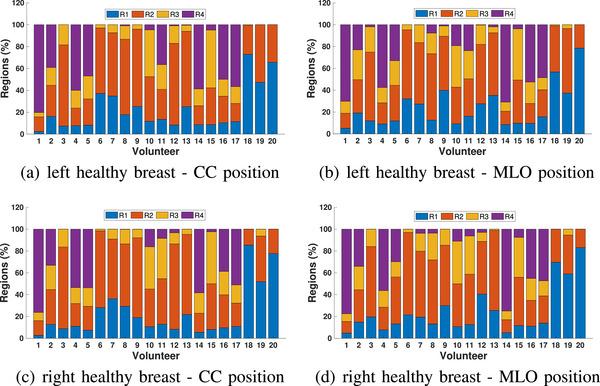
The microwave scanner consists of planar transmit and receive arrays that are placed in contact with the breast. The arrays are placed horizontally to collect the CC view, then tilted to an angle of 45 degrees to collect the MLO view. Signals with frequency content from 0.1 to 8 GHz are transmitted through the tissue, and the characteristics of the detected signals are used to estimate the microwave frequency properties (permittivity). Estimates at each sensor pair are mapped to the imaging plane. The average microwave frequency properties are calculated for the breast region identified in each image. Images are also segmented using k-means and thresholding to further explore tumor detection. Statistical analysis is applied, specifically analysis of variance (ANOVA) to determine differences between views and groups.
RESULTS
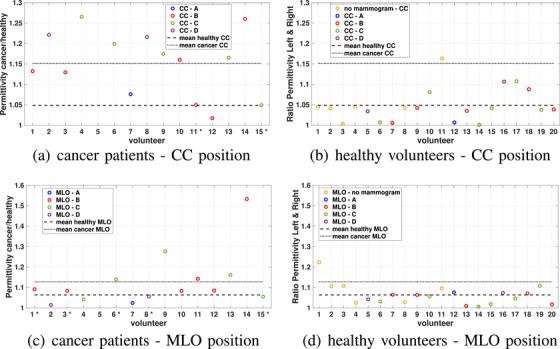
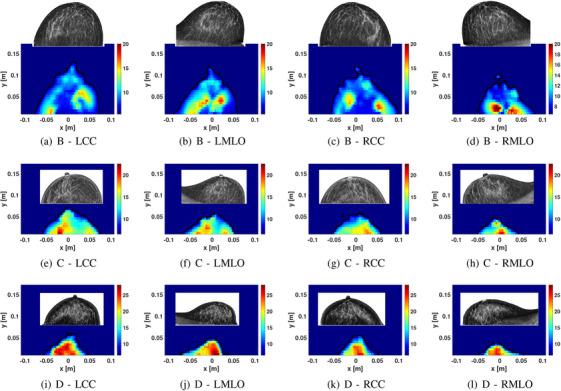
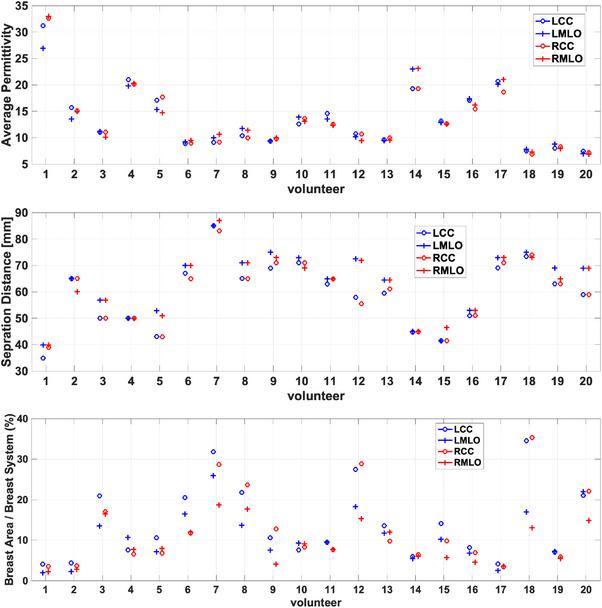
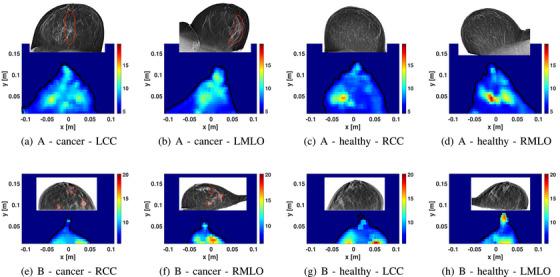
20 healthy participants and 14 cancer patients are scanned. Right and left breasts are compared for each patient. Consistency is noted when comparing the CC scans of the breasts of healthy participants; similar observations are made for the MLO scans. Similarity between CC and MLO views of the same breast is also noted and confirmed via ANOVA testing. For patients with confirmed cancer, greater differences are noted between the breasts in at least one view when observing images and average properties. The ratio of the average permittivity of the cancerous breast to the contralateral breast is significantly different than the ratio observed in healthy volunteers when considering CC views. Greater ratios are also observed for patients with higher breast densities.
CONCLUSION
This study demonstrates the potential for a transmission-based microwave scanner to detect tumors.
背景
微波成像已被用于乳腺癌检测,其依据是健康组织和癌组织在微波频率特性上的差异。具体而言,在通过微波断层扫描生成的乳房图像中,可能会识别出介电常数和/或电导率的局部增加。在基于雷达的图像中,在特性发生变化的地方可能会观察到响应。我们的团队开发了一种微波成像方法,通过分析穿过组织传输的信号特征来创建介电常数图,以类似于乳腺X线摄影的视角扫描乳房。
目的
本研究旨在评估基于透射的微波成像系统检测肿瘤的可行性。具体而言,对对照组和一组患有癌症诊断的女性的双侧乳房进行头尾位(CC)和内外斜位(MLO)扫描,以便于与乳腺X线摄影进行比较。
方法
微波扫描仪由与乳房接触的平面发射和接收阵列组成。阵列水平放置以采集CC视图,然后倾斜45度以采集MLO视图。频率范围为0.1至8 GHz的信号穿过组织传输,检测到的信号特征用于估计微波频率特性(介电常数)。每个传感器对的估计值被映射到成像平面。计算每个图像中识别出的乳房区域的平均微波频率特性。还使用k均值和阈值化对图像进行分割,以进一步探索肿瘤检测。应用统计分析,特别是方差分析(ANOVA)来确定视图和组之间的差异。
结果
对20名健康参与者和14名癌症患者进行了扫描。对每位患者的左右乳房进行了比较。在比较健康参与者乳房的CC扫描时发现了一致性;MLO扫描也有类似观察结果。同一乳房的CC和MLO视图之间的相似性也被注意到,并通过ANOVA测试得到证实。对于确诊为癌症的患者,在观察图像和平均特性时,至少在一个视图中乳房之间的差异更大。在考虑CC视图时,患侧乳房与对侧乳房的平均介电常数之比与健康志愿者中观察到的比率有显著差异。乳房密度较高的患者也观察到更高的比率。
结论
本研究证明了基于透射的微波扫描仪检测肿瘤的潜力。

 Zotero 插件