
血液系统恶性肿瘤的CAR-T细胞免疫治疗后的内皮损伤
Endothelial Injury Following CAR-T Cell Immunotherapy for Hematological Malignancies.
作者信息
Demosthenous Christos, Evangelidis Paschalis, Gatsis Athanasios, Mitroulis Ioannis, Vakalopoulou Sofia, Vardi Anna, Bountoura Stefania, Sakellari Ioanna, Gavriilaki Eleni
机构信息
BMT Unit, Hematology Department, George Papanicolaou General Hospital, 57010 Thessaloniki, Greece.
Second Propedeutic Department of Internal Medicine, Hippocration Hospital, Aristotle University of Thessaloniki, 54642 Thessaloniki, Greece.
出版信息
Cancers (Basel). 2025 Sep 1;17(17):2876. doi: 10.3390/cancers17172876.
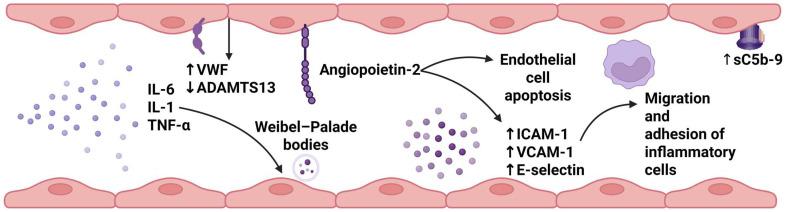
Chimeric antigen receptor-T (CAR-T) cell immunotherapy constitutes a cornerstone in the management of patients with relapsed/refractory B-cell lineage lymphoid malignancies. Toxicities such as cytokine release syndrome (CRS), immune effector cell-associated neurotoxicity syndrome (ICANS), and hematotoxicity (ICAHT) have been recognized in the post-infusion period. The initial interplay between CAR-T cells and tumor cells, followed by cytokine release and the bystander activation of the innate immunity cells, result in endothelial cell injury. In the current review, the ongoing research regarding endothelial injury in CAR-T cell recipients is summarized. Various markers of endothelial injury have been investigated in CAR-T cell recipients, including markers of complement activation, such as soluble C5b-9, endothelial dysfunction (angiopoietin-2, VCAM1, ICAM-1), inflammation, and thrombosis (von Willebrand antigen, ADAMTS13, thrombomodulin). The expression level of these endothelial injury markers has been identified as impaired in CAR-T cell recipients, not only when compared with healthy controls but also among patients with severe CRS/ICANS and those with mild toxicities or without toxicities. Furthermore, the Endothelial Activation and Stress Index (EASIX) and modified versions of this score, calculated in the pre- and early post-infusion period, seem to predict development of severe toxicities, ICAHT, and, thus, poor overall survival in CAR-T cell patients. More data concerning the role of these endothelial injury markers and clinical outcomes in CAR-T cell settings are essential.
嵌合抗原受体T(CAR-T)细胞免疫疗法是复发/难治性B细胞系淋巴恶性肿瘤患者治疗的基石。细胞因子释放综合征(CRS)、免疫效应细胞相关神经毒性综合征(ICANS)和血液毒性(ICAHT)等毒性反应在输注后阶段已被认识到。CAR-T细胞与肿瘤细胞之间的初始相互作用,随后是细胞因子释放和先天免疫细胞的旁观者激活,导致内皮细胞损伤。在本综述中,总结了关于CAR-T细胞接受者内皮损伤的正在进行的研究。已经在CAR-T细胞接受者中研究了各种内皮损伤标志物,包括补体激活标志物,如可溶性C5b-9、内皮功能障碍(血管生成素-2、血管细胞黏附分子1、细胞间黏附分子1)、炎症和血栓形成(血管性血友病因子抗原、含血小板解聚蛋白和金属蛋白酶13、血栓调节蛋白)。这些内皮损伤标志物的表达水平已被确定在CAR-T细胞接受者中受损,不仅与健康对照相比,而且在严重CRS/ICANS患者与轻度毒性或无毒性患者之间也是如此。此外,在输注前和输注后早期计算的内皮激活和应激指数(EASIX)及其改良版本似乎可以预测CAR-T细胞患者严重毒性、ICAHT的发生,从而预测总体生存率较差。关于这些内皮损伤标志物的作用以及在CAR-T细胞环境中的临床结果的更多数据至关重要。
 Zotero 插件