
结合分子动力学和机器学习预测结直肠癌中导致BRAF耐药的变异体
Combining Molecular Dynamics and Machine Learning to Predict Drug Resistance Causing Variants of BRAF in Colorectal Cancer.
作者信息
Xie Longsheng, Lockhart Christopher, Klimov Dmitri K, Jafri Mohsin Saleet
机构信息
School of Systems Biology, George Mason University, Fairfax, VA 22020, USA.
Center for Biomedical Engineering and Technology, University of Maryland School of Medicine, Baltimore, MD 21201, USA.
出版信息
Molecules. 2025 Aug 30;30(17):3556. doi: 10.3390/molecules30173556.
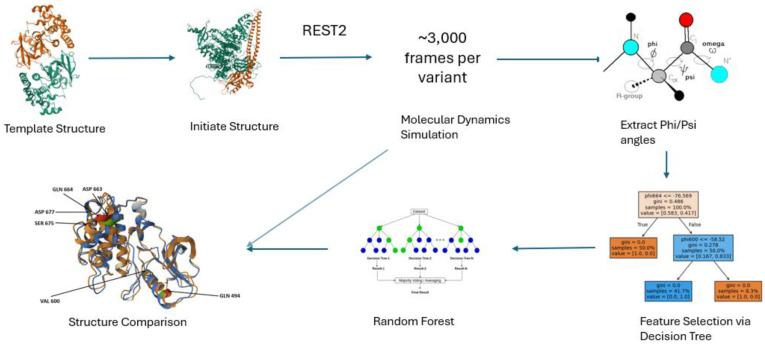
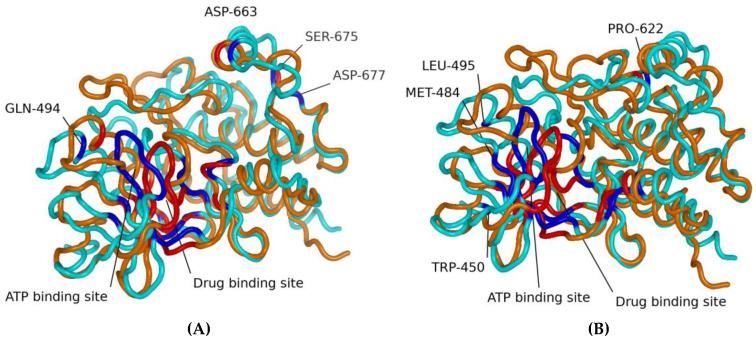
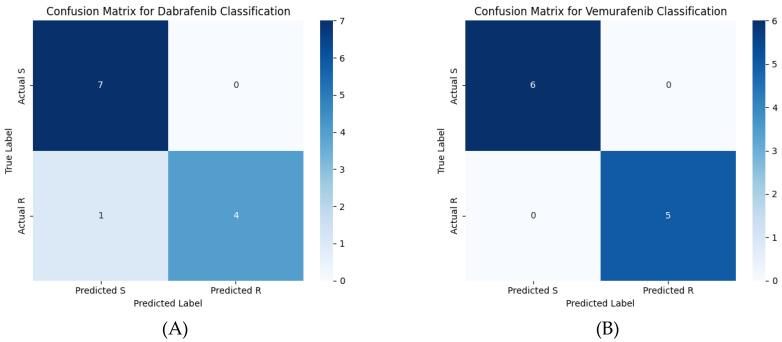
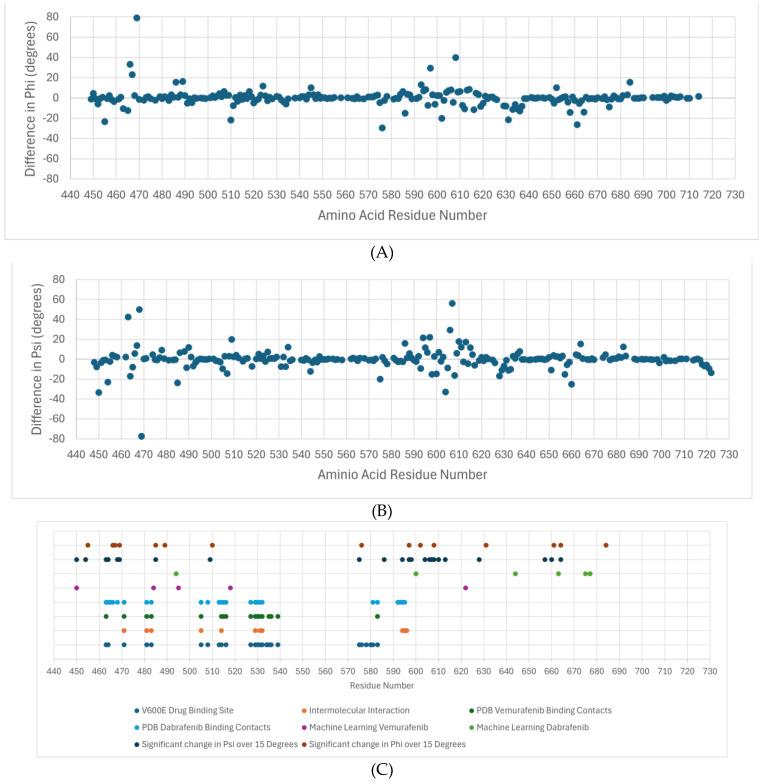
The BRAF protein regulates cell growth and division through key signaling pathways. Mutations in BRAF, particularly the V600E variant, are frequently observed in colorectal cancer (CRC) and are associated with poor prognosis and therapeutic challenges. Tumors harboring certain BRAF mutations often exhibit primary resistance to BRAF inhibitor monotherapies. Over time, these tumors can also develop acquired resistance, further complicating treatment. In this study, we employed replica exchange molecular dynamics simulations combined with machine learning techniques to investigate the structural alterations induced by BRAF mutations and their contribution to drug resistance. Our analyses revealed that conformational changes in mutant BRAF proteins associated with dabrafenib residues psi494, phi600, phi644, phi663, psi675, and phi677 were sufficient for classifying drug-resistant vs. drug-sensitive variants. Similarly, for vemurafenib, residues psi450, phi484, phi495, phi518, psi622, and phi622 were the key residues that influence drug binding and resistance mechanisms. These residues are located in the N-lobe of CR3, which is responsible for ATP binding and the regulation of BRAF kinase activity. These findings offer deeper insights into the molecular basis of BRAF-driven resistance and provide predictive models for phenotypic outcomes of various BRAF mutations. The study underscores the importance of targeting specific BRAF variants for more effective, personalized therapeutic strategies in drug-resistant CRC patients.
BRAF蛋白通过关键信号通路调节细胞生长和分裂。BRAF突变,尤其是V600E变体,在结直肠癌(CRC)中经常被观察到,并且与预后不良和治疗挑战相关。携带某些BRAF突变的肿瘤通常对BRAF抑制剂单药治疗表现出原发性耐药。随着时间的推移,这些肿瘤也可能产生获得性耐药,使治疗更加复杂。在本研究中,我们采用复制交换分子动力学模拟结合机器学习技术,研究BRAF突变诱导的结构改变及其对耐药性的影响。我们的分析表明,与达拉非尼残基psi494、phi600、phi644、phi663、psi675和phi677相关的突变BRAF蛋白的构象变化足以区分耐药和敏感变体。同样,对于维莫非尼,残基psi450、phi484、phi495、phi518、psi622和phi622是影响药物结合和耐药机制的关键残基。这些残基位于CR3的N叶,负责ATP结合和BRAF激酶活性的调节。这些发现为BRAF驱动的耐药性的分子基础提供了更深入的见解,并为各种BRAF突变的表型结果提供了预测模型。该研究强调了针对特定BRAF变体制定更有效、个性化治疗策略对于耐药CRC患者的重要性。


 Zotero 插件