
用于调节宫颈癌光动力疗法中缺氧微环境的最新纳米颗粒:体内研究综述
Latest Nanoparticles to Modulate Hypoxic Microenvironment in Photodynamic Therapy of Cervical Cancer: A Review of In Vivo Studies.
作者信息
Bartusik-Aebisher Dorota, Saad Mohammad A, Przygórzewska Agnieszka, Woźnicki Paweł, Aebisher David
机构信息
Department of Biochemistry and General Chemistry, Collegium Medicum, Faculty of Medicine, University of Rzeszów, 35-310 Rzeszów, Poland.
Wellman Center for Photomedicine, Massachusetts General Hospital and Harvard Medical School, Boston, MA 02114, USA.
出版信息
Int J Mol Sci. 2025 Sep 1;26(17):8503. doi: 10.3390/ijms26178503.
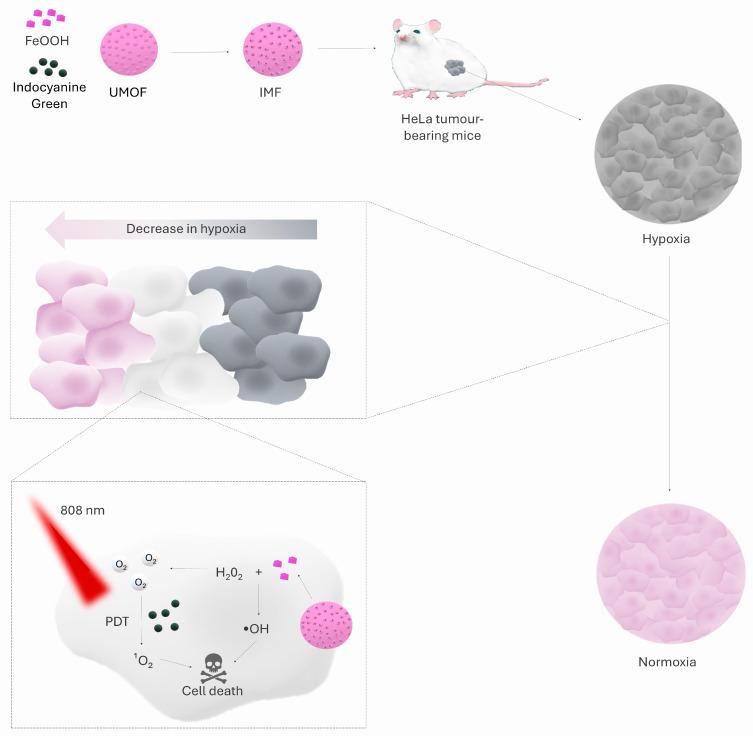
Photodynamic therapy (PDT) is a promising, minimally invasive treatment for cervical cancer, but its efficacy is significantly limited by hypoxia-oxygen deficiency in the tumour microenvironment. The aim of this study was to present strategies to counteract hypoxia in PDT using the latest nanotechnologies. Based on a review of the literature available in PubMed/MEDLINE, Scopus, and Web of Science databases, covering the period from January 2024 to March 2025, nine original in vivo studies were identified that investigated the use of nanoparticle-based strategies to overcome hypoxia and enhance the efficacy of PDT in cervical cancer. A variety of approaches to improve tumour oxygenation are described, including the catalytic decomposition of hydrogen peroxide (HO) with manganese oxide (MnO), the use of bimetallic nanozymes (e.g., AuPt), and FeOOH structures and oxygen storage and control systems (e.g., endoperoxides). Strategies to reduce oxygen consumption by cancer cells, such as nitric oxide (NO) release or inhibition of mitochondrial oxidative phosphorylation, are also discussed. The review shows that appropriately designed nanoparticles can effectively counteract hypoxia, enhancing the efficacy of PDT by intensifying reactive oxygen species (ROS) generation and modulating HIF-1α factor expression. The strategies presented here have the potential to significantly improve the efficacy of photodynamic therapy in the treatment of cervical cancer, especially under conditions of limited oxygen availability.
光动力疗法(PDT)是一种很有前景的宫颈癌微创治疗方法,但其疗效因肿瘤微环境中的缺氧——氧缺乏而受到显著限制。本研究的目的是提出利用最新纳米技术对抗光动力疗法中缺氧问题的策略。基于对PubMed/MEDLINE、Scopus和Web of Science数据库中2024年1月至2025年3月期间可用文献的综述,确定了九项原始体内研究,这些研究调查了基于纳米颗粒的策略在克服缺氧和提高光动力疗法治疗宫颈癌疗效方面的应用。描述了多种改善肿瘤氧合的方法,包括用氧化锰(MnO)催化分解过氧化氢(HO)、使用双金属纳米酶(如AuPt)以及FeOOH结构和氧储存与控制系统(如内过氧化物)。还讨论了减少癌细胞耗氧量的策略,如一氧化氮(NO)释放或抑制线粒体氧化磷酸化。该综述表明,经过适当设计的纳米颗粒可以有效对抗缺氧,通过增强活性氧(ROS)生成和调节缺氧诱导因子-1α(HIF-1α)因子表达来提高光动力疗法的疗效。本文提出的策略有可能显著提高光动力疗法治疗宫颈癌的疗效,尤其是在氧供应有限的情况下。

 Zotero 插件