
身体活动和身体功能在中国老年人身体虚弱转变预测中的作用:来自中国健康与养老追踪调查(CHARLS)的纵向观察研究
The Role of Physical Activity and Physical Function in Predicting Physical Frailty Transitions in Chinese Older Adults: Longitudinal Observational Study From CHARLS.
作者信息
Zeng Ziwei, Hsu Chun Liang, Sit Cindy Hui-Ping, Wong Stephen Heung-Sang, Yang Yijian
机构信息
Department of Sports Science and Physical Education, The Chinese University of Hong Kong, Shatin, Hong Kong, China (Hong Kong), 852 39434001.
Department of Rehabilitation Sciences, The Hong Kong Polytechnic University, Hong Kong, China (Hong Kong).
出版信息
JMIR Aging. 2025 Sep 15;8:e75887. doi: 10.2196/75887.
BACKGROUND
Frailty is a dynamic geriatric syndrome associated with adverse health outcomes, yet its progression can be mitigated through targeted interventions.
OBJECTIVE
This study aimed to investigate predictors of frailty transitions in Chinese older adults, focusing on physical activity (PA) and physical function.
METHODS
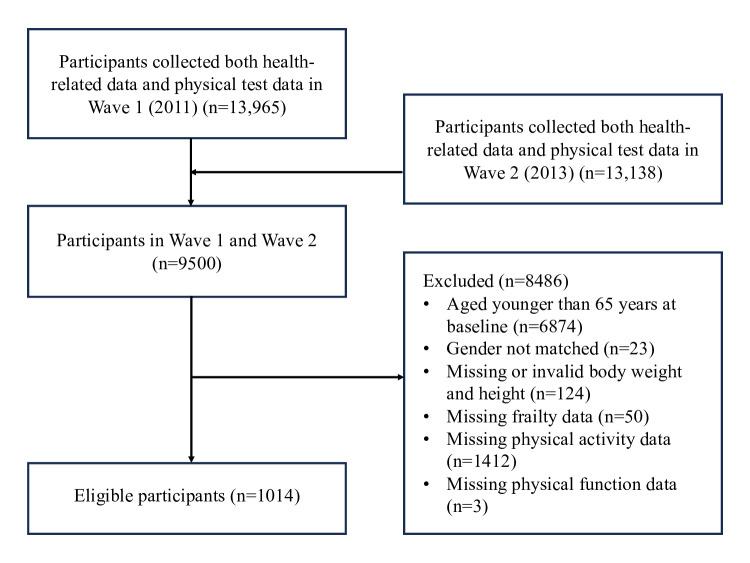
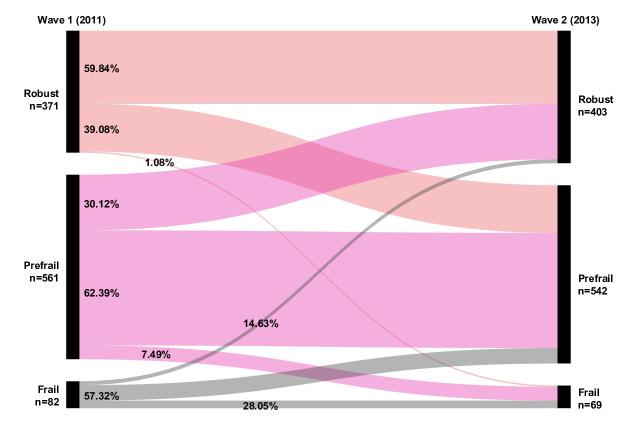
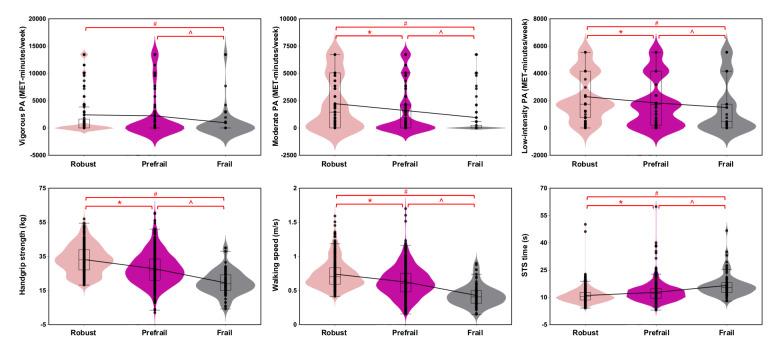
Using data from the China Health and Retirement Longitudinal Study (CHARLS), we examined transitions between frailty states (robust, prefrail, and frail) from 2011 (baseline) to 2013 (follow-up) among 1014 participants aged 65 years and older. The following outcomes were assessed, including frailty using the physical frailty phenotype, PA using a modified International Physical Activity Questionnaire, and physical function using the Short Physical Performance Battery (SPPB) and handgrip strength. Ordinal logistic regression models were used to examine the relationship between PA, physical function, and frailty transitions.
RESULTS
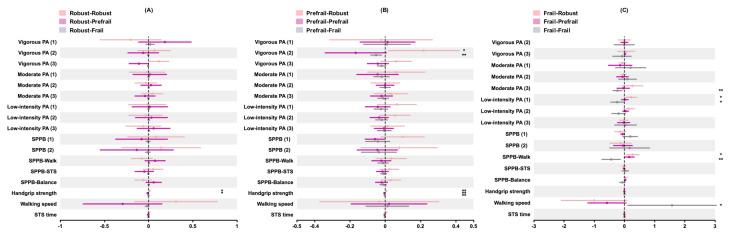
Results showed that higher PA levels and better physical function reduced the likelihood of worsening frailty or increased the probability of transitioning to robustness. Key findings from the subgroup include: among robust individuals, greater handgrip strength predicted maintained robustness (average marginal effects [AME]=1.12%; P=.02); in prefrail individuals, higher vigorous PA (AME=21.76%; P=.04) and handgrip strength (AME=0.64%; P=.003) increased transitions to robustness; for frail individuals, increased low-intensity PA (AME =22.48%; P=.04) and higher SPPB walking subscores (AME=27.73%; P=.02) promoted improvement to nonfrailty.
CONCLUSIONS
These findings highlight the importance of tailored interventions based on baseline frailty status. Promoting PA and improving physical function, particularly muscle strength and mobility function, may help delay or reverse frailty progression.
背景
衰弱是一种与不良健康结局相关的动态老年综合征,但其进展可通过针对性干预得到缓解。
目的
本研究旨在调查中国老年人衰弱状态转变的预测因素,重点关注身体活动(PA)和身体功能。
方法
利用中国健康与养老追踪调查(CHARLS)的数据,我们研究了2011年(基线)至2013年(随访)期间1014名65岁及以上参与者在衰弱状态(健康、衰弱前期和衰弱)之间的转变情况。评估了以下结果,包括使用身体衰弱表型评估衰弱,使用改良的国际身体活动问卷评估PA,以及使用简短身体表现量表(SPPB)和握力评估身体功能。采用有序逻辑回归模型来研究PA、身体功能与衰弱转变之间的关系。
结果
结果显示,较高的PA水平和较好的身体功能降低了衰弱恶化的可能性或增加了转变为健康状态的概率。亚组的主要发现包括:在健康个体中,更大的握力预测维持健康状态(平均边际效应[AME]=1.12%;P=0.02);在衰弱前期个体中,较高的剧烈PA(AME=21.76%;P=0.04)和握力(AME=0.64%;P=0.003)增加了转变为健康状态的概率;对于衰弱个体,增加低强度PA(AME =22.48%;P=0.04)和较高的SPPB步行子评分(AME=27.73%;P=0.02)促进了向非衰弱状态的改善。
结论
这些发现突出了根据基线衰弱状态进行针对性干预的重要性。促进PA和改善身体功能,特别是肌肉力量和运动功能,可能有助于延缓或逆转衰弱进展。
 Zotero 插件