
复发性肝细胞癌的射频消融治疗:局部肿瘤进展与肝内远处复发的10年结果
Radiofrequency ablation for recurrent hepatocellular carcinoma: 10-year outcomes of local tumor progression vs intrahepatic distant recurrence.
作者信息
Guo Huan-Ling, Yao Jia-Qian, Zheng Xin, Huang Tong-Yi, Zhang Xiao-Er, Zhang Rui, Wu Wen-Xin, Xie Xiao-Yan, Xu Ming
机构信息
Department of Medical Ultrasonics, Institute of Diagnostic and Interventional Ultrasound, The First Affiliated Hospital of Sun Yat-Sen University, Guangzhou, China.
出版信息
Insights Imaging. 2025 Sep 16;16(1):191. doi: 10.1186/s13244-025-02080-9.
OBJECTIVES
To compare the long-term outcome of radiofrequency ablation (RFA) for local tumor progression (LTP) vs intrahepatic distant recurrence (IDR) in recurrent hepatocellular carcinoma (rHCC), including cases with repeated LTP.
MATERIALS AND METHODS
From 2010 to 2022, 1326 rHCC patients treated with curative-intent RFA were identified. Propensity score matching (PSM) was used to balance the bias between the LTP group and the IDR group. Overall survival (OS) and progression-free survival (PFS), were compared between groups using log-rank tests and Cox proportional hazards models.
RESULTS
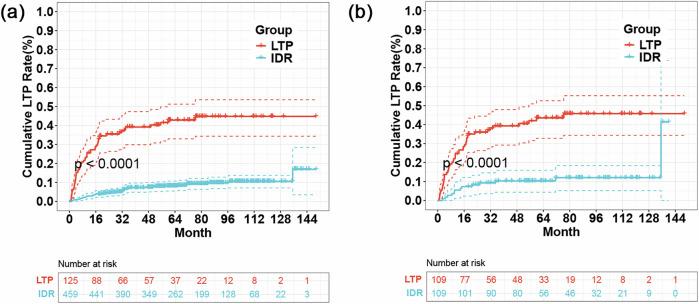
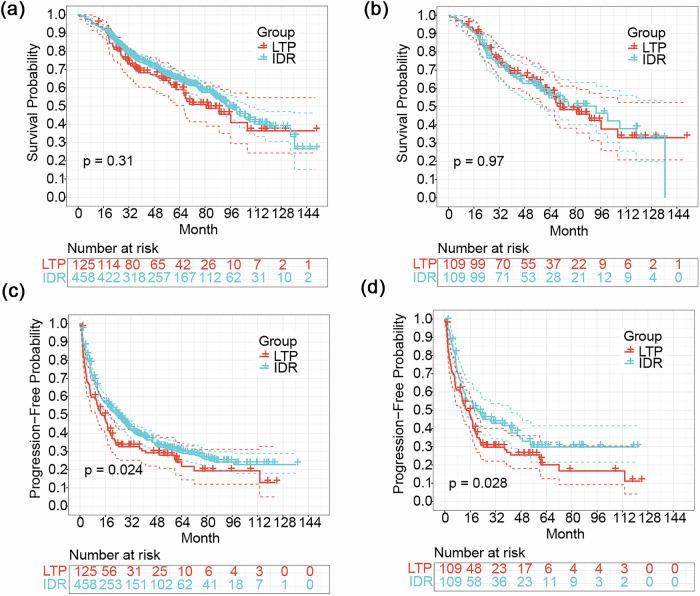
A total of 584 patients were finally enrolled (125 LTPs, 459 IDRs), with a median follow-up of 5.8 years. After PSM, 218 patients (109 patients in each group) were selected. The median OS was comparable between LTP and IDR (70.3 months vs 93.1 months, p = 0.974). However, PFS was significantly worse in the LTP group (13.8 months vs 20.9 months, p = 0.028). LTP incidence was higher in the LTP group (42.2% vs 12.8%, p < 0.001). Multiple recurrences, early recurrence (≤ 1 year), and ≥ 3 LTP episodes were independent risk factors for OS. The median OS decreased with increasing LTP episodes (0: 99.3 months; 1: 86.9 months; 2: 88.9 months; ≥ 3: 44.9 months, p = 0.031).
CONCLUSIONS
RFA demonstrated effective control of LTP in rHCC, with comparable OS but worse PFS compared with IDR, primarily due to the higher risk of LTP. RFA may not be the first choice for those with ≥ 3 LTP episodes.
CRITICAL RELEVANCE STATEMENT
LTP of hepatocellular carcinoma shows higher recurrence than IDR after RFA, requiring close follow-up. Three or more repeat LTPs significantly worsen prognosis, suggesting the need for alternative treatment strategies.
KEY POINTS
Long-term outcomes of RFA for LTP vs IDR of hepatocellular carcinoma remain unclear. LTP has worse PFS; ≥ 3 repeat LTP significantly worsens OS. LTP tends to recur after RFA, requiring close follow-up; ≥ 3 repeat LTPs need alternative local treatment.
目的
比较复发性肝细胞癌(rHCC)中局部肿瘤进展(LTP)与肝内远处复发(IDR)的射频消融(RFA)长期疗效,包括反复发生LTP的病例。
材料与方法
2010年至2022年,共纳入1326例接受根治性意向RFA治疗的rHCC患者。采用倾向评分匹配(PSM)平衡LTP组和IDR组之间的偏差。使用对数秩检验和Cox比例风险模型比较两组的总生存期(OS)和无进展生存期(PFS)。
结果
最终纳入584例患者(125例LTP,459例IDR),中位随访时间为5.8年。PSM后,选取218例患者(每组109例)。LTP组和IDR组的中位OS相当(70.3个月 vs 93.1个月,p = 0.974)。然而,LTP组的PFS明显更差(13.8个月 vs 20.9个月,p = 0.028)。LTP组的LTP发生率更高(42.2% vs 12.8%,p < 0.001)。多次复发、早期复发(≤1年)和≥3次LTP发作是OS的独立危险因素。中位OS随着LTP发作次数的增加而降低(0次:99.3个月;1次:86.9个月;2次:88.9个月;≥3次:44.9个月,p = 0.031)。
结论
RFA对rHCC中的LTP具有有效的控制作用,与IDR相比,OS相当,但PFS更差,主要是因为LTP风险更高。对于有≥3次LTP发作的患者,RFA可能不是首选。
关键相关声明
肝细胞癌的LTP在RFA后显示出比IDR更高的复发率,需要密切随访。三次或更多次重复LTP会显著恶化预后,提示需要替代治疗策略。
要点
RFA治疗肝细胞癌LTP与IDR的长期疗效尚不清楚。LTP的PFS更差;≥3次重复LTP会显著恶化OS。LTP在RFA后容易复发,需要密切随访;≥3次重复LTP需要替代局部治疗。


 Zotero 插件