
食源性病毒:一个新出现的问题。
Foodborne viruses: an emerging problem.
作者信息
Koopmans Marion, Duizer Erwin
机构信息
National Institute of Public Health and the Environment (RIVM), Antonie van Leeuwenhoeklaan, 9, NL-3720 BA Bilthoven, The Netherlands.
出版信息
Int J Food Microbiol. 2004 Jan 1;90(1):23-41. doi: 10.1016/s0168-1605(03)00169-7.
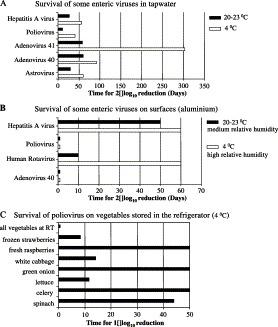
Several groups of viruses may infect persons after ingestion and then are shed via stool. Of these, the norovirus (NoV) and hepatitis A virus (HAV) are currently recognised as the most important human foodborne pathogens with regard to the number of outbreaks and people affected in the Western world. NoV and HAV are highly infectious and may lead to widespread outbreaks. The clinical manifestation of NoV infection, however, is relatively mild. Asymptomatic infections are common and may contribute to the spread of the infection. Introduction of NoV in a community or population (a seeding event) may be followed by additional spread because of the highly infectious nature of NoV, resulting in a great number of secondary infections (50% of contacts). Hepatitis A is an increasing problem because of the decrease in immunity of populations in countries with high standards of hygiene. Molecular-based methods can detect viruses in shellfish but are not yet available for other foods. The applicability of the methods currently available for monitoring foods for viral contamination is unknown. No consistent correlation has been found between the presence of indicator microorganisms (i.e. bacteriophages, E. coli) and viruses. NoV and HAV are highly infectious and exhibit variable levels of resistance to heat and disinfection agents. However, they are both inactivated at 100 degrees C. No validated model virus or model system is available for studies of inactivation of NoV, although investigations could make use of structurally similar viruses (i.e. canine and feline caliciviruses). In the absence of a model virus or model system, food safety guidelines need to be based on studies that have been performed with the most resistant enteric RNA viruses (i.e. HAV, for which a model system does exist) and also with bacteriophages (for water). Most documented foodborne viral outbreaks can be traced to food that has been manually handled by an infected foodhandler, rather than to industrially processed foods. The viral contamination of food can occur anywhere in the process from farm to fork, but most foodborne viral infections can be traced back to infected persons who handle food that is not heated or otherwise treated afterwards. Therefore, emphasis should be on stringent personal hygiene during preparation. If viruses are present in food preprocessing, residual viral infectivity may be present after some industrial processes. Therefore, it is key that sufficient attention be given to good agriculture practice (GAP) and good manufacturing practice (GMP) to avoid introduction of viruses onto the raw material and into the food-manufacturing environment, and to HACCP to assure adequate management of (control over) viruses present during the manufacturing process. If viruses are present in foods after processing, they remain infectious in most circumstances and in most foods for several days or weeks, especially if kept cooled (at 4 degrees C). Therefore, emphasis should be on stringent personal hygiene during preparation. For the control of foodborne viral infections, it is necessary to: Heighten awareness about the presence and spread of these viruses by foodhandlers; Optimise and standardise methods for the detection of foodborne viruses; Develop laboratory-based surveillance to detect large, common-source outbreaks at an early stage; and Emphasise consideration of viruses in setting up food safety quality control and management systems (GHP, GMP, HACCP).
几类病毒在被人摄入后可能会感染人体,然后通过粪便排出。其中,就西方世界的疫情爆发数量和受影响人数而言,诺如病毒(NoV)和甲型肝炎病毒(HAV)目前被认为是最重要的人类食源性病原体。诺如病毒和甲型肝炎病毒具有高度传染性,可能导致广泛的疫情爆发。然而,诺如病毒感染的临床表现相对较轻。无症状感染很常见,可能会促使感染传播。由于诺如病毒具有高度传染性,在社区或人群中引入诺如病毒(一次播散事件)后可能会出现进一步传播,从而导致大量继发感染(50%的接触者感染)。由于卫生标准较高国家的人群免疫力下降,甲型肝炎问题日益严重。基于分子的方法可以检测贝类中的病毒,但尚未应用于其他食品。目前可用于监测食品病毒污染的方法的适用性尚不清楚。在指示微生物(即噬菌体、大肠杆菌)的存在与病毒之间未发现一致的相关性。诺如病毒和甲型肝炎病毒具有高度传染性,并且对热和消毒剂表现出不同程度的抗性。然而,它们在100摄氏度时均会失活。虽然研究可以利用结构相似的病毒(即犬猫杯状病毒),但目前尚无经过验证的模型病毒或模型系统可用于诺如病毒灭活研究。在没有模型病毒或模型系统的情况下,食品安全指南需要基于对最具抗性的肠道RNA病毒(即存在模型系统的甲型肝炎病毒)以及噬菌体(用于水)所进行的研究。大多数有记录的食源性病毒疫情可追溯到受感染的食品处理人员手工处理过的食品,而非工业加工食品。食品的病毒污染可能发生在从农场到餐桌的任何环节,但大多数食源性病毒感染可追溯到处理未加热或之后未进行其他处理的食品的感染者。因此,重点应放在制备过程中的严格个人卫生上。如果在食品预处理过程中存在病毒,经过一些工业加工后可能仍会残留病毒感染性。因此,关键是要充分重视良好农业规范(GAP)和良好生产规范(GMP),以避免将病毒引入原材料和食品生产环境,并重视危害分析与关键控制点(HACCP),以确保对生产过程中存在的病毒进行充分管理(控制)。如果在加工后的食品中存在病毒,在大多数情况下,它们在大多数食品中会在数天或数周内保持感染性, 特别是如果冷藏(4摄氏度)保存。因此,重点应放在制备过程中的严格个人卫生上。为了控制食源性病毒感染,有必要:提高食品处理人员对这些病毒的存在和传播的认识;优化和规范食源性病毒的检测方法;开展基于实验室的监测,以便在早期发现大规模的共同来源疫情;以及在建立食品安全质量控制和管理系统(GHP、GMP、HACCP)时强调对病毒的考量。
 Zotero 插件