
新生儿重症监护病房婴儿邻苯二甲酸酯暴露:单酯和氧化代谢产物的尿液浓度
Exposure to phthalates in neonatal intensive care unit infants: urinary concentrations of monoesters and oxidative metabolites.
作者信息
Weuve Jennifer, Sánchez Brisa N, Calafat Antonia M, Schettler Ted, Green Ronald A, Hu Howard, Hauser Russ
机构信息
Department of Environmental Health, Harvard School of Public Health, Boston, Massachusetts, USA.
出版信息
Environ Health Perspect. 2006 Sep;114(9):1424-31. doi: 10.1289/ehp.8926.
OBJECTIVE
We previously demonstrated that among 54 infants in neonatal intensive care units, exposure to polyvinyl chloride plastic medical devices containing the plasticizer di(2-ethylhexyl) phthalate (DEHP) is associated with urinary concentrations of mono(2-ethylhexyl) phthalate (MEHP) , a DEHP metabolite. In this follow-up report, we studied the neonates' exposure to DEHP-containing devices in relation to urinary concentrations of two other DEHP metabolites, and to urinary concentrations of metabolites of dibutyl phthalate (DBP) and benzylbutyl phthalate (BzBP) , phthalates found in construction materials and personal care products.
MEASUREMENTS
A priori, we classified the intensiveness of these 54 infants' exposure to DEHP-containing medical products. We measured three metabolites of DEHP in infants' urine: MEHP and two of its oxidative metabolites, mono(2-ethyl-5-hydroxylhexyl) phthalate (MEHHP) and mono(2-ethyl-5-oxohexyl) phthalate (MEOHP) . We also measured monobutyl phthalate (MBP) , a metabolite of DBP, and monobenzyl phthalate (MBzP), a metabolite of BzBP.
RESULTS
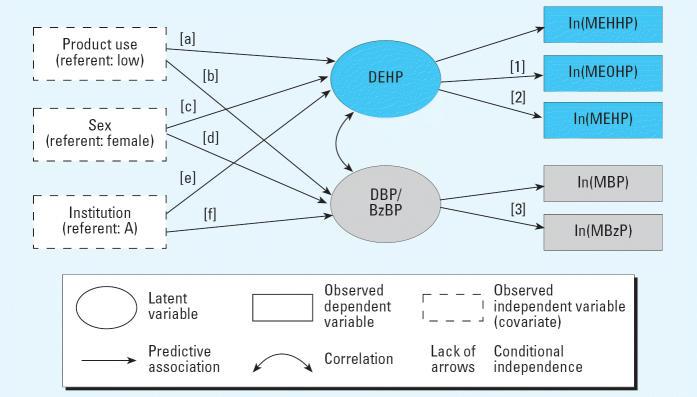
Intensiveness of DEHP-containing product use was monotonically associated with all three DEHP metabolites. Urinary concentrations of MEHHP and MEOHP among infants in the high-DEHP-intensiveness group were 13-14 times the concentrations among infants in the low-intensiveness group (p</= 0.007). Concentrations of MBP were somewhat higher in the medium- and high-DEHP-intensiveness group; MBzP did not vary by product use group. Incorporating all phthalate data into a structural equation model confirmed the specific monotonic association between intensiveness of product use and biologic measures of DEHP.
CONCLUSION
Inclusion of the oxidative metabolites MEHHP and MEOHP strengthened the association between intensiveness of product use and biologic indices of DEHP exposure over that observed with MEHP alone.
目的
我们之前证明,在新生儿重症监护病房的54名婴儿中,接触含有增塑剂邻苯二甲酸二(2-乙基己基)酯(DEHP)的聚氯乙烯塑料医疗设备与DEHP代谢物单(2-乙基己基)邻苯二甲酸酯(MEHP)的尿液浓度有关。在这份随访报告中,我们研究了新生儿接触含DEHP设备与另外两种DEHP代谢物的尿液浓度以及邻苯二甲酸二丁酯(DBP)和邻苯二甲酸苄基丁酯(BzBP)(在建筑材料和个人护理产品中发现的邻苯二甲酸盐)代谢物的尿液浓度之间的关系。
测量
我们预先对这54名婴儿接触含DEHP医疗产品的强度进行了分类。我们测量了婴儿尿液中DEHP的三种代谢物:MEHP及其两种氧化代谢物,单(2-乙基-5-羟基己基)邻苯二甲酸酯(MEHHP)和单(2-乙基-5-氧代己基)邻苯二甲酸酯(MEOHP)。我们还测量了DBP的代谢物单丁基邻苯二甲酸酯(MBP)和BzBP的代谢物单苄基邻苯二甲酸酯(MBzP)。
结果
含DEHP产品使用强度与所有三种DEHP代谢物呈单调相关。高DEHP强度组婴儿尿液中MEHHP和MEOHP的浓度是低强度组婴儿浓度的13 - 14倍(p≤0.007)。中、高DEHP强度组中MBP的浓度略高;MBzP在不同产品使用组之间没有差异。将所有邻苯二甲酸盐数据纳入结构方程模型证实了产品使用强度与DEHP生物学指标之间特定的单调关联。
结论
纳入氧化代谢物MEHHP和MEOHP后,产品使用强度与DEHP暴露生物学指标之间的关联比仅观察到MEHP时更强。
 Zotero 插件