
S0跨膜片段在BK通道电压依赖性门控中的作用。
A role for the S0 transmembrane segment in voltage-dependent gating of BK channels.
作者信息
Koval Olga M, Fan Yun, Rothberg Brad S
机构信息
Department of Physiology, University of Texas Health Science Center at San Antonio, TX 78229, USA.
出版信息
J Gen Physiol. 2007 Mar;129(3):209-20. doi: 10.1085/jgp.200609662. Epub 2007 Feb 12.
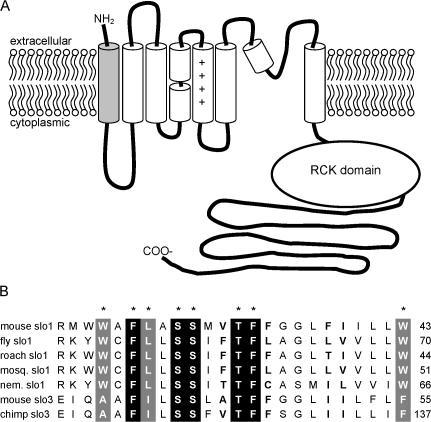
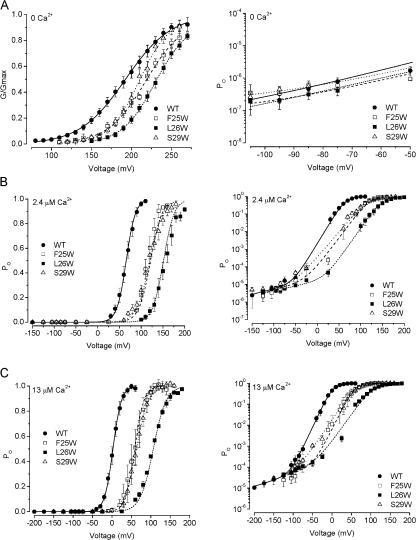
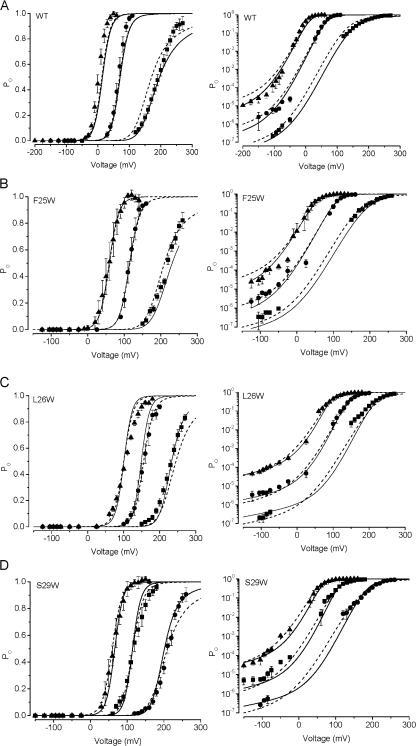
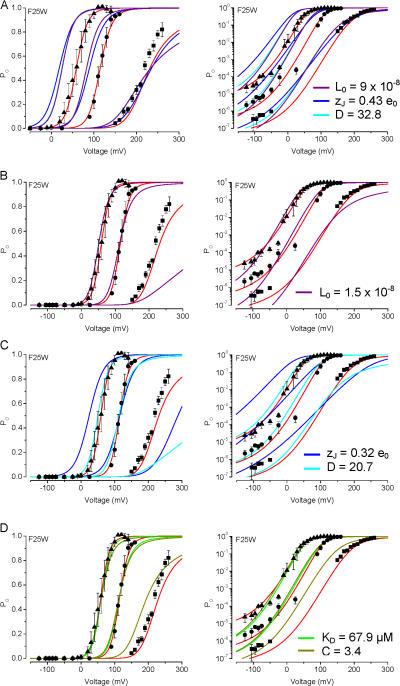
BK (Maxi-K) channel activity is allosterically regulated by a Ca2+ sensor, formed primarily by the channel's large cytoplasmic carboxyl tail segment, and a voltage sensor, formed by its transmembrane helices. As with other voltage-gated K channels, voltage sensing in the BK channel is accomplished through interactions of the S1-S4 transmembrane segments with the electric field. However, the BK channel is unique in that it contains an additional amino-terminal transmembrane segment, S0, which is important in the functional interaction between BK channel alpha and beta subunits. In this study, we used perturbation mutagenesis to analyze the role of S0 in channel gating. Single residues in the S0 region of the BK channel were substituted with tryptophan to give a large change in side chain volume; native tryptophans in S0 were substituted with alanine. The effects of the mutations on voltage- and Ca2+-dependent gating were quantified using patch-clamp electrophysiology. Three of the S0 mutants (F25W, L26W, and S29W) showed especially large shifts in their conductance-voltage (G-V) relations along the voltage axis compared to wild type. The G-V shifts for these mutants persisted at nominally 0 Ca2+, suggesting that these effects cannot arise simply from altered Ca2+ sensitivity. The basal open probabilities for these mutants at hyperpolarized voltages (where voltage sensor activation is minimal) were similar to wild type, suggesting that these mutations may primarily perturb voltage sensor function. Further analysis using the dual allosteric model for BK channel gating showed that the major effects of the F25W, L26W, and S29W mutations could be accounted for primarily by decreasing the equilibrium constant for voltage sensor movement. We conclude that S0 may make functional contact with other transmembrane regions of the BK channel to modulate the equilibrium between resting and active states of the channel's voltage sensor.
BK(大电导钙激活钾通道)通道活性受变构调节,其由主要由通道的大细胞质羧基末端片段形成的Ca2+传感器和由其跨膜螺旋形成的电压传感器介导。与其他电压门控钾通道一样,BK通道中的电压传感是通过S1 - S4跨膜片段与电场的相互作用来实现的。然而,BK通道的独特之处在于它包含一个额外的氨基末端跨膜片段S0,这在BK通道α亚基和β亚基之间的功能相互作用中很重要。在本研究中,我们使用扰动诱变来分析S0在通道门控中的作用。BK通道S0区域的单个残基被色氨酸取代,以使侧链体积发生较大变化;S0中的天然色氨酸被丙氨酸取代。使用膜片钳电生理学对突变对电压和Ca2+依赖性门控的影响进行了量化。与野生型相比,三个S0突变体(F25W、L26W和S29W)的电导 - 电压(G - V)关系沿电压轴显示出特别大的偏移。这些突变体的G - V偏移在名义上0 Ca2+时仍然存在,表明这些效应不能简单地由改变的Ca2+敏感性引起。这些突变体在超极化电压(电压传感器激活最小)下的基础开放概率与野生型相似,表明这些突变可能主要干扰电压传感器功能。使用BK通道门控的双变构模型进行的进一步分析表明,F25W、L26W和S29W突变的主要影响主要可以通过降低电压传感器移动的平衡常数来解释。我们得出结论,S0可能与BK通道的其他跨膜区域进行功能接触,以调节通道电压传感器的静息状态和激活状态之间的平衡。




 Zotero 插件