
使用泊洛沙姆生物膜模型评估用于医学的抗生素。
Evaluating antibiotics for use in medicine using a poloxamer biofilm model.
作者信息
Clutterbuck Abi L, Cochrane Christine A, Dolman Jayne, Percival Steven L
机构信息
University of Wales, Institute of Rural Studies, Aberystwyth, Ceredigion, Wales, SY23 3AL, UK.
出版信息
Ann Clin Microbiol Antimicrob. 2007 Feb 15;6:2. doi: 10.1186/1476-0711-6-2.
BACKGROUND
Wound infections, due to biofilms, are a constant problem because of their recalcitrant nature towards antibiotics. Appropriate antibiotic selection for the treatment of these biofilm infections is important. The traditional in vitro disc diffusion method for antibiotic selection uses bacterial cultures grown on agar plates. However, the form of bacterial growth on agar is not representative of how bacteria grow in wounds and other tissue sites as here bacteria grow naturally in a biofilm. The aim of this research was to test a more appropriate method for testing antimicrobial efficacy on biofilms and compare with the standard methods used for antibiotic sensitivity testing.
METHODS
Outer Membrane Protein analysis was performed on E.coli, Staphylococcus aureus, Pseudomonas aeruginosa, Proteus mirabilis and Acinetobacter juni when grown on Mueller Hinton agar ('quasi-biofilm state') and 30% Poloxamer hydrogel ('true- biofilm state). Susceptibility to antibiotics on 28 clinical isolates was determined using the modified Kirby Bauer disc diffusion method, on agar and 30% Poloxamer.
RESULTS
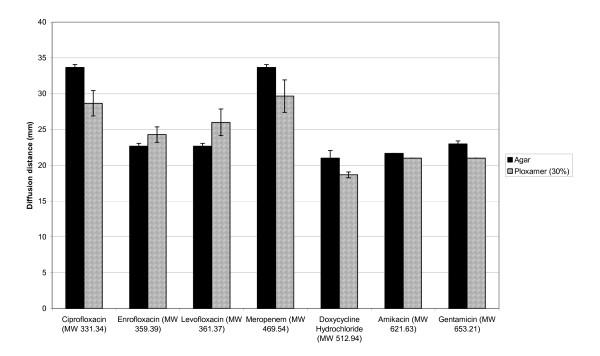
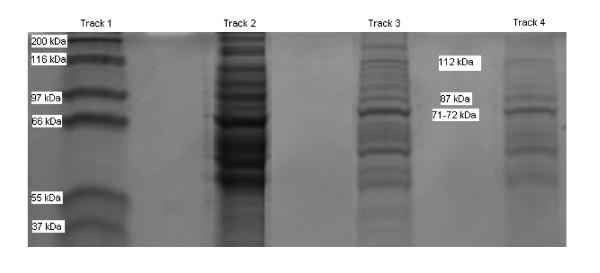
Similar outer membrane proteins [OMPs] were identified in bacteria grown in a biofilm state and on a 30% poloxamer hydrogel, which were very different to the OMPs identified in bacteria grown on Mueller-Hinton agar and broth. There was a significant difference between the means of the clearance zones around the antibiotic discs on standard agar and poloxamer gels [P < 0.05]. The zones of clearance were generally smaller for poloxamer-grown bacteria than those grown on standard agar. Diffusion distances of various antibiotics through agar and 30% poloxamer showed no significant difference [P > 0.05].
CONCLUSION
The findings of this experiment suggest that poloxamer gel could be used as an appropriate medium on which to conduct biofilm antibiotic susceptibility tests as it enables bacteria to be grown in a state representative of the infected surface from which the culture was taken.
背景
由于生物膜导致的伤口感染一直是个问题,因为它们对抗生素具有顽固的抗性。选择合适的抗生素来治疗这些生物膜感染很重要。传统的用于抗生素选择的体外纸片扩散法使用在琼脂平板上生长的细菌培养物。然而,琼脂上细菌的生长形式并不代表细菌在伤口和其他组织部位的生长方式,因为在这里细菌以生物膜的形式自然生长。本研究的目的是测试一种更合适的方法来测试生物膜上的抗菌效果,并与用于抗生素敏感性测试的标准方法进行比较。
方法
对在穆勒-欣顿琼脂(“准生物膜状态”)和30%泊洛沙姆水凝胶(“真生物膜状态”)上生长的大肠杆菌、金黄色葡萄球菌、铜绿假单胞菌、奇异变形杆菌和琼氏不动杆菌进行外膜蛋白分析。使用改良的 Kirby Bauer 纸片扩散法,在琼脂和30%泊洛沙姆上测定28株临床分离株对抗生素的敏感性。
结果
在生物膜状态和30%泊洛沙姆水凝胶上生长的细菌中鉴定出相似的外膜蛋白[OMPs],这与在穆勒-欣顿琼脂和肉汤上生长的细菌中鉴定出的OMPs有很大不同。标准琼脂和泊洛沙姆凝胶上抗生素纸片周围的抑菌圈直径平均值之间存在显著差异[P < 0.05]。泊洛沙姆上生长的细菌的抑菌圈通常比在标准琼脂上生长的细菌的抑菌圈小。各种抗生素在琼脂和30%泊洛沙姆中的扩散距离没有显著差异[P > 0.05]。
结论
本实验结果表明,泊洛沙姆凝胶可作为进行生物膜抗生素敏感性试验的合适培养基,因为它能使细菌在代表取自感染表面的培养物的状态下生长。
 Zotero 插件