
从长寿酵母菌株的表达谱推断转录修饰
Inference of transcription modification in long-live yeast strains from their expression profiles.
作者信息
Cheng Chao, Fabrizio Paola, Ge Huanying, Longo Valter D, Li Lei M
机构信息
Molecular and Computational biology program, Department of Biological Sciences, University of Southern California, Los Angeles, CA 90089-2910, USA.
出版信息
BMC Genomics. 2007 Jul 6;8:219. doi: 10.1186/1471-2164-8-219.
BACKGROUND
Three kinases: Sch9, PKA and TOR, are suggested to be involved in both the replicative and chronological ageing in yeast. They function in pathways whose down-regulation leads to life span extension. Several stress response proteins, including two transcription factors Msn2 and Msn4, mediate the longevity extension phenotype associated with decreased activity of either Sch9, PKA, or TOR. However, the mechanisms of longevity, especially the underlying transcription program have not been fully understood.
RESULTS
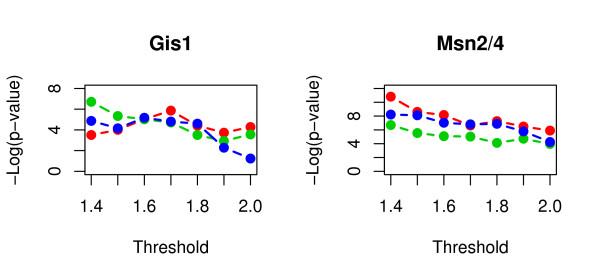
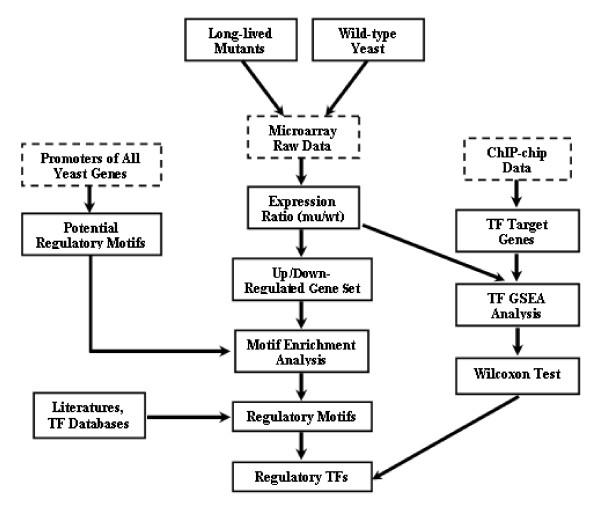
We measured the gene expression profiles in wild type yeast and three long-lived mutants: sch9Delta, ras2Delta, and tor1Delta. To elucidate the transcription program that may account for the longevity extension, we identified the transcription factors that are systematically and significantly associated with the expression differentiation in these mutants with respect to wild type by integrating microarray expression data with motif and ChIP-chip data, respectively. Our analysis suggests that three stress response transcription factors, Msn2, Msn4 and Gis1, are activated in all the three mutants. We also identify some other transcription factors such as Fhl1 and Hsf1, which may also be involved in the transcriptional modification in the long-lived mutants.
CONCLUSION
Combining microarray expression data with other data sources such as motif and ChIP-chip data provides biological insights into the transcription modification that leads to life span extension. In the chronologically long-lived mutant: sch9Delta, ras2Delta, and tor1Delta, several common stress response transcription factors are activated compared with the wild type according to our systematic transcription inference.
背景
三种激酶,即Sch9、PKA和TOR,被认为参与酵母的复制性衰老和时序性衰老过程。它们在一些通路中发挥作用,这些通路的下调会导致寿命延长。包括两个转录因子Msn2和Msn4在内的几种应激反应蛋白介导了与Sch9、PKA或TOR活性降低相关的寿命延长表型。然而,寿命延长的机制,尤其是潜在的转录程序尚未完全明确。
结果
我们测定了野生型酵母以及三个长寿突变体(sch9Delta、ras2Delta和tor1Delta)的基因表达谱。为了阐明可能导致寿命延长的转录程序,我们分别通过将微阵列表达数据与基序数据和染色质免疫沉淀芯片(ChIP-chip)数据相结合,鉴定了与这些突变体相对于野生型的表达分化有系统且显著关联的转录因子。我们的分析表明,三种应激反应转录因子Msn2、Msn4和Gis1在所有这三个突变体中均被激活。我们还鉴定了一些其他转录因子,如Fhl1和Hsf1,它们可能也参与了长寿突变体中的转录修饰。
结论
将微阵列表达数据与基序和ChIP-chip数据等其他数据源相结合,为导致寿命延长的转录修饰提供了生物学见解。根据我们的系统转录推断,在时序性长寿突变体sch9Delta、ras2Delta和tor1Delta中,与野生型相比,有几种常见的应激反应转录因子被激活。
 Zotero 插件