
新辅助治疗中使用来曲唑:P024试验
Letrozole in the neoadjuvant setting: the P024 trial.
作者信息
Ellis Matthew J, Ma Cynthia
机构信息
Medical Oncology, Washington University, Campus Box 8056, 660 Euclid Ave, St Louis, MO 63110, USA.
出版信息
Breast Cancer Res Treat. 2007;105 Suppl 1(Suppl 1):33-43. doi: 10.1007/s10549-007-9701-x. Epub 2007 Oct 3.
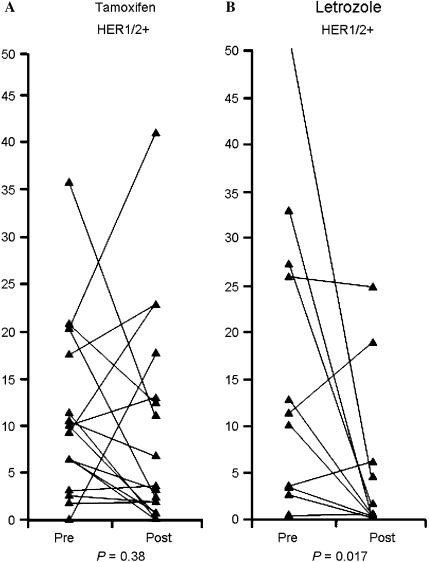
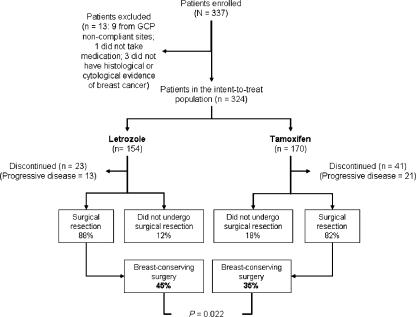
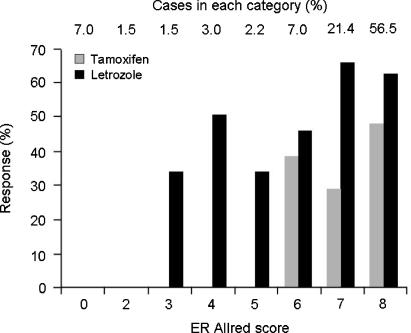
Neoadjuvant chemotherapy trials have consistently reported lower response rates in hormone receptor-positive (HR+) breast cancer when compared with HR- cases. Preoperative endocrine therapy has therefore become a logical alternative and has gained considerable momentum from the finding that aromatase inhibitors (AIs) are more effective than tamoxifen for HR+ breast cancer in both the neoadjuvant and adjuvant settings. The most convincing neoadjuvant trial to demonstrate the superiority of an AI versus tamoxifen was the P024 study, a large multinational double-blind trial in postmenopausal women with HR+ breast cancer ineligible for breast-conserving surgery. The overall response rate (ORR) was 55% for letrozole and 36% for tamoxifen (P<0.001). Significantly more letrozole-treated patients underwent breast-conserving surgery (45 vs. 35%, respectively; P=0.022). In addition, ORR was significantly higher with letrozole than tamoxifen in the human epidermal growth factor receptor HER1/HER2+ subgroup (P=0.0004). The clinical efficacy of letrozole in HER2+ breast cancer was confirmed by fluorescent in situ hybridization analysis and was found to be comparable to that of HER2- cases (ORR 71% in both subsets). Biomarker studies confirmed the superiority of letrozole in centrally assessed estrogen receptor-positive (ER+) tumors and found a strong relationship with the degree of ER positivity for both agents. Interestingly, letrozole was effective even in marginally ER+ tumors and, unlike tamoxifen, consistently reduced the expression from estrogen-regulated genes (progesterone receptor and trefoil factor 1). Furthermore, when analyzed by Ki67 immunohistochemistry, letrozole was significantly more effective than tamoxifen in reducing tumor proliferation (P=0.0009). Thus, neoadjuvant letrozole is safe and superior to tamoxifen in the treatment of postmenopausal women with HR+ locally advanced breast cancer.
新辅助化疗试验一直报告称,与激素受体阴性(HR-)的乳腺癌病例相比,激素受体阳性(HR+)的乳腺癌缓解率较低。因此,术前内分泌治疗成为一种合理的替代方案,并且由于发现芳香化酶抑制剂(AIs)在新辅助和辅助治疗中对HR+乳腺癌比他莫昔芬更有效,这一方案获得了相当大的推动力。证明AI优于他莫昔芬的最有说服力的新辅助试验是P024研究,这是一项针对不符合保乳手术条件的绝经后HR+乳腺癌女性的大型跨国双盲试验。来曲唑组的总缓解率(ORR)为55%,他莫昔芬组为36%(P<0.001)。接受来曲唑治疗的患者接受保乳手术的比例显著更高(分别为45%和35%;P=0.022)。此外,在人表皮生长因子受体HER1/HER2+亚组中,来曲唑的ORR显著高于他莫昔芬(P=0.0004)。荧光原位杂交分析证实了来曲唑在HER2+乳腺癌中的临床疗效,并且发现其与HER2-病例相当(两个亚组的ORR均为71%)。生物标志物研究证实了来曲唑在中心评估的雌激素受体阳性(ER+)肿瘤中的优越性,并发现两种药物与ER阳性程度都有很强的关系。有趣的是,来曲唑即使在边缘ER+肿瘤中也有效,并且与他莫昔芬不同,它持续降低雌激素调节基因(孕激素受体和三叶因子1)的表达。此外,通过Ki67免疫组织化学分析,来曲唑在降低肿瘤增殖方面比他莫昔芬显著更有效(P=0.0009)。因此,新辅助来曲唑在治疗绝经后HR+局部晚期乳腺癌方面安全且优于他莫昔芬。
 Zotero 插件