
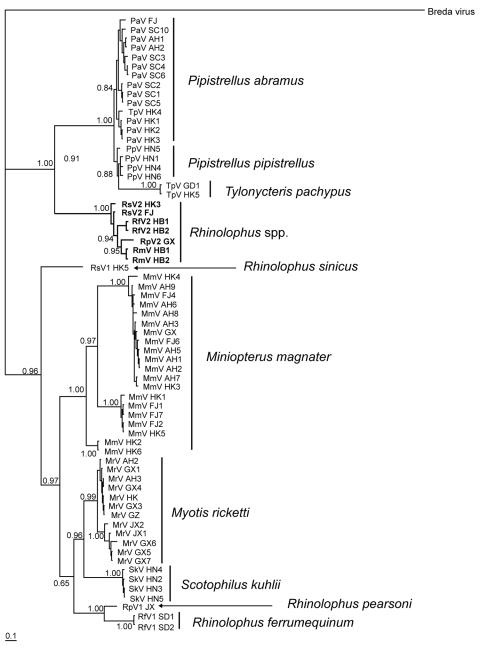
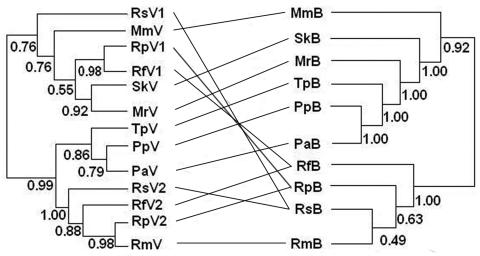
蝙蝠冠状病毒与其宿主之间的进化关系。
Evolutionary relationships between bat coronaviruses and their hosts.
作者信息
Cui Jie, Han Naijian, Streicker Daniel, Li Gang, Tang Xianchun, Shi Zhengli, Hu Zhihong, Zhao Guoping, Fontanet Arnaud, Guan Yi, Wang Linfa, Jones Gareth, Field Hume E, Daszak Peter, Zhang Shuyi
机构信息
East China Normal University, Shanghai, People's Republic of China.
出版信息
Emerg Infect Dis. 2007 Oct;13(10):1526-32. doi: 10.3201/eid1310.070448.
Recent studies have suggested that bats are the natural reservoir of a range of coronaviruses (CoVs), and that rhinolophid bats harbor viruses closely related to the severe acute respiratory syndrome (SARS) CoV, which caused an outbreak of respiratory illness in humans during 2002-2003. We examined the evolutionary relationships between bat CoVs and their hosts by using sequence data of the virus RNA-dependent RNA polymerase gene and the bat cytochrome b gene. Phylogenetic analyses showed multiple incongruent associations between the phylogenies of rhinolophid bats and their CoVs, which suggested that host shifts have occurred in the recent evolutionary history of this group. These shifts may be due to either virus biologic traits or host behavioral traits. This finding has implications for the emergence of SARS and for the potential future emergence of SARS-CoVs or related viruses.
最近的研究表明,蝙蝠是多种冠状病毒(CoV)的天然宿主,并且菊头蝠携带的病毒与严重急性呼吸综合征(SARS)冠状病毒密切相关,该病毒在2002年至2003年期间引发了人类呼吸道疾病的爆发。我们通过使用病毒RNA依赖性RNA聚合酶基因和蝙蝠细胞色素b基因的序列数据,研究了蝙蝠冠状病毒与其宿主之间的进化关系。系统发育分析显示,菊头蝠及其冠状病毒的系统发育之间存在多种不一致的关联,这表明在该类群的近期进化历史中发生了宿主转移。这些转移可能是由于病毒生物学特性或宿主行为特性所致。这一发现对SARS的出现以及未来SARS冠状病毒或相关病毒的潜在出现具有重要意义。


 Zotero 插件