
核苷酸生物合成对于细菌在人体血液中的生长至关重要。
Nucleotide biosynthesis is critical for growth of bacteria in human blood.
作者信息
Samant Shalaka, Lee Hyunwoo, Ghassemi Mahmood, Chen Juan, Cook James L, Mankin Alexander S, Neyfakh Alexander A
机构信息
Center for Pharmaceutical Biotechnology, University of Illinois at Chicago, Chicago, Illinois, United States of America.
出版信息
PLoS Pathog. 2008 Feb 8;4(2):e37. doi: 10.1371/journal.ppat.0040037.
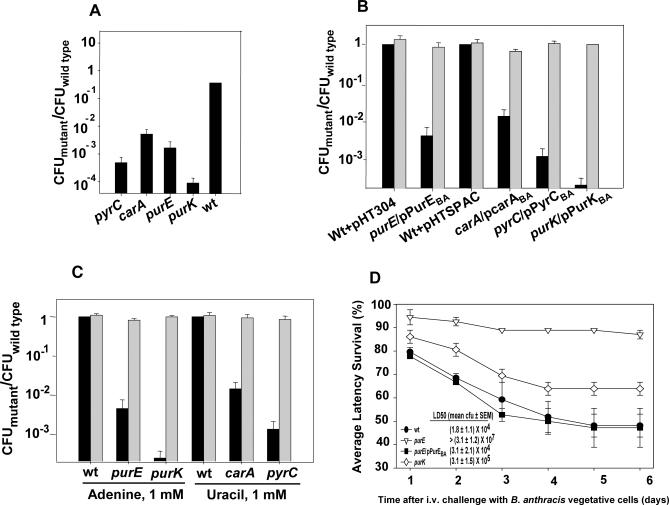
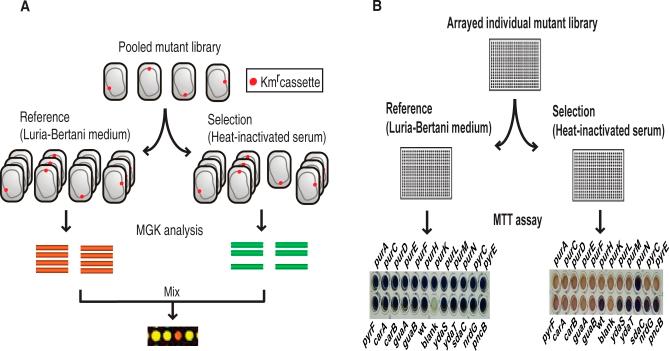
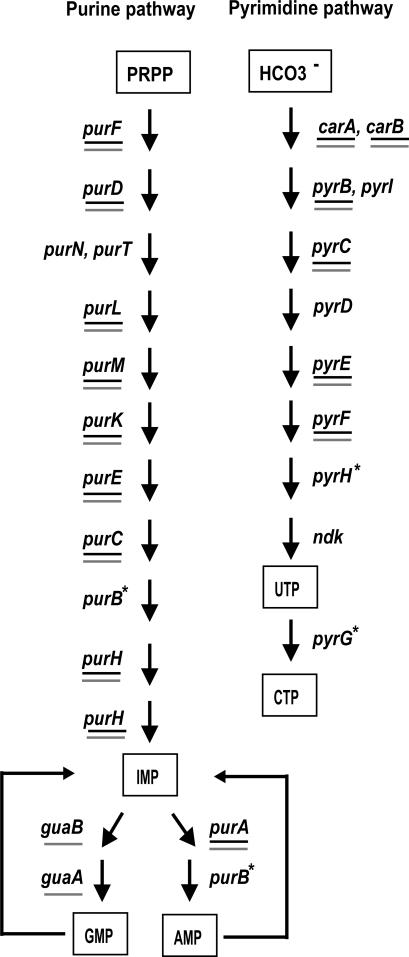
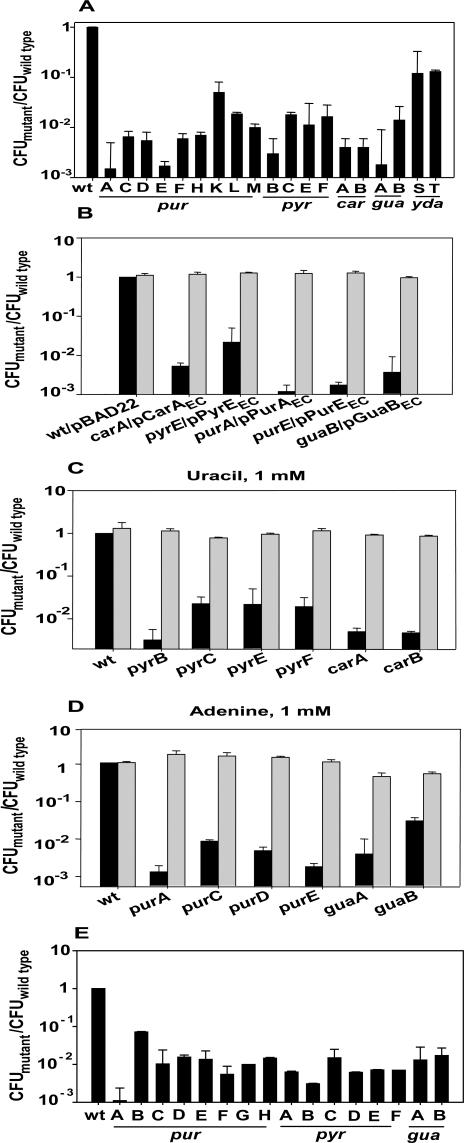
Proliferation of bacterial pathogens in blood represents one of the most dangerous stages of infection. Growth in blood serum depends on the ability of a pathogen to adjust metabolism to match the availability of nutrients. Although certain nutrients are scarce in blood and need to be de novo synthesized by proliferating bacteria, it is unclear which metabolic pathways are critical for bacterial growth in blood. In this study, we identified metabolic functions that are essential specifically for bacterial growth in the bloodstream. We used two principally different but complementing techniques to comprehensively identify genes that are required for the growth of Escherichia coli in human serum. A microarray-based and a dye-based mutant screening approach were independently used to screen a library of 3,985 single-gene deletion mutants in all non-essential genes of E. coli (Keio collection). A majority of the mutants identified consistently by both approaches carried a deletion of a gene involved in either the purine or pyrimidine nucleotide biosynthetic pathway and showed a 20- to 1,000-fold drop in viable cell counts as compared to wild-type E. coli after 24 h of growth in human serum. This suggests that the scarcity of nucleotide precursors, but not other nutrients, is the key limitation for bacterial growth in serum. Inactivation of nucleotide biosynthesis genes in another gram-negative pathogen, Salmonella enterica, and in the gram-positive pathogen Bacillus anthracis, prevented their growth in human serum. The growth of the mutants could be rescued by genetic complementation or by addition of appropriate nucleotide bases to human serum. Furthermore, the virulence of the B. anthracis purE mutant, defective in purine biosynthesis, was dramatically attenuated in a murine model of bacteremia. Our data indicate that de novo nucleotide biosynthesis represents the single most critical metabolic function for bacterial growth in blood and reveal the corresponding enzymes as putative antibiotic targets for the treatment of bloodstream infections.
血液中细菌病原体的增殖是感染最危险的阶段之一。病原体在血清中的生长取决于其调整新陈代谢以适应营养物质可用性的能力。尽管血液中某些营养物质稀缺,需要由增殖的细菌从头合成,但尚不清楚哪些代谢途径对细菌在血液中的生长至关重要。在本研究中,我们确定了对细菌在血流中生长至关重要的代谢功能。我们使用了两种主要不同但互补的技术来全面鉴定大肠杆菌在人血清中生长所需的基因。基于微阵列和基于染料的突变体筛选方法被独立用于筛选大肠杆菌所有非必需基因(Keio文库)中的3985个单基因缺失突变体文库。两种方法一致鉴定出的大多数突变体携带参与嘌呤或嘧啶核苷酸生物合成途径的基因缺失,并且在人血清中生长24小时后,与野生型大肠杆菌相比,活细胞计数下降了20至1000倍。这表明核苷酸前体的稀缺而非其他营养物质是血清中细菌生长的关键限制因素。另一种革兰氏阴性病原体肠炎沙门氏菌和革兰氏阳性病原体炭疽芽孢杆菌中核苷酸生物合成基因失活,阻止了它们在人血清中的生长。突变体的生长可以通过基因互补或向人血清中添加适当的核苷酸碱基来挽救。此外,嘌呤生物合成有缺陷的炭疽芽孢杆菌purE突变体在菌血症小鼠模型中的毒力显著减弱。我们的数据表明,从头核苷酸生物合成是细菌在血液中生长的唯一最关键的代谢功能,并揭示了相应的酶作为治疗血流感染的潜在抗生素靶点。
 Zotero 插件