
缺乏AI-2受体的基因组证据表明,luxS在大多数细菌中发挥非群体感应作用。
Lack of genomic evidence of AI-2 receptors suggests a non-quorum sensing role for luxS in most bacteria.
作者信息
Rezzonico Fabio, Duffy Brion
机构信息
Agroscope Changins-Wädenswil ACW, Division of Plant Protection, CH-8820 Wädenswil, Switzerland.
出版信息
BMC Microbiol. 2008 Sep 20;8:154. doi: 10.1186/1471-2180-8-154.
BACKGROUND
Great excitement accompanied discoveries over the last decade in several Gram-negative and Gram-positive bacteria of the LuxS protein, which catalyzes production of the AI-2 autoinducer molecule for a second quorum sensing system (QS-2). Since the luxS gene was found to be widespread among the most diverse bacterial taxa, it was hypothesized that AI-2 may constitute the basis of a universal microbial language, a kind of bacterial Esperanto. Many of the studies published in this field have drawn a direct correlation between the occurrence of the luxS gene in a given organism and the presence and functionality of a QS-2 therein. However, rarely hathe existence of potential AI-2 receptors been examined. This is important, since it is now well recognized that LuxS also holds a central role as a metabolic enzyme in the activated methyl cycle which is responsible for the generation of S-adenosyl-L-methionine, the major methyl donor in the cell.
RESULTS
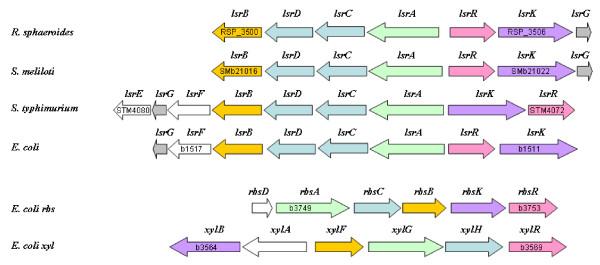
In order to assess whether the role of LuxS in these bacteria is indeed related to AI-2 mediated quorum sensing we analyzed genomic databases searching for established AI-2 receptors (i.e., LuxPQ-receptor of Vibrio harveyi and Lsr ABC-transporter of Salmonella typhimurium) and other presumed QS-related proteins and compared the outcome with published results about the role of QS-2 in these organisms. An unequivocal AI-2 related behavior was restricted primarily to organisms bearing known AI-2 receptor genes, while phenotypes of luxS mutant bacteria lacking these genes could often be explained simply by assuming deficiencies in sulfur metabolism.
CONCLUSION
Genomic analysis shows that while LuxPQ is restricted to Vibrionales, the Lsr-receptor complex is mainly present in pathogenic bacteria associated with endotherms. This suggests that QS-2 may play an important role in interactions with animal hosts. In most other species, however, the role of LuxS appears to be limited to metabolism, although in a few cases the presence of yet unknown receptors or the adaptation of pre-existent effectors to QS-2 must be postulated.
背景
在过去十年中,对几种革兰氏阴性菌和革兰氏阳性菌中LuxS蛋白的发现引发了极大的关注。LuxS蛋白催化生成AI-2自诱导分子,用于第二种群体感应系统(QS-2)。由于luxS基因在种类繁多的细菌类群中广泛存在,因此有人推测AI-2可能构成一种通用微生物语言的基础,一种细菌世界语。该领域发表的许多研究都直接关联了特定生物体中luxS基因的存在与其内部QS-2的存在及功能。然而,潜在AI-2受体的存在很少被研究。这很重要,因为现在人们已经充分认识到,LuxS在活化甲基循环中作为一种代谢酶也起着核心作用,该循环负责生成细胞中主要的甲基供体S-腺苷-L-甲硫氨酸。
结果
为了评估LuxS在这些细菌中的作用是否确实与AI-2介导的群体感应相关,我们分析了基因组数据库,寻找已确定的AI-2受体(即哈维氏弧菌的LuxPQ受体和鼠伤寒沙门氏菌的Lsr ABC转运蛋白)以及其他假定的与群体感应相关的蛋白质,并将结果与已发表的关于QS-2在这些生物体中作用的结果进行比较。明确的与AI-2相关的行为主要局限于携带已知AI-2受体基因的生物体,而缺乏这些基因的luxS突变细菌的表型通常可以简单地通过假设硫代谢缺陷来解释。
结论
基因组分析表明,虽然LuxPQ仅限于弧菌目,但Lsr受体复合物主要存在于与恒温动物相关的病原菌中。这表明QS-2可能在与动物宿主的相互作用中起重要作用。然而,在大多数其他物种中,LuxS的作用似乎仅限于代谢,尽管在少数情况下,必须假定存在未知受体或已存在的效应器适应了QS-2。

 Zotero 插件