
1型糖尿病的“完美风暴”:肠道微生物群、肠道通透性和黏膜免疫之间的复杂相互作用。
The "perfect storm" for type 1 diabetes: the complex interplay between intestinal microbiota, gut permeability, and mucosal immunity.
作者信息
Vaarala Outi, Atkinson Mark A, Neu Josef
机构信息
Laboratory for Immunobiology, Department of Viral Diseases and Immunology, National Public Health Institute, Helsinki, Finland.
出版信息
Diabetes. 2008 Oct;57(10):2555-62. doi: 10.2337/db08-0331.
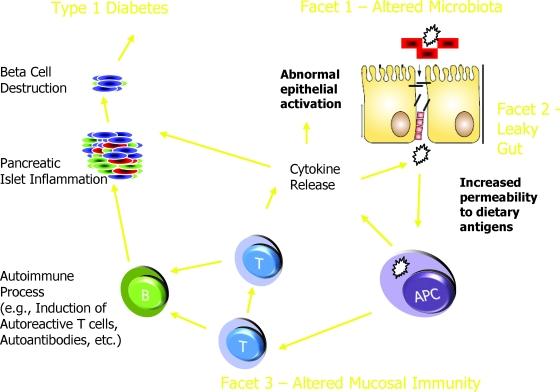
It is often stated that type 1 diabetes results from a complex interplay between varying degrees of genetic susceptibility and environmental factors. While agreeing with this principal, our desire is that this Perspectives article will highlight another complex interplay potentially associated with this disease involving facets related to the gut, one where individual factors that, upon their interaction with each another, form a "perfect storm" critical to the development of type 1 diabetes. This trio of factors includes an aberrant intestinal microbiota, a "leaky" intestinal mucosal barrier, and altered intestinal immune responsiveness. Studies examining the microecology of the gastrointestinal tract have identified specific microorganisms whose presence appears related (either quantitatively or qualitatively) to disease; in type 1 diabetes, a role for microflora in the pathogenesis of disease has recently been suggested. Increased intestinal permeability has also been observed in animal models of type 1 diabetes as well as in humans with or at increased-risk for the disease. Finally, an altered mucosal immune system has been associated with the disease and is likely a major contributor to the failure to form tolerance, resulting in the autoimmunity that underlies type 1 diabetes. Herein, we discuss the complex interplay between these factors and raise testable hypotheses that form a fertile area for future investigations as to the role of the gut in the pathogenesis and prevention of type 1 diabetes.
人们常说,1型糖尿病是由不同程度的遗传易感性和环境因素之间复杂的相互作用所致。虽然认同这一主要观点,但我们希望这篇观点文章能突出另一种可能与该疾病相关的复杂相互作用,涉及与肠道相关的多个方面,即个体因素相互作用时会形成一场对1型糖尿病发展至关重要的“完美风暴”。这三个因素包括异常的肠道微生物群、“渗漏”的肠道黏膜屏障和改变的肠道免疫反应性。研究胃肠道微生态的研究已经确定了某些特定微生物,其存在似乎与疾病有关(无论是在数量上还是质量上);在1型糖尿病中,最近有人提出微生物群在疾病发病机制中起作用。在1型糖尿病动物模型以及患有该疾病或有患病风险增加的人类中,也观察到肠道通透性增加。最后,黏膜免疫系统的改变与该疾病有关,并且可能是导致无法形成耐受性的主要因素,从而导致1型糖尿病所基于的自身免疫。在此,我们讨论这些因素之间的复杂相互作用,并提出可检验的假设,这些假设为未来研究肠道在1型糖尿病发病机制和预防中的作用提供了一个富有成果的领域。


 Zotero 插件