
UniHI 4:用于人类蛋白质-蛋白质相互作用组查询、分析和可视化的新工具。
UniHI 4: new tools for query, analysis and visualization of the human protein-protein interactome.
作者信息
Chaurasia Gautam, Malhotra Soniya, Russ Jenny, Schnoegl Sigrid, Hänig Christian, Wanker Erich E, Futschik Matthias E
机构信息
Institute for Theoretical Biology, Charité, Humboldt-University, Berlin, Germany.
出版信息
Nucleic Acids Res. 2009 Jan;37(Database issue):D657-60. doi: 10.1093/nar/gkn841. Epub 2008 Nov 4.
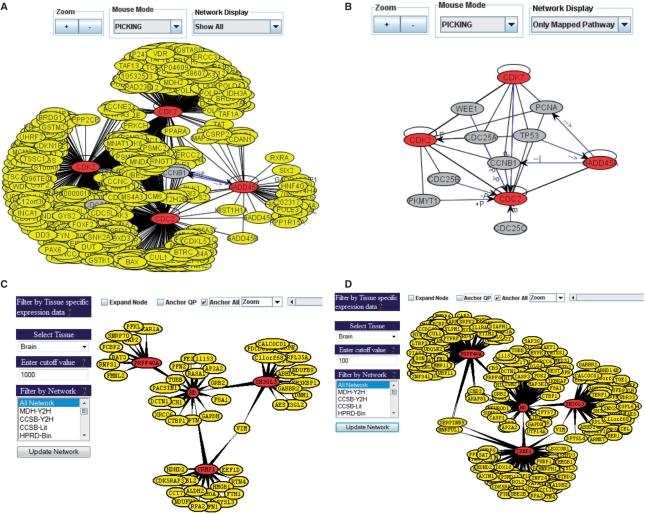
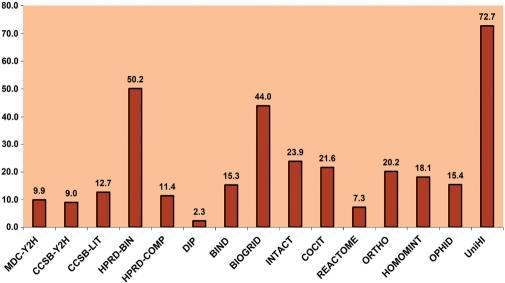
Human protein interaction maps have become important tools of biomedical research for the elucidation of molecular mechanisms and the identification of new modulators of disease processes. The Unified Human Interactome database (UniHI, http://www.unihi.org) provides researchers with a comprehensive platform to query and access human protein-protein interaction (PPI) data. Since its first release, UniHI has considerably increased in size. The latest update of UniHI includes over 250,000 interactions between approximately 22,300 unique proteins collected from 14 major PPI sources. However, this wealth of data also poses new challenges for researchers due to the complexity of interaction networks retrieved from the database. We therefore developed several new tools to query, analyze and visualize human PPI networks. Most importantly, UniHI allows now the construction of tissue-specific interaction networks and focused querying of canonical pathways. This will enable researchers to target their analysis and to prioritize candidate proteins for follow-up studies.
人类蛋白质相互作用图谱已成为生物医学研究的重要工具,用于阐明分子机制和识别疾病过程的新调节剂。统一人类相互作用组数据库(UniHI,http://www.unihi.org)为研究人员提供了一个查询和访问人类蛋白质-蛋白质相互作用(PPI)数据的综合平台。自首次发布以来,UniHI的规模大幅增加。UniHI的最新更新包括从14个主要PPI来源收集的约22,300种独特蛋白质之间的超过250,000种相互作用。然而,由于从数据库中检索到的相互作用网络的复杂性,这些丰富的数据也给研究人员带来了新挑战。因此,我们开发了几种新工具来查询、分析和可视化人类PPI网络。最重要的是,UniHI现在允许构建组织特异性相互作用网络并对经典途径进行重点查询。这将使研究人员能够针对他们的分析,并为后续研究确定候选蛋白质的优先级。
 Zotero 插件