
不同纬度地区的日照与黑色素瘤风险:对5700例病例和7216例对照的汇总分析
Sun exposure and melanoma risk at different latitudes: a pooled analysis of 5700 cases and 7216 controls.
作者信息
Chang Yu-mei, Barrett Jennifer H, Bishop D Timothy, Armstrong Bruce K, Bataille Veronique, Bergman Wilma, Berwick Marianne, Bracci Paige M, Elwood J Mark, Ernstoff Marc S, Gallagher Richard P, Green Adèle C, Gruis Nelleke A, Holly Elizabeth A, Ingvar Christian, Kanetsky Peter A, Karagas Margaret R, Lee Tim K, Le Marchand Loïc, Mackie Rona M, Olsson Håkan, Østerlind Anne, Rebbeck Timothy R, Sasieni Peter, Siskind Victor, Swerdlow Anthony J, Titus-Ernstoff Linda, Zens Michael S, Newton-Bishop Julia A
机构信息
Section of Epidemiology and Biostatistics, Leeds Institute of Molecular Medicine, Leeds, UK.
出版信息
Int J Epidemiol. 2009 Jun;38(3):814-30. doi: 10.1093/ije/dyp166. Epub 2009 Apr 8.
BACKGROUND
Melanoma risk is related to sun exposure; we have investigated risk variation by tumour site and latitude.
METHODS
We performed a pooled analysis of 15 case-control studies (5700 melanoma cases and 7216 controls), correlating patterns of sun exposure, sunburn and solar keratoses (three studies) with melanoma risk. Pooled odds ratios (pORs) and 95% Bayesian confidence intervals (CIs) were estimated using Bayesian unconditional polytomous logistic random-coefficients models.
RESULTS
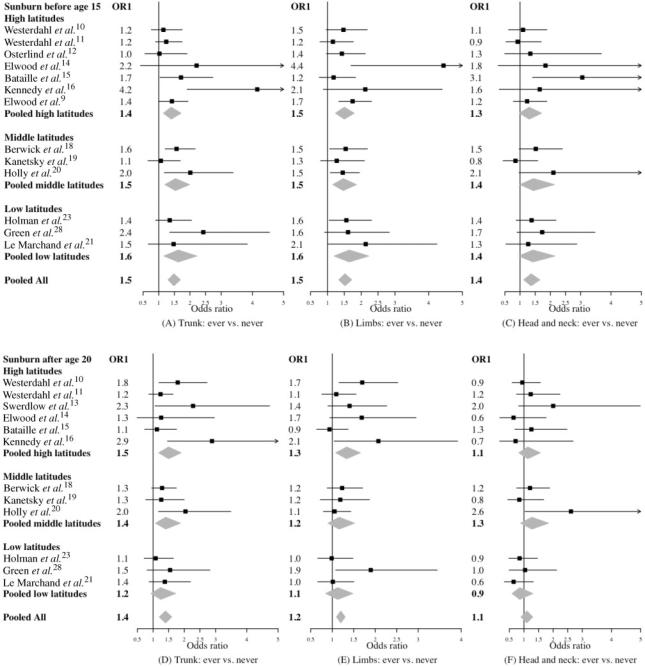
Recreational sun exposure was a risk factor for melanoma on the trunk (pOR = 1.7; 95% CI: 1.4-2.2) and limbs (pOR = 1.4; 95% CI: 1.1-1.7), but not head and neck (pOR = 1.1; 95% CI: 0.8-1.4), across latitudes. Occupational sun exposure was associated with risk of melanoma on the head and neck at low latitudes (pOR = 1.7; 95% CI: 1.0-3.0). Total sun exposure was associated with increased risk of melanoma on the limbs at low latitudes (pOR = 1.5; 95% CI: 1.0-2.2), but not at other body sites or other latitudes. The pORs for sunburn in childhood were 1.5 (95% CI: 1.3-1.7), 1.5 (95% CI: 1.3-1.7) and 1.4 (95% CI: 1.1-1.7) for melanoma on the trunk, limbs, and head and neck, respectively, showing little variation across latitudes. The presence of head and neck solar keratoses was associated with increased risk of melanoma on the head and neck (pOR = 4.0; 95% CI: 1.7-9.1) and limbs (pOR = 4.0; 95% CI: 1.9-8.4).
CONCLUSION
Melanoma risk at different body sites is associated with different amounts and patterns of sun exposure. Recreational sun exposure and sunburn are strong predictors of melanoma at all latitudes, whereas measures of occupational and total sun exposure appear to predict melanoma predominately at low latitudes.
背景
黑色素瘤风险与阳光暴露有关;我们研究了肿瘤部位和纬度对风险的影响。
方法
我们对15项病例对照研究(5700例黑色素瘤病例和7216例对照)进行了汇总分析,将阳光暴露、晒伤和日光性角化病模式(三项研究)与黑色素瘤风险相关联。使用贝叶斯无条件多分类逻辑随机系数模型估计汇总比值比(pOR)和95%贝叶斯置信区间(CI)。
结果
在各个纬度,娱乐性阳光暴露是躯干(pOR = 1.7;95% CI:1.4 - 2.2)和四肢(pOR = 1.4;95% CI:1.1 - 1.7)黑色素瘤的危险因素,但不是头颈部(pOR = 1.1;95% CI:0.8 - 1.4)。职业性阳光暴露与低纬度地区头颈部黑色素瘤风险相关(pOR = 1.7;95% CI:1.0 - 3.0)。总阳光暴露与低纬度地区四肢黑色素瘤风险增加相关(pOR = 1.5;95% CI:1.0 - 2.2),但在其他身体部位或其他纬度则不然。儿童期晒伤的pOR值在躯干、四肢和头颈部黑色素瘤中分别为1.5(95% CI:1.3 - 1.7)、1.5(95% CI:1.3 - 1.7)和1.4(95% CI:1.1 - 1.7),在各个纬度变化不大。头颈部日光性角化病的存在与头颈部(pOR = 4.0;95% CI:1.7 - 9.1)和四肢(pOR = 4.0;95% CI:1.9 - 8.4)黑色素瘤风险增加相关。
结论
不同身体部位的黑色素瘤风险与不同的阳光暴露量和模式有关。娱乐性阳光暴露和晒伤是所有纬度黑色素瘤的强预测因素,而职业性和总阳光暴露量似乎主要在低纬度地区预测黑色素瘤。


 Zotero 插件