
临床工作人员通过自动测量踝肱压力指数来诊断非糖尿病和糖尿病患者的外周动脉疾病。
Automated ankle-brachial pressure index measurement by clinical staff for peripheral arterial disease diagnosis in nondiabetic and diabetic patients.
作者信息
Clairotte Cécile, Retout Sylvie, Potier Louis, Roussel Ronan, Escoubet Brigitte
机构信息
Département de Physiologie-Explorations Fonctionnelles, Assistance Publique-Hôpitaux de Paris, Hôpital Bichat, Paris, France.
出版信息
Diabetes Care. 2009 Jul;32(7):1231-6. doi: 10.2337/dc08-2230. Epub 2009 Apr 14.
OBJECTIVE
Peripheral arterial disease (PAD) is a prognostic marker in cardiovascular disease. The use of Doppler-measured ankle-brachial pressure index (Dop-ABI) for PAD diagnosis is limited because of time, required training, and costs. We assessed automated oscillometric measurement of the ankle-brachial pressure index (Osc-ABI) by nurses and clinical staff.
RESEARCH DESIGN AND METHODS
Clinical staff obtained Osc-ABI with an automated oscillometric device in 146 patients (83 with diabetes) at the time of Dop-ABI measurement and ultrasound evaluation.
RESULTS
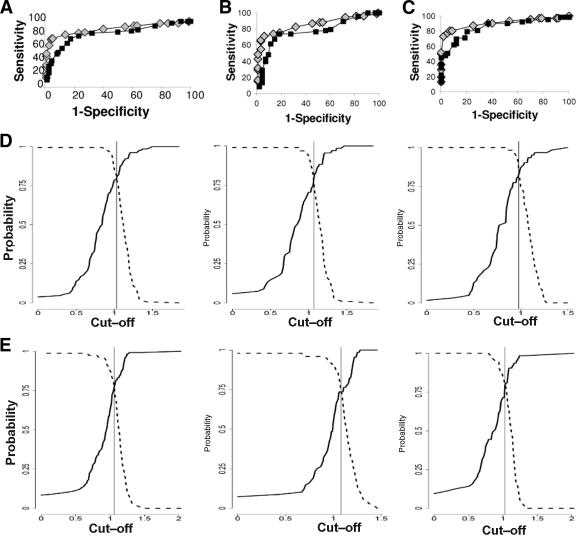
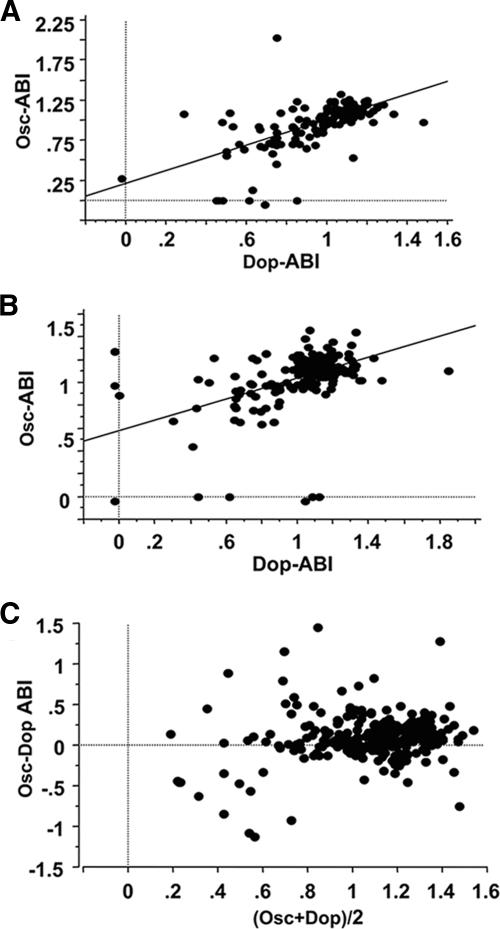
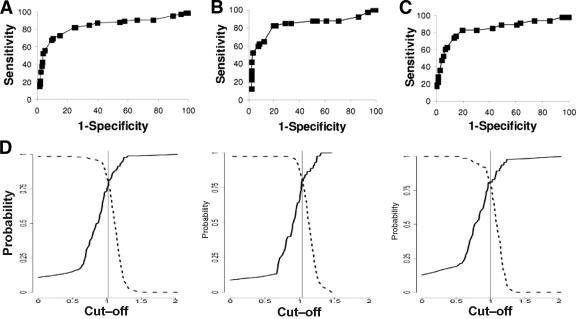
Measurements were obtained in most legs (Dop-ABI 98%; Osc-ABI 95.5%). Dop- and Osc-ABI were significantly related in diabetic and nondiabetic patients with good agreement over a wide range of values. When Dop-ABI <or=0.90 was used as the gold standard for PAD, receiver operating characteristic curve analysis showed that PAD was accurately diagnosed with Osc-ABI in diabetic patients. When ultrasound was used to define PAD, Dop-ABI had better diagnostic performance than Osc-ABI in the whole population and in diabetic patients (P = 0.026). Both methods gave similar results in nondiabetic patients. The cutoff values for the highest sensitivity and specificity for PAD screening were between 1.0 and 1.1. Estimation of cost with the French medical care system fees showed a potential reduction by three of the screening procedures.
CONCLUSIONS
PAD screening could be improved by using Osc-ABI measured by clinical staff with the benefit of greater cost-effectiveness but at the risk of lower diagnostic performance in diabetic patients.
目的
外周动脉疾病(PAD)是心血管疾病的一个预后标志物。由于时间、所需培训和成本等因素,使用多普勒测量的踝臂压力指数(Dop-ABI)来诊断PAD存在局限性。我们评估了护士和临床工作人员使用自动振荡法测量踝臂压力指数(Osc-ABI)的情况。
研究设计与方法
临床工作人员在对146例患者(83例患有糖尿病)进行Dop-ABI测量和超声评估时,使用自动振荡装置获取Osc-ABI。
结果
大多数下肢均获得了测量值(Dop-ABI为98%;Osc-ABI为95.5%)。在糖尿病患者和非糖尿病患者中,Dop-ABI与Osc-ABI显著相关,在广泛的数值范围内一致性良好。当将Dop-ABI≤0.90用作PAD的金标准时,受试者工作特征曲线分析表明,在糖尿病患者中,Osc-ABI能够准确诊断PAD。当使用超声来定义PAD时,在总体人群和糖尿病患者中,Dop-ABI的诊断性能优于Osc-ABI(P = 0.026)。两种方法在非糖尿病患者中得出的结果相似。PAD筛查的最高灵敏度和特异性的临界值在1.0至1.1之间。根据法国医疗保健系统费用估算成本显示,三种筛查程序可能会降低成本。
结论
使用临床工作人员测量的Osc-ABI进行PAD筛查可能会得到改善,其好处是具有更高的成本效益,但糖尿病患者存在诊断性能较低的风险。
 Zotero 插件