
使用自动示波和手持式多普勒设备通过踝臂指数测量评估建筑工人外周动脉疾病风险
Assessment of peripheral artery disease risk in building construction workers by Ankle-Brachial index measurement with automated oscillometric and hand-held Doppler device.
作者信息
Verma Manish K, Gangwar Vibha, Jasrotia Rajani B, John Nitin A
机构信息
Department of Physiology, Dr. Ram Manohar Lohia Institute of Medical Sciences, Gomti Nagar, Lucknow, Uttar Pradesh, India.
Department of Physiology, All India Institute of Medical Sciences, Bibinagar, Telengana, India.
出版信息
J Family Med Prim Care. 2022 Jan;11(1):139-143. doi: 10.4103/jfmpc.jfmpc_102_21. Epub 2022 Jan 31.
BACKGROUND
Peripheral arterial disease (PAD) remains underdiagnosed, partly because of the limitations of the Doppler ankle-brachial index (ABI) with regards to equipment, training, and time constraints.
AIMS
To compare the accuracy and validity of automated oscillometric ABI measurement in detecting PAD in primary care settings against a gold standard Doppler device.
SETTINGS AND DESIGN
A cross-sectional observational study was conducted at the physiology department, Dr. Ram Manohar Lohia Institute of Medical Sciences (DrRMLIMS), Lucknow.
METHODS AND MATERIAL
A total of 200 male building construction workers of all types of age groups between 20 and 40 years were recruited. The ABI measurement was performed using the Watch BP Office and hand-held HI.dop, BT-200 Vascular Doppler device.
STATISTICAL ANALYSIS USED
The Bland-Altman plot and receiver operator characteristics (ROC) curve were determined to analyze the agreement between the two methods. For the reliability of the test, Pearson's correlation with linear regression was done and the intraclass correlation (ICC) coefficient was calculated.
RESULTS
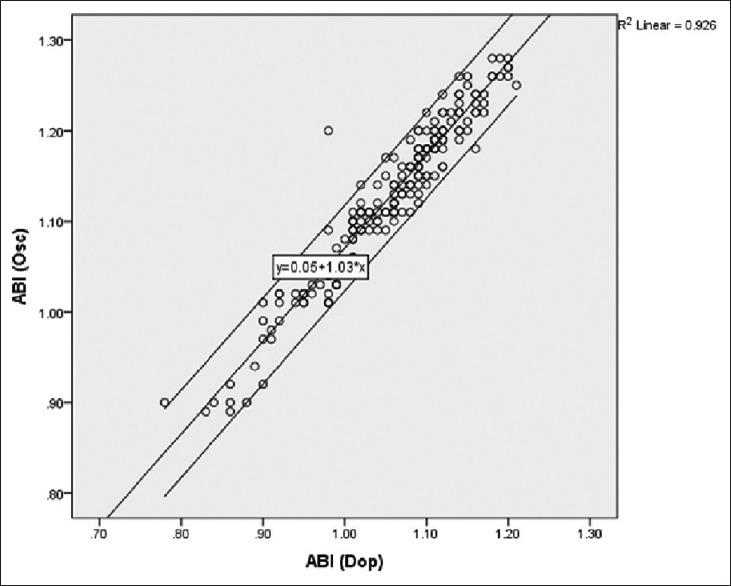
The mean ABI (Osc) and ABI (Dop) were 1.13 ± 0.09 and 1.06 ± 0.08, respectively. The ABI (Dop) and ABI (Osc) methods were highly correlated Pearson's correlation coefficient of 0.96 with 95% confidence interval (CI) ranges between 0.985 and 1.066 ( < 0.001). On linear regression analysis, the ABI (Dop) predicted ABI (Osc) 92.6% correctly. The paired mean difference between the two measuring devices was 0.07 (95% CI = -0.03 to -0.12). At 0.90 cut-off value of diagnosing PAD, the sensitivity is 50%, specificity 100%, positive predictive value 100%, and negative predictive value 97% by an oscillometric automated device.
CONCLUSION
Our finding suggested that ABI measurement by the automated oscillometric device is reliable, free of examiner bias, and less time-consuming.
背景
外周动脉疾病(PAD)的诊断率仍然较低,部分原因在于多普勒踝臂指数(ABI)在设备、培训和时间限制方面存在局限性。
目的
在初级保健环境中,将自动振荡式ABI测量检测PAD的准确性和有效性与金标准多普勒设备进行比较。
设置与设计
在勒克瑙的拉姆·马诺哈尔·洛希亚医学科学研究所(DrRMLIMS)生理科进行了一项横断面观察性研究。
方法与材料
共招募了200名年龄在20至40岁之间的各类男性建筑工人。使用Watch BP Office和手持式HI.dop、BT - 200血管多普勒设备进行ABI测量。
所用统计分析
采用Bland - Altman图和受试者工作特征(ROC)曲线来分析两种方法之间的一致性。为了检验的可靠性,进行了Pearson相关性与线性回归分析,并计算了组内相关系数(ICC)。
结果
平均振荡式ABI(Osc)和多普勒ABI(Dop)分别为1.13±0.09和1.06±0.08。ABI(Dop)和ABI(Osc)方法高度相关,Pearson相关系数为0.96,95%置信区间(CI)在0.985至1.066之间(<0.001)。在线性回归分析中,ABI(Dop)对ABI(Osc)的预测正确率为92.6%。两种测量设备的配对平均差异为0.07(95%CI = -0.03至 -0.12)。在诊断PAD的0.90临界值时,振荡式自动设备的灵敏度为50%,特异性为100%,阳性预测值为100%,阴性预测值为97%。
结论
我们的研究结果表明,自动振荡式设备测量ABI可靠,无检查者偏差,且耗时较少。


 Zotero 插件