
面部裂隙的遗传决定因素:利用来自斯堪的纳维亚半岛的两项全国性腭裂研究对357个候选基因进行分析。
Genetic determinants of facial clefting: analysis of 357 candidate genes using two national cleft studies from Scandinavia.
作者信息
Jugessur Astanand, Shi Min, Gjessing Håkon Kristian, Lie Rolv Terje, Wilcox Allen James, Weinberg Clarice Ring, Christensen Kaare, Boyles Abee Lowman, Daack-Hirsch Sandra, Trung Truc Nguyen, Bille Camilla, Lidral Andrew Carl, Murray Jeffrey Clark
机构信息
Craniofacial Development, Musculoskeletal Disorders, Murdoch Childrens Research Institute, Royal Children's Hospital, Parkville, Australia.
出版信息
PLoS One. 2009;4(4):e5385. doi: 10.1371/journal.pone.0005385. Epub 2009 Apr 29.
BACKGROUND
Facial clefts are common birth defects with a strong genetic component. To identify fetal genetic risk factors for clefting, 1536 SNPs in 357 candidate genes were genotyped in two population-based samples from Scandinavia (Norway: 562 case-parent and 592 control-parent triads; Denmark: 235 case-parent triads).
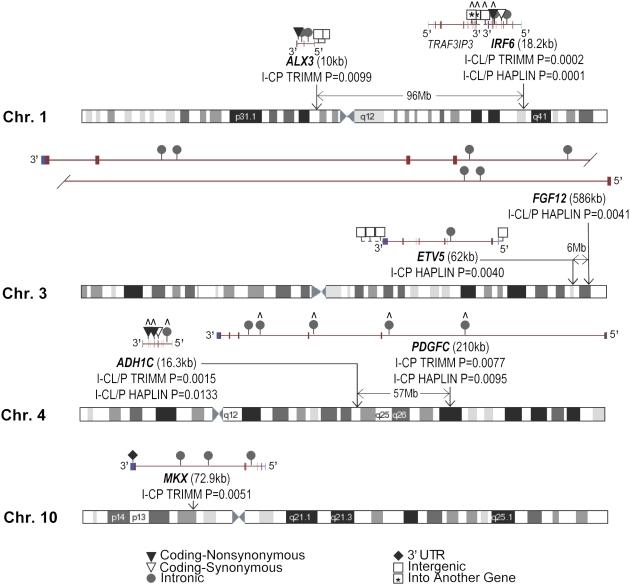
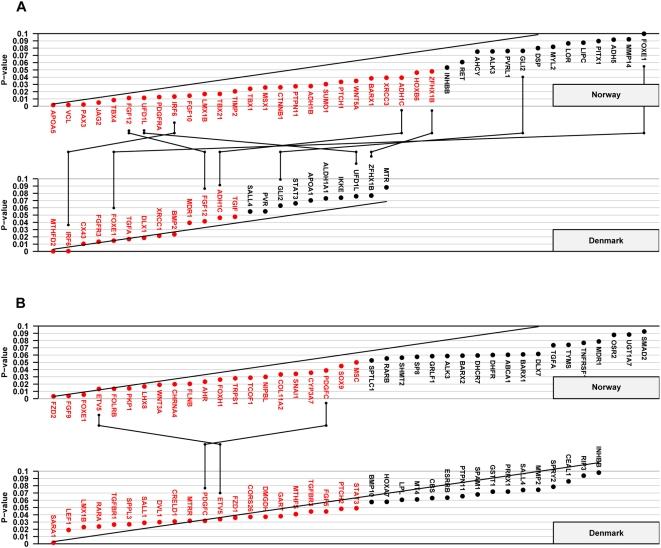
METHODOLOGY/PRINCIPAL FINDINGS: We used two complementary statistical methods, TRIMM and HAPLIN, to look for associations across these two national samples. TRIMM tests for association in each gene by using multi-SNP genotypes from case-parent triads directly without the need to infer haplotypes. HAPLIN on the other hand estimates the full haplotype distribution over a set of SNPs and estimates relative risks associated with each haplotype. For isolated cleft lip with or without cleft palate (I-CL/P), TRIMM and HAPLIN both identified significant associations with IRF6 and ADH1C in both populations, but only HAPLIN found an association with FGF12. For isolated cleft palate (I-CP), TRIMM found associations with ALX3, MKX, and PDGFC in both populations, but only the association with PDGFC was identified by HAPLIN. In addition, HAPLIN identified an association with ETV5 that was not detected by TRIMM.
CONCLUSION/SIGNIFICANCE: Strong associations with seven genes were replicated in the Scandinavian samples and our approach effectively replicated the strongest previously known association in clefting--with IRF6. Based on two national cleft cohorts of similar ancestry, two robust statistical methods and a large panel of SNPs in the most promising cleft candidate genes to date, this study identified a previously unknown association with clefting for ADH1C and provides additional candidates and analytic approaches to advance the field.
背景
面部裂隙是常见的出生缺陷,具有很强的遗传因素。为了确定胎儿发生裂隙的遗传风险因素,在来自斯堪的纳维亚半岛的两个基于人群的样本中,对357个候选基因中的1536个单核苷酸多态性(SNP)进行了基因分型(挪威:562个病例-父母和592个对照-父母三联体;丹麦:235个病例-父母三联体)。
方法/主要发现:我们使用了两种互补的统计方法,即TRIMM和HAPLIN,来在这两个国家样本中寻找关联。TRIMM通过直接使用病例-父母三联体的多SNP基因型来检测每个基因中的关联,无需推断单倍型。另一方面,HAPLIN估计一组SNP上的完整单倍型分布,并估计与每个单倍型相关的相对风险。对于单纯性唇裂伴或不伴腭裂(I-CL/P),TRIMM和HAPLIN在两个人群中均发现与IRF6和ADH1C存在显著关联,但只有HAPLIN发现与FGF12存在关联(在两个人群中)。对于单纯性腭裂(I-CP),TRIMM在两个人群中均发现与ALX3、MKX和PDGFC存在关联,但只有与PDGFC的关联被HAPLIN识别。此外,HAPLIN识别出与ETV5存在关联,而TRIMM未检测到。
结论/意义:在斯堪的纳维亚样本中重复发现了与七个基因的强关联,并且我们的方法有效地重复了先前已知的在裂隙形成中最强的关联——与IRF6的关联。基于两个具有相似血统的国家腭裂队列、两种稳健的统计方法以及迄今为止在最有希望的腭裂候选基因中的一大组SNP,本研究确定了ADH1C与腭裂的一种先前未知的关联,并提供了额外的候选基因和分析方法以推动该领域的发展。


 Zotero 插件