
亚洲和欧洲口面部裂隙三联体中X染色体亲本来源效应分析确定了与Xp22.2相关的关联及其他基因座。
Analysis of Parent-of-Origin Effects on the X Chromosome in Asian and European Orofacial Cleft Triads Identifies Associations with , and Additional Loci at Xp22.2.
作者信息
Skare Øivind, Lie Rolv T, Haaland Øystein A, Gjerdevik Miriam, Romanowska Julia, Gjessing Håkon K, Jugessur Astanand
机构信息
Department of Occupational Medicine and Epidemiology, National Institute of Occupational Health, Oslo, Norway.
Department of Global Public Health and Primary Care, University of Bergen, Bergen, Norway.
出版信息
Front Genet. 2018 Feb 22;9:25. doi: 10.3389/fgene.2018.00025. eCollection 2018.
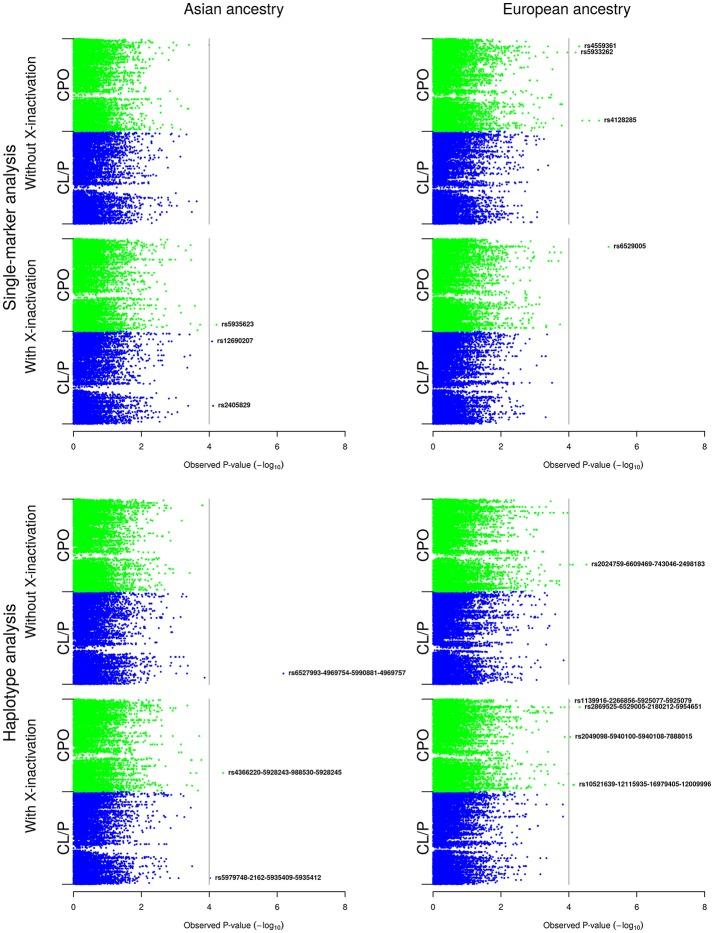
Although both the mother's and father's alleles are present in the offspring, they may not operate at the same level. These parent-of-origin (PoO) effects have not yet been explored on the X chromosome, which motivated us to develop new methods for detecting such effects. Orofacial clefts (OFCs) exhibit sex-specific differences in prevalence and are examples of traits where a search for various types of effects on the X chromosome might be relevant. We upgraded our R-package Haplin to enable genome-wide analyses of PoO effects, as well as power simulations for different statistical models. 14,486 X-chromosome SNPs in 1,291 Asian and 1,118 European case-parent triads of isolated OFCs were available from a previous GWAS. For each ethnicity, cleft lip with or without cleft palate (CL/P) and cleft palate only (CPO) were analyzed separately using two X-inactivation models and a sliding-window approach to haplotype analysis. In addition, we performed analyses restricted to female offspring. Associations were identified in "Dystrophin" (, Xp21.2-p21.1), "Fibroblast growth factor 13" (, Xq26.3-q27.1) and "EGF-like domain multiple 6" (, Xp22.2), with biologically plausible links to OFCs. Unlike , the other associations on chromosomal region Xp22.2 had no apparent connections to OFCs. However, the Xp22.2 region itself is of potential interest because it contains genes for clefting syndromes [for example, "Oral-facial-digital syndrome 1" () and "Midline 1" ()]. Overall, the identified associations were highly specific for ethnicity, cleft subtype and X-inactivation model, except for in which associations were identified in both CPO and CL/P, in the model with X-inactivation and in Europeans only. The specificity of the associations for ethnicity, cleft subtype and X-inactivation model underscores the utility of conducting subanalyses, despite the ensuing need to adjust for additional multiple testing. Further investigations are needed to confirm the associations with , and . Furthermore, chromosomal region Xp22.2 appears to be a hotspot for genes implicated in clefting syndromes and thus constitutes an exciting direction to pursue in future OFCs research. More generally, the new methods presented here are readily adaptable to the study of X-linked PoO effects in other outcomes that use a family-based design.
尽管后代中同时存在母亲和父亲的等位基因,但它们的作用水平可能不同。这些源自亲本(PoO)的效应在X染色体上尚未得到研究,这促使我们开发检测此类效应的新方法。口腔颌面部裂隙(OFCs)在患病率上存在性别差异,是寻找X染色体上各种效应可能相关的性状的例子。我们升级了R包Haplin,以实现对PoO效应的全基因组分析,以及针对不同统计模型的功效模拟。之前的一项全基因组关联研究(GWAS)提供了1291例亚洲和1118例欧洲孤立性OFC病例-亲本三联体中的14486个X染色体单核苷酸多态性(SNP)。对于每个种族,分别使用两种X染色体失活模型和一种单倍型分析的滑动窗口方法,对唇裂伴或不伴腭裂(CL/P)和仅腭裂(CPO)进行分析。此外,我们仅对女性后代进行了分析。在“肌营养不良蛋白”(位于Xp21.2-p21.1)、“成纤维细胞生长因子1十三”(位于Xq26.3-q27.1)和“EGF样结构域多重6”(位于Xp22.2)中发现了关联,这些关联与OFCs存在生物学上合理的联系。与其他情况不同,染色体区域Xp22.2上的其他关联与OFCs没有明显联系。然而,Xp22.2区域本身具有潜在的研究价值,因为它包含腭裂综合征的相关基因[例如,“口腔-面部-指综合征1”(相关基因)和“中线1”(相关基因)]。总体而言,除了在仅针对欧洲人的X染色体失活模型中,在CPO和CL/P中均发现关联的情况外,所确定的关联对种族、腭裂亚型和X染色体失活模型具有高度特异性。关联对种族、腭裂亚型和X染色体失活模型的特异性强调了进行亚组分析的实用性,尽管随之需要针对额外的多重检验进行调整。需要进一步研究来证实与相关基因以及相关基因的关联。此外,染色体区域Xp22.2似乎是与腭裂综合征相关基因的热点区域,因此构成了未来OFCs研究中一个令人兴奋的研究方向。更一般地说,本文提出的新方法很容易适用于使用基于家系设计的其他结果中X连锁PoO效应的研究。




 Zotero 插件