
用于步态训练的新型摆动辅助非机动外骨骼
Novel swing-assist un-motorized exoskeletons for gait training.
作者信息
Mankala Kalyan K, Banala Sai K, Agrawal Sunil K
机构信息
Department of Mechanical Engineering, University of Delaware, Newark, DE 19716, USA.
出版信息
J Neuroeng Rehabil. 2009 Jul 3;6:24. doi: 10.1186/1743-0003-6-24.
BACKGROUND
Robotics is emerging as a promising tool for functional training of human movement. Much of the research in this area over the last decade has focused on upper extremity orthotic devices. Some recent commercial designs proposed for the lower extremity are powered and expensive - hence, these could have limited affordability by most clinics. In this paper, we present a novel un-motorized bilateral exoskeleton that can be used to assist in treadmill training of motor-impaired patients, such as with motor-incomplete spinal cord injury. The exoskeleton is designed such that the human leg will have a desirable swing motion, once it is strapped to the exoskeleton. Since this exoskeleton is un-motorized, it can potentially be produced cheaply and could reduce the physical demand on therapists during treadmill training.
RESULTS
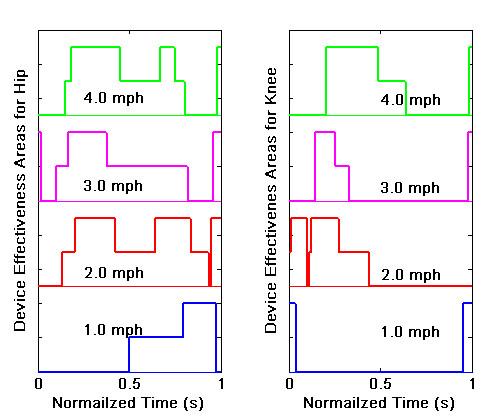
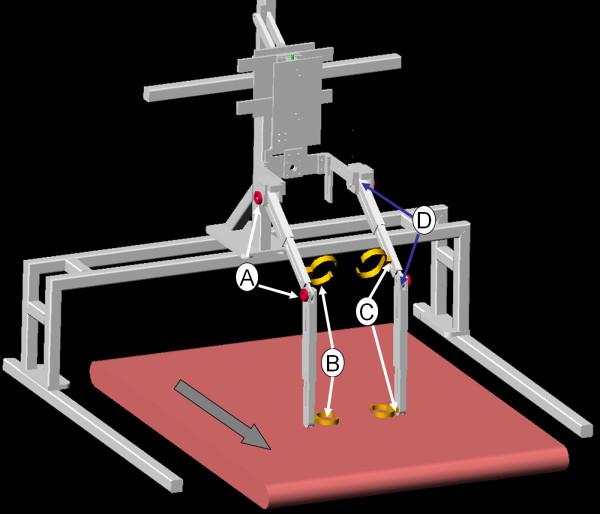
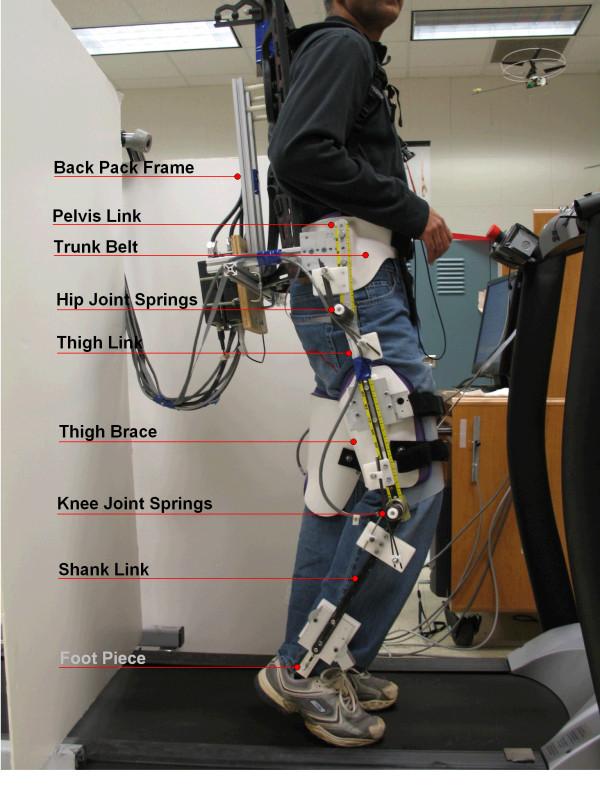
A swing-assist bilateral exoskeleton was designed and fabricated at the University of Delaware having the following salient features: (i) The design uses torsional springs at the hip and the knee joints to assist the swing motion. The springs get charged by the treadmill during stance phase of the leg and provide propulsion forces to the leg during swing. (ii) The design of the exoskeleton uses simple dynamic models of sagittal plane walking, which are used to optimize the parameters of the springs so that the foot can clear the ground and have a desirable forward motion during walking. The bilateral exoskeleton was tested on a healthy subject during treadmill walking for a range of walking speeds between 1.0 mph and 4.0 mph. Joint encoders and interface force-torque sensors mounted on the exoskeleton were used to evaluate the effectiveness of the exoskeleton in terms of the hip and knee joint torques applied by the human during treadmill walking.
CONCLUSION
We compared two different cases. In case 1, we estimated the torque applied by the human joints when walking with the device using the joint kinematic data and interface force-torque sensors. In case 2, we calculated the required torque to perform a similar gait only using the kinematic data collected from joint motion sensors. On analysis, we found that at 2.0 mph, the device was effective in reducing the maximum hip torque requirement and the knee joint torque during the beginning of the swing. These behaviors were retained as the treadmill speed was changed between 1-4 mph. These results were remarkable considering the simplicity of the dynamic model, model uncertainty, non-ideal spring behavior, and friction in the joints. We believe that the results can be further improved in the future. Nevertheless, this promises to provide a useful and effective methodology for design of un-motorized exoskeletons to assist and train swing of motor-impaired patients.
背景
机器人技术正成为一种用于人类运动功能训练的有前景的工具。过去十年该领域的许多研究都集中在上肢矫形器械上。最近一些针对下肢提出的商业设计是 powered 且昂贵的——因此,大多数诊所可能难以承受。在本文中,我们展示了一种新型的非电动双侧外骨骼,可用于协助运动功能受损患者进行跑步机训练,比如运动不完全性脊髓损伤患者。这种外骨骼的设计使得人类腿部一旦绑在上面就能有理想的摆动动作。由于这种外骨骼是非电动的,它有可能以低成本生产,并且可以减少跑步机训练期间治疗师的体力消耗。
结果
在特拉华大学设计并制造了一种摆动辅助双侧外骨骼,具有以下显著特点:(i)该设计在髋关节和膝关节处使用扭转弹簧来辅助摆动动作。弹簧在腿部站立阶段由跑步机充电,并在摆动阶段为腿部提供推进力。(ii)外骨骼的设计使用矢状面行走的简单动力学模型,用于优化弹簧参数,以便在行走过程中脚能离地并具有理想的向前运动。在跑步机上对一名健康受试者进行了双侧外骨骼测试,行走速度范围为 1.0 英里/小时至 4.0 英里/小时。安装在外骨骼上的关节编码器和界面力 - 扭矩传感器用于评估外骨骼在跑步机行走过程中对人类施加的髋关节和膝关节扭矩方面的有效性。
结论
我们比较了两种不同情况。在情况 1 中,我们使用关节运动学数据和界面力 - 扭矩传感器估计了使用该设备行走时人类关节施加的扭矩。在情况 2 中,我们仅使用从关节运动传感器收集的运动学数据计算执行类似步态所需的扭矩。经过分析,我们发现以 2.0 英里/小时的速度行走时,该设备在减少最大髋关节扭矩需求以及摆动开始时的膝关节扭矩方面是有效的。当跑步机速度在 1 - 4 英里/小时之间变化时,这些特性得以保持。考虑到动力学模型的简单性、模型不确定性、非理想弹簧行为以及关节中的摩擦力,这些结果是显著的。我们相信未来结果可以进一步改善。尽管如此,这有望为设计非电动外骨骼以协助和训练运动功能受损患者的摆动提供一种有用且有效的方法。




 Zotero 插件