
恶性疟原虫分离株中与玫瑰花结形成相关的PfEMP1-DBLα序列变异,这些分离株导致严重和非复杂性疟疾。
Sequence variation of PfEMP1-DBLalpha in association with rosette formation in Plasmodium falciparum isolates causing severe and uncomplicated malaria.
作者信息
Horata Natharinee, Kalambaheti Thareerat, Craig Alister, Khusmith Srisin
机构信息
Department of Microbiology and Immunology, Faculty of Tropical Medicine, Mahidol University, Bangkok, Thailand.
出版信息
Malar J. 2009 Aug 4;8:184. doi: 10.1186/1475-2875-8-184.
BACKGROUND
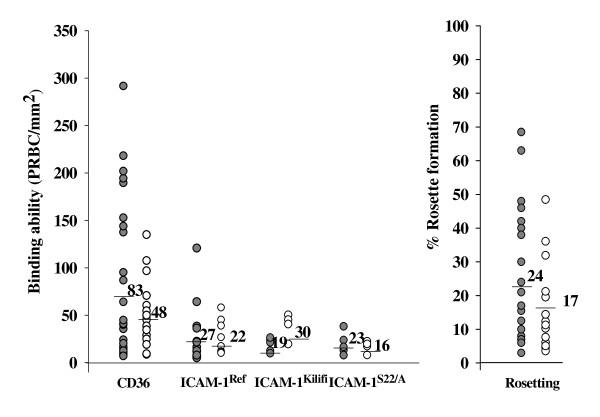
Rosetting and cytoadherence of Plasmodium falciparum-infected red blood cells have been associated with severity of malaria. ICAM-1 and CD36 are the main host cell receptors, while PfEMP1-DBLalpha is a major parasite ligand, which can contribute to rosette formation. This study is aimed at demonstrating whether the highly polymorphic PfEMP1-DBLalpha sequences occurring among Thai isolates causing severe and uncomplicated malaria are associated with their ability to form rosettes and reflected the clinical outcome of the patients.
METHODS
Two hundred and ninety five PfEMP1-DBLalpha sequences from Thai clinical isolates causing severe and uncomplicated malaria were evaluated by sequencing and direct comparison using the specific text string analysis functions in Microsoft Excel and Perl. The relationships between the PfEMP1-DBLalpha sequences were also analysed by network analysis. The binding abilities of parasitized red blood cells (PRBCs) to CD36, wild type ICAM-1, ICAM-1Kilifi and ICAM-1S22/A under static condition were included.
RESULTS
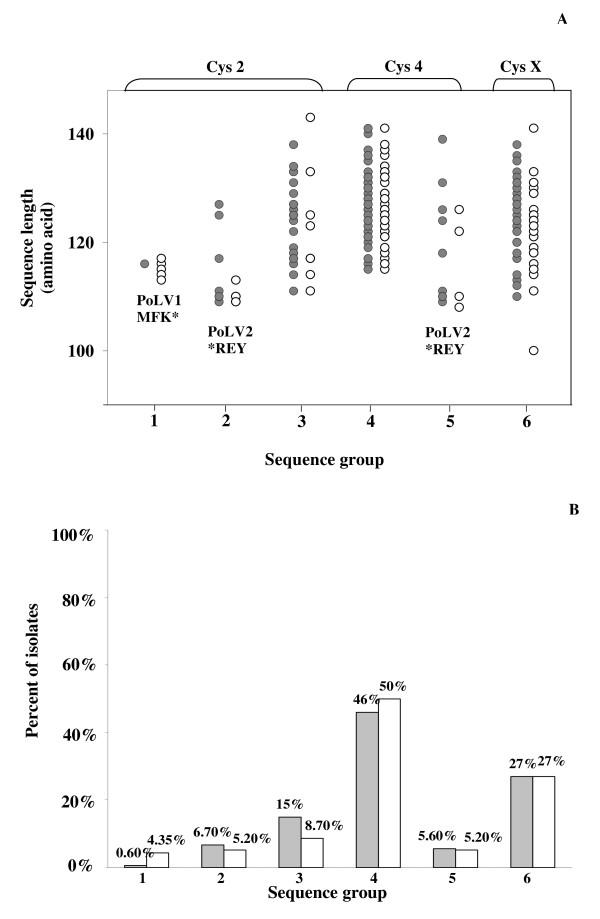
Two hundred and eighty one non-identical amino acid sequences were identified (< 95% sequence identity). When the distributions of semi-conserved features (PoLV1-4 and sequence group) within the rosetting domain PfEMP1-DBLalpha were observed, close similarity was found between isolates from the two disease groups. The sequence group 1 representing uncomplicated malaria was significantly different from the sequence group 3 representing the majority of severe malaria (p = 0.027). By using a simple non-phylogenetic approach to visualize the sharing of polymorphic blocks (position specific polymorphic block, PSPB) and cys/PoLV among DBLalpha sequences, the sequence group 1 was split from the other five sequence groups. The isolates belonging to sequence group 5 gave the highest mean rosetting rate (21.31%). However, within sequence group 2 and group 6, the isolates causing severe malaria had significantly higher rosetting rate than those causing uncomplicated malaria (p = 0.014, p = 0.007, respectively).
CONCLUSION
This is the first report of PfEMP1-DBLalpha analysis in clinical Thai isolates using semi-conserved features (cys/PoLV and PSPBs). The cys/PoLV group 5 gave the highest rosetting rate. PfEMP1-DBLalpha domains in Thai isolates are highly diverse, however, clinical isolates from severe and uncomplicated malaria shared common sequences.
背景
恶性疟原虫感染的红细胞的玫瑰花结形成和细胞黏附与疟疾的严重程度相关。细胞间黏附分子-1(ICAM-1)和CD36是主要的宿主细胞受体,而恶性疟原虫红细胞膜蛋白1(PfEMP1)的DBLα结构域是主要的寄生虫配体,可促进玫瑰花结的形成。本研究旨在证明,在泰国导致重症和非重症疟疾的分离株中出现的高度多态性的PfEMP1-DBLα序列,是否与其形成玫瑰花结的能力相关,并反映患者的临床结局。
方法
通过测序以及使用Microsoft Excel和Perl中的特定文本字符串分析功能进行直接比较,对来自泰国导致重症和非重症疟疾的临床分离株的295个PfEMP1-DBLα序列进行评估。还通过网络分析来分析PfEMP1-DBLα序列之间的关系。纳入了在静态条件下被寄生的红细胞(PRBCs)与CD36、野生型ICAM-1、基利菲ICAM-1和ICAM-1S22/A的结合能力。
结果
鉴定出281个不同的氨基酸序列(序列同一性<95%)。当观察玫瑰花结形成结构域PfEMP1-DBLα内半保守特征(PoLV1-4和序列组)的分布时,发现两个疾病组的分离株之间有密切的相似性。代表非重症疟疾的序列组1与代表大多数重症疟疾的序列组3有显著差异(p = 0.027)。通过使用一种简单的非系统发育方法来可视化多态性模块(位置特异性多态性模块,PSPB)和DBLα序列中的半胱氨酸/PoLV的共享情况,序列组1与其他五个序列组分开。属于序列组5的分离株的平均玫瑰花结形成率最高(21.31%)。然而,在序列组2和组6中,导致重症疟疾的分离株的玫瑰花结形成率显著高于导致非重症疟疾的分离株(分别为p = 0.014,p = 0.007)。
结论
这是首次使用半保守特征(半胱氨酸/PoLV和PSPBs)对泰国临床分离株中的PfEMP1-DBLα进行分析的报告。半胱氨酸/PoLV组5的玫瑰花结形成率最高。泰国分离株中的PfEMP1-DBLα结构域高度多样,然而,重症和非重症疟疾的临床分离株共享共同的序列。


 Zotero 插件