
论细胞与病毒的起源:原始病毒世界假说
On the origin of cells and viruses: primordial virus world scenario.
作者信息
Koonin Eugene V
机构信息
National Center for Biotechnology Information, National Library of Medicine, National Institutes of Health, Bethesda, MD 20894, USA.
出版信息
Ann N Y Acad Sci. 2009 Oct;1178(1):47-64. doi: 10.1111/j.1749-6632.2009.04992.x.
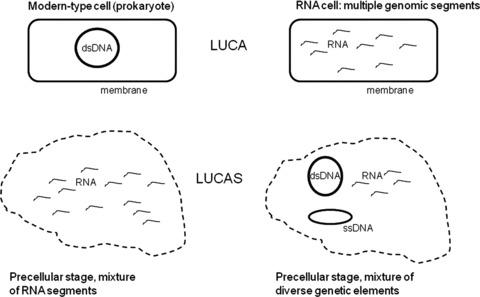
It is proposed that the precellular stage of biological evolution unraveled within networks of inorganic compartments that harbored a diverse mix of virus-like genetic elements. This stage of evolution might makes up the Last Universal Cellular Ancestor (LUCA) that more appropriately could be denoted Last Universal Cellular Ancestral State (LUCAS). Such a scenario recapitulates the ideas of J. B. S. Haldane sketched in his classic 1928 essay. However, unlike in Haldane's day, considerable support for this scenario exits today: lack of homology between core DNA replication system components in archaea and bacteria, distinct membrane chemistries and enzymes of lipid biosynthesis in archaea and bacteria, spread of several viral hallmark genes among diverse groups of viruses, and the extant archaeal and bacterial chromosomes appear to be shaped by accretion of diverse, smaller replicons. Under the viral model of precellular evolution, the key components of cells originated as components of virus-like entities. The two surviving types of cellular life forms, archaea and bacteria, might have emerged from the LUCAS independently, along with, probably, numerous forms now extinct.
有人提出,生物进化的细胞前阶段是在无机隔室网络中展开的,这些隔室中包含各种类似病毒的遗传元件。进化的这个阶段可能构成了最后的共同细胞祖先(LUCA),更恰当的说法可能是最后的共同细胞祖先状态(LUCAS)。这种情况概括了J. B. S. 霍尔丹在其1928年经典论文中勾勒的观点。然而,与霍尔丹时代不同的是,如今这种情况有相当多的支持证据:古菌和细菌的核心DNA复制系统组件之间缺乏同源性、古菌和细菌的膜化学和脂质生物合成酶不同、几种病毒标志性基因在不同病毒群体中的传播,以及现存的古菌和细菌染色体似乎是由不同的、较小的复制子积累形成的。在细胞前进化的病毒模型下,细胞的关键组件起源于类似病毒的实体组件。两种现存的细胞生命形式,即古菌和细菌,可能是从LUCAS独立出现的,可能还伴随着许多现已灭绝的形式。
 Zotero 插件