
通过自适应模糊逻辑方法揭示转录相互作用。
Uncovering transcriptional interactions via an adaptive fuzzy logic approach.
机构信息
Institute of Biomedical Engineering, National Taiwan University, Taipei, Taiwan.
出版信息
BMC Bioinformatics. 2009 Dec 6;10:400. doi: 10.1186/1471-2105-10-400.
BACKGROUND
To date, only a limited number of transcriptional regulatory interactions have been uncovered. In a pilot study integrating sequence data with microarray data, a position weight matrix (PWM) performed poorly in inferring transcriptional interactions (TIs), which represent physical interactions between transcription factors (TF) and upstream sequences of target genes. Inferring a TI means that the promoter sequence of a target is inferred to match the consensus sequence motifs of a potential TF, and their interaction type such as AT or RT is also predicted. Thus, a robust PWM (rPWM) was developed to search for consensus sequence motifs. In addition to rPWM, one feature extracted from ChIP-chip data was incorporated to identify potential TIs under specific conditions. An interaction type classifier was assembled to predict activation/repression of potential TIs using microarray data. This approach, combining an adaptive (learning) fuzzy inference system and an interaction type classifier to predict transcriptional regulatory networks, was named AdaFuzzy.
RESULTS
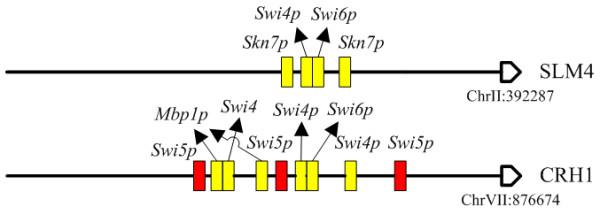
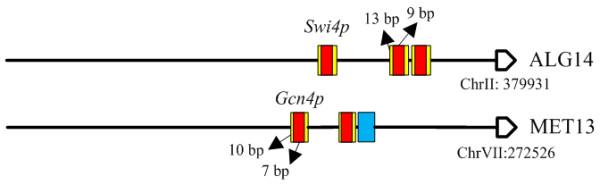
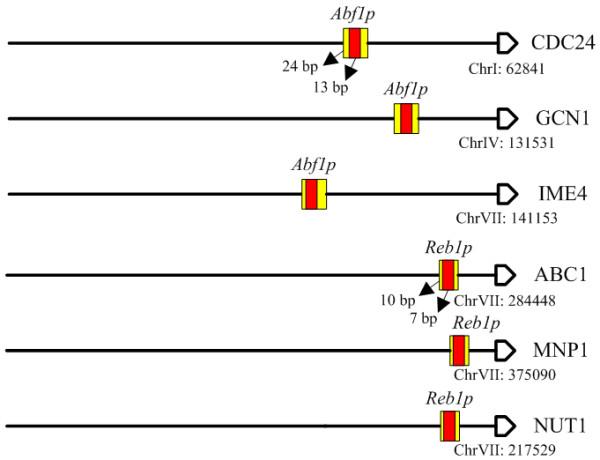
AdaFuzzy was applied to predict TIs using real genomics data from Saccharomyces cerevisiae. Following one of the latest advances in predicting TIs, constrained probabilistic sparse matrix factorization (cPSMF), and using 19 transcription factors (TFs), we compared AdaFuzzy to four well-known approaches using over-representation analysis and gene set enrichment analysis. AdaFuzzy outperformed these four algorithms. Furthermore, AdaFuzzy was shown to perform comparably to 'ChIP-experimental method' in inferring TIs identified by two sets of large scale ChIP-chip data, respectively. AdaFuzzy was also able to classify all predicted TIs into one or more of the four promoter architectures. The results coincided with known promoter architectures in yeast and provided insights into transcriptional regulatory mechanisms.
CONCLUSION
AdaFuzzy successfully integrates multiple types of data (sequence, ChIP, and microarray) to predict transcriptional regulatory networks. The validated success in the prediction results implies that AdaFuzzy can be applied to uncover TIs in yeast.
背景
迄今为止,仅发现了有限数量的转录调控相互作用。在一项整合序列数据和微阵列数据的初步研究中,位置权重矩阵 (PWM) 在推断转录相互作用 (TI) 方面表现不佳,TI 代表转录因子 (TF) 和靶基因上游序列之间的物理相互作用。推断 TI 意味着推断靶基因的启动子序列与潜在 TF 的共识序列基序匹配,并且还预测了它们的相互作用类型,如 AT 或 RT。因此,开发了稳健的 PWM (rPWM) 来搜索共识序列基序。除了 rPWM 之外,还从 ChIP-chip 数据中提取了一个特征,用于在特定条件下识别潜在的 TI。使用微阵列数据组装了一个相互作用类型分类器来预测潜在 TI 的激活/抑制。这种方法,结合自适应(学习)模糊推理系统和相互作用类型分类器来预测转录调控网络,被命名为 AdaFuzzy。
结果
AdaFuzzy 应用于使用酿酒酵母的真实基因组学数据预测 TI。在预测 TI 的最新进展之一——约束概率稀疏矩阵分解 (cPSMF) 之后,并且使用 19 个转录因子 (TF),我们使用过度表示分析和基因集富集分析将 AdaFuzzy 与四种知名方法进行了比较。AdaFuzzy 优于这四种算法。此外,AdaFuzzy 在推断由两组大规模 ChIP-chip 数据分别识别的 TI 方面,表现与“ChIP-实验方法”相当。AdaFuzzy 还能够将所有预测的 TI 分类为四种启动子结构之一或更多种。结果与酵母中的已知启动子结构一致,并提供了对转录调控机制的深入了解。
结论
AdaFuzzy 成功地整合了多种类型的数据(序列、ChIP 和微阵列)来预测转录调控网络。验证成功的预测结果表明,AdaFuzzy 可用于发现酵母中的 TI。


 Zotero 插件