
用于提高心肌水肿检测的 T2 定量
T2 quantification for improved detection of myocardial edema.
机构信息
Department of Biomedical Engineering, The Ohio State University, Columbus, Ohio, USA.
出版信息
J Cardiovasc Magn Reson. 2009 Dec 30;11(1):56. doi: 10.1186/1532-429X-11-56.
BACKGROUND
T2-Weighted (T2W) magnetic resonance imaging (MRI) pulse sequences have been used to detect edema in patients with acute myocardial infarction and differentiate acute from chronic infarction. T2W sequences have suffered from several problems including (i) signal intensity variability caused by phased array coils, (ii) high signal from slow moving ventricular chamber blood that can mimic and mask elevated T2 in sub-endocardial myocardium, (iii) motion artifacts, and (iv) the subjective nature of T2W image interpretation. In this work we demonstrate the advantages of a quantitative T2 mapping technique to accurately and reliably detect regions of edematous myocardial tissue without the limitations of qualitative T2W imaging.
METHODS
Methods of T2 mapping were evaluated on phantoms; the best of these protocols was then optimized for in vivo imaging. The optimized protocol was used to study the spatial, view-dependent, and inter-subject variability and motion sensitivity in healthy subjects. Using the insights gained from this, the utility of T2 mapping was demonstrated in a porcine model of acute myocardial infarction (AMI) and in three patients with AMI.
RESULTS
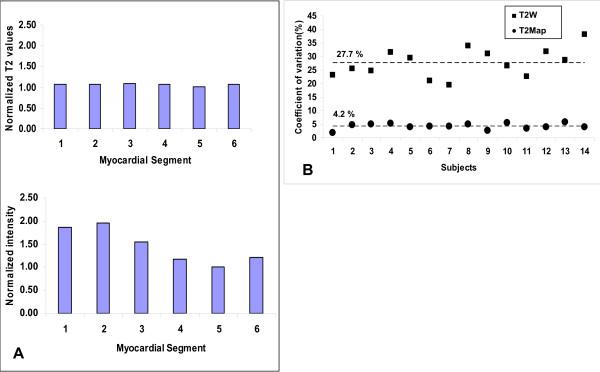
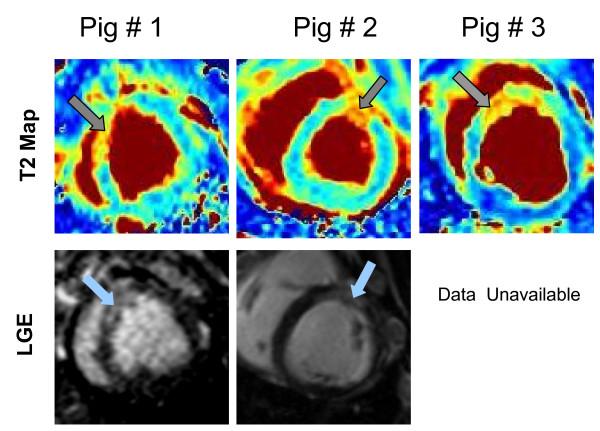
T2-prepared SSFP demonstrated greater accuracy in estimating the T2 of phantoms than multi-echo turbo spin echo. The T2 of human myocardium was found to be 52.18 +/- 3.4 ms (range: 48.96 ms to 55.67 ms), with variability between subjects unrelated to heart rate. Unlike T2W images, T2 maps did not show any signal variation due to the variable sensitivity of phased array coils and were insensitive to cardiac motion. In the three pigs and three patients with AMI, the T2 of the infarcted region was significantly higher than that of remote myocardium.
CONCLUSION
Quantitative T2 mapping addresses the well-known problems associated with T2W imaging of the heart and offers the potential for increased accuracy in the detection of myocardial edema.
背景
T2 加权(T2W)磁共振成像(MRI)脉冲序列已被用于检测急性心肌梗死患者的水肿,并区分急性和慢性梗死。T2W 序列存在一些问题,包括(i)相控阵线圈引起的信号强度变化,(ii)缓慢移动的心室腔血液的高信号,可模拟和掩盖心内膜下心肌的升高 T2,(iii)运动伪影,以及(iv)T2W 图像解释的主观性。在这项工作中,我们展示了定量 T2 映射技术的优势,该技术可准确可靠地检测水肿性心肌组织区域,而不会受到定性 T2W 成像的限制。
方法
在体模上评估了 T2 映射方法;然后对这些方案中的最佳方案进行了优化,以进行体内成像。优化后的方案用于研究健康受试者的空间、视图依赖性和个体间变异性以及运动敏感性。利用从这些研究中获得的见解,在急性心肌梗死(AMI)猪模型和 3 名 AMI 患者中展示了 T2 映射的实用性。
结果
T2 准备的 SSFP 比多回波涡轮自旋回波更准确地估计体模的 T2。人类心肌的 T2 被发现为 52.18 +/- 3.4 ms(范围:48.96 ms 至 55.67 ms),个体间的变异性与心率无关。与 T2W 图像不同,T2 图不显示由于相控阵线圈的可变灵敏度而导致的任何信号变化,并且对心脏运动不敏感。在 3 头猪和 3 名 AMI 患者中,梗死区的 T2 明显高于远隔心肌。
结论
定量 T2 映射解决了与心脏 T2W 成像相关的已知问题,并为提高心肌水肿检测的准确性提供了潜力。



 Zotero 插件