
大肠杆菌和酵母中蛋白质复合物的比较进化分析。
Comparative evolutionary analysis of protein complexes in E. coli and yeast.
机构信息
Research Department of Structural & Molecular Biology, University College London, London, WC1E 6BT, UK.
出版信息
BMC Genomics. 2010 Feb 1;11:79. doi: 10.1186/1471-2164-11-79.
BACKGROUND
Proteins do not act in isolation; they frequently act together in protein complexes to carry out concerted cellular functions. The evolution of complexes is poorly understood, especially in organisms other than yeast, where little experimental data has been available.
RESULTS
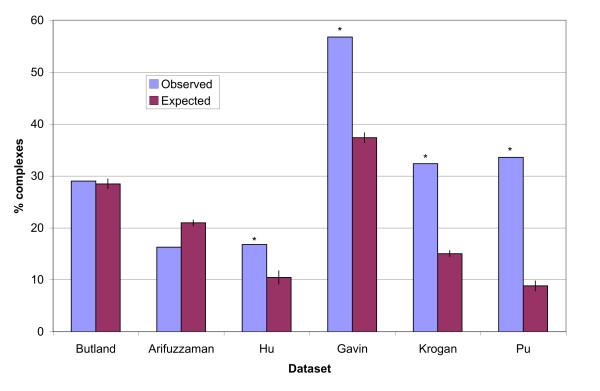
We generated accurate, high coverage datasets of protein complexes for E. coli and yeast in order to study differences in the evolution of complexes between these two species. We show that substantial differences exist in how complexes have evolved between these organisms. A previously proposed model of complex evolution identified complexes with cores of interacting homologues. We support findings of the relative importance of this mode of evolution in yeast, but find that it is much less common in E. coli. Additionally it is shown that those homologues which do cluster in complexes are involved in eukaryote-specific functions. Furthermore we identify correlated pairs of non-homologous domains which occur in multiple protein complexes. These were identified in both yeast and E. coli and we present evidence that these too may represent complex cores in yeast but not those of E. coli.
CONCLUSIONS
Our results suggest that there are differences in the way protein complexes have evolved in E. coli and yeast. Whereas some yeast complexes have evolved by recruiting paralogues, this is not apparent in E. coli. Furthermore, such complexes are involved in eukaryotic-specific functions. This implies that the increase in gene family sizes seen in eukaryotes in part reflects multiple family members being used within complexes. However, in general, in both E. coli and yeast, homologous domains are used in different complexes.
背景
蛋白质并非孤立地发挥作用;它们经常在蛋白质复合物中共同作用,以执行协同的细胞功能。复合物的进化还不太清楚,尤其是在除酵母以外的生物体中,那里几乎没有实验数据。
结果
为了研究这两个物种之间复合物进化的差异,我们为大肠杆菌和酵母生成了准确、高覆盖率的蛋白质复合物数据集。我们表明,这两个生物体之间的复合物进化存在显著差异。之前提出的复合物进化模型确定了具有相互作用同源物核心的复合物。我们支持该模型在酵母中的相对重要性的发现,但发现它在大肠杆菌中要少见得多。此外,还表明那些在复合物中聚类的同源物参与了真核生物特有的功能。此外,我们还鉴定了在多个蛋白质复合物中出现的相关非同源结构域对。这些在酵母和大肠杆菌中都有发现,我们提供的证据表明,这些在酵母中也可能代表复合物的核心,但在大肠杆菌中则不然。
结论
我们的结果表明,大肠杆菌和酵母中蛋白质复合物的进化方式存在差异。虽然一些酵母复合物是通过招募旁系同源物进化而来的,但在大肠杆菌中则不明显。此外,这样的复合物涉及真核生物特有的功能。这意味着真核生物中基因家族大小的增加部分反映了多个家族成员在复合物中被使用。然而,一般来说,在大肠杆菌和酵母中,同源结构域用于不同的复合物。


 Zotero 插件