
骨形态发生蛋白-2(BMP-2)独立于音猬因子(SHH)信号发挥作用,并触发再生蝾螈肢体中的细胞凝聚和凋亡。
BMP-2 functions independently of SHH signaling and triggers cell condensation and apoptosis in regenerating axolotl limbs.
作者信息
Guimond Jean-Charles, Lévesque Mathieu, Michaud Pierre-Luc, Berdugo Jérémie, Finnson Kenneth, Philip Anie, Roy Stéphane
机构信息
Department of Stomatology, Faculty of Dentistry, Université de Montréal, Montreal (QC) Canada.
出版信息
BMC Dev Biol. 2010 Feb 12;10:15. doi: 10.1186/1471-213X-10-15.
BACKGROUND
Axolotls have the unique ability, among vertebrates, to perfectly regenerate complex body parts, such as limbs, after amputation. In addition, axolotls pattern developing and regenerating autopods from the anterior to posterior axis instead of posterior to anterior like all tetrapods studied to date. Sonic hedgehog is important in establishing this anterior-posterior axis of limbs in all tetrapods including axolotls. Interestingly, its expression is conserved (to the posterior side of limb buds and blastemas) in axolotl limbs as in other tetrapods. It has been suggested that BMP-2 may be the secondary mediator of sonic hedgehog, although there is mounting evidence to the contrary in mice. Since BMP-2 expression is on the anterior portion of developing and regenerating limbs prior to digit patterning, opposite to the expression of sonic hedgehog, we examined whether BMP-2 expression was dependent on sonic hedgehog signaling and whether it affects patterning of the autopod during regeneration.
RESULTS
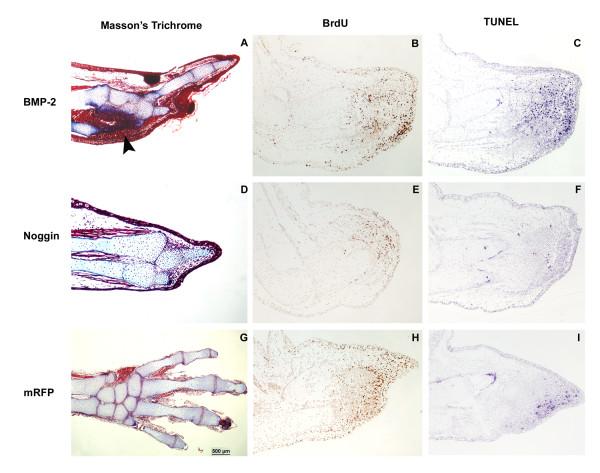
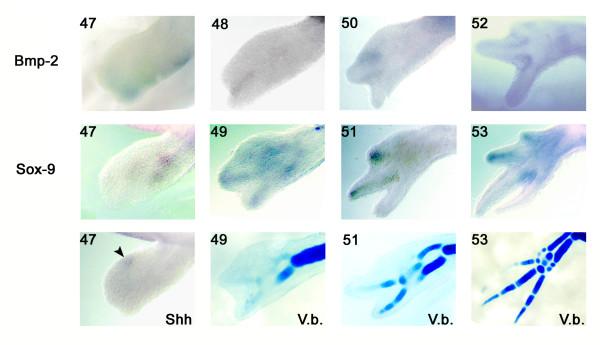
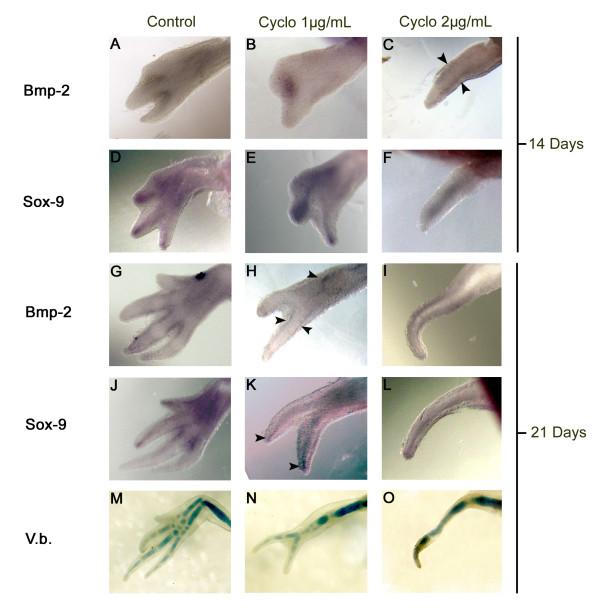
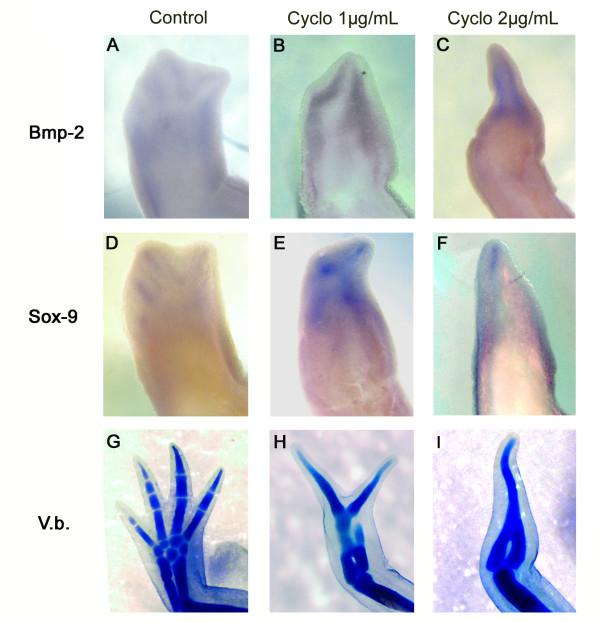
The expression of BMP-2 and SOX-9 in developing and regenerating axolotl limbs corresponded to the first digits forming in the anterior portion of the autopods. The inhibition of sonic hedgehog signaling with cyclopamine caused hypomorphic limbs (during development and regeneration) but did not affect the expression of BMP-2 and SOX-9. Overexpression of BMP-2 in regenerating limbs caused a loss of digits. Overexpression of Noggin (BMP inhibitor) in regenerating limbs also resulted in a loss of digits. Histological analysis indicated that the loss due to BMP-2 overexpression was the result of increased cell condensation and apoptosis while the loss caused by Noggin was due to a decrease in cell division.
CONCLUSION
The expression of BMP-2 and its target SOX-9 was independent of sonic hedgehog signaling in developing and regenerating limbs. Their expression correlated with chondrogenesis and the appearance of skeletal elements has described in other tetrapods. Overexpression of BMP-2 did not cause the formation of extra digits, which is consistent with the hypothesis that it is not the secondary signal of sonic hedgehog. However, it did cause the formation of hypomorphic limbs as a result of increased cellular condensation and apoptosis. Taken together, these results suggest that BMP-2 does not have a direct role in patterning regenerating limbs but may be important to trigger condensation prior to ossification and to mediate apoptosis.
背景
蝾螈在脊椎动物中具有独特的能力,即截肢后能完美再生复杂的身体部位,如四肢。此外,与迄今为止研究的所有四足动物从后向前模式化发育和再生的足不同,蝾螈从前往后模式化发育和再生足。在包括蝾螈在内的所有四足动物中,音猬因子在确立四肢的前后轴方面很重要。有趣的是,与其他四足动物一样,其在蝾螈四肢中的表达(在肢芽和再生芽基的后侧)是保守的。有人提出骨形态发生蛋白-2(BMP-2)可能是音猬因子的次要介导因子,尽管在小鼠中有越来越多的相反证据。由于在指形成模式之前,BMP-2的表达位于发育和再生四肢的前部,与音猬因子的表达相反,我们研究了BMP-2的表达是否依赖于音猬因子信号传导,以及它在再生过程中是否影响足的模式化。
结果
在发育和再生的蝾螈四肢中,BMP-2和SOX-9的表达与在足前部形成的第一指相对应。用环杷明抑制音猬因子信号传导导致四肢发育不全(在发育和再生过程中),但不影响BMP-2和SOX-9的表达。在再生四肢中过表达BMP-2导致指缺失。在再生四肢中过表达头蛋白(BMP抑制剂)也导致指缺失。组织学分析表明,BMP-2过表达导致的指缺失是细胞凝聚增加和细胞凋亡的结果,而头蛋白导致的指缺失是由于细胞分裂减少。
结论
在发育和再生的四肢中,BMP-2及其靶标SOX-9的表达独立于音猬因子信号传导。它们的表达与软骨形成以及其他四足动物中所述的骨骼元素的出现相关。BMP-2的过表达并未导致额外指的形成,这与它不是音猬因子的次要信号这一假设一致。然而,它确实由于细胞凝聚增加和细胞凋亡导致了发育不全的四肢的形成。综上所述,这些结果表明BMP-2在再生四肢的模式化中没有直接作用,但可能在骨化前触发凝聚和介导细胞凋亡方面很重要。


 Zotero 插件