
对美国某些口腔癌发病率上升的州的主要风险因素进行分析。
Analysis of primary risk factors for oral cancer from select US states with increasing rates.
作者信息
Bunnell Anthony, Pettit Nathan, Reddout Nicole, Sharma Kanika, O'Malley Susan, Chino Michelle, Kingsley Karl
机构信息
Department of Biomedical Sciences, School of Dental Medicine, University of Nevada, Las Vegas, USA.
出版信息
Tob Induc Dis. 2010 Feb 23;8(1):5. doi: 10.1186/1617-9625-8-5.
OBJECTIVES
To examine the primary risk factor for oral cancer in the US, smoking and tobacco use, among the specific US states that experienced short-term increases in oral cancer incidence and mortality.
METHODS
Population-based data on oral cancer morbidity and mortality in the US were obtained from the National Cancer Institute's (NCI) Surveillance, Epidemiology, and End Results (SEER) database for analysis of recent trends. Data were also obtained from the Centers for Disease Control and Prevention (CDC) Behavioral Risk Factor Surveillance System (BRFSS) to measure current and former trends of tobacco usage. To comprehensive measures of previous state tobacco use and tobacco-related policies, the Initial Outcomes Index (IOI, 1992-1993) and the Strength of Tobacco Control index (SoTC, 1999-2000) were also used for evaluation and comparison.
RESULTS
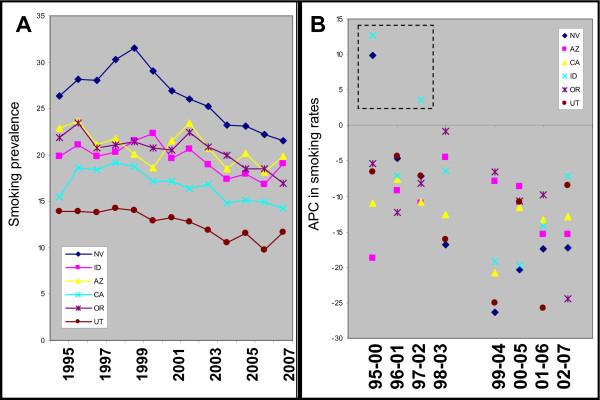
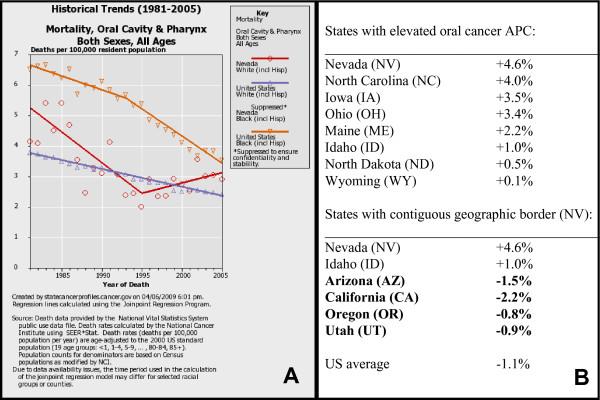
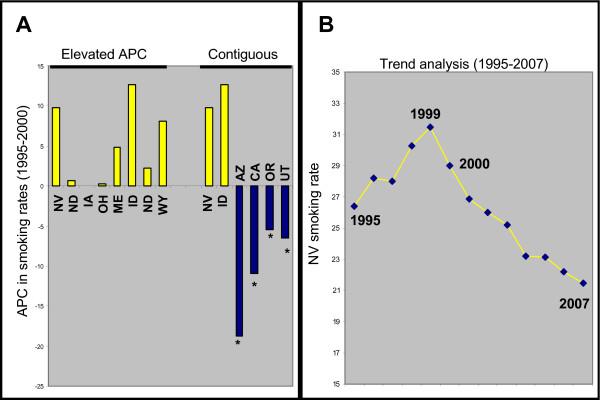
Analysis of the NCI-SEER data confirmed a previous report of geographic increases in oral cancer and demonstrated these were state-specific, were not regional, and were unrelated to previously observed increases among females and minorities. Analysis of the CDC-BRFSS data revealed these states had relatively higher percentages of smokers currently, as well as historically. In addition, analysis of the IOI and SoTC indexes suggest that many factors, including cigarette pricing, taxes and home or workplace bans, may have had significant influence on smoking prevalence in these areas. Trend analysis of these data uncovered a recent and significant reversal in smoking rates that suggest oral cancer incidence and mortality may also begin to decline in the near future.
CONCLUSION
Due to the rising costs of health care in the US and the limited resources available for health prevention efforts, it is essential to organize and direct more effective efforts by public health officials and epidemiologists, as well as funding from local, state and federal governments, to reduce and eliminate identified health disparities. This study provides evidence how these efforts may be directed to specific geographic areas, and towards the white males, previously thought to be unaffected by the increases in oral cancer among females and minorities.
目的
在美国口腔癌发病率和死亡率短期内出现上升的特定州中,研究口腔癌的主要风险因素——吸烟和烟草使用情况。
方法
从美国国家癌症研究所(NCI)的监测、流行病学和最终结果(SEER)数据库中获取美国口腔癌发病和死亡的基于人群的数据,以分析近期趋势。还从疾病控制与预防中心(CDC)的行为风险因素监测系统(BRFSS)获取数据,以衡量当前和过去的烟草使用趋势。为全面衡量先前的州烟草使用情况和与烟草相关的政策,还使用初始结果指数(IOI,1992 - 1993年)和烟草控制力度指数(SoTC,1999 - 2000年)进行评估和比较。
结果
对NCI - SEER数据的分析证实了先前关于口腔癌在地理上增加的报告,并表明这些增加是特定州的,而非区域性的,且与先前观察到的女性和少数族裔中的增加无关。对CDC - BRFSS数据的分析显示,这些州目前以及历史上吸烟者的比例相对较高。此外,对IOI和SoTC指数的分析表明,许多因素,包括香烟定价、税收以及家庭或工作场所禁烟等,可能对这些地区的吸烟流行率产生了重大影响。对这些数据的趋势分析发现吸烟率近期出现了显著逆转,这表明口腔癌的发病率和死亡率在不久的将来可能也会开始下降。
结论
由于美国医疗保健成本不断上升,且用于健康预防工作的资源有限,公共卫生官员和流行病学家必须组织并开展更有效的工作,同时地方、州和联邦政府提供资金,以减少和消除已确定的健康差距。本研究提供了证据,证明这些努力可如何针对特定地理区域以及先前被认为未受女性和少数族裔口腔癌增加影响的白人男性。

 Zotero 插件