
斑马鱼颅面骨发育生长和形态形成的模式。
Modes of developmental outgrowth and shaping of a craniofacial bone in zebrafish.
机构信息
Institute of Neuroscience, University of Oregon, Eugene, Oregon, United States of America.
出版信息
PLoS One. 2010 Mar 5;5(3):e9475. doi: 10.1371/journal.pone.0009475.
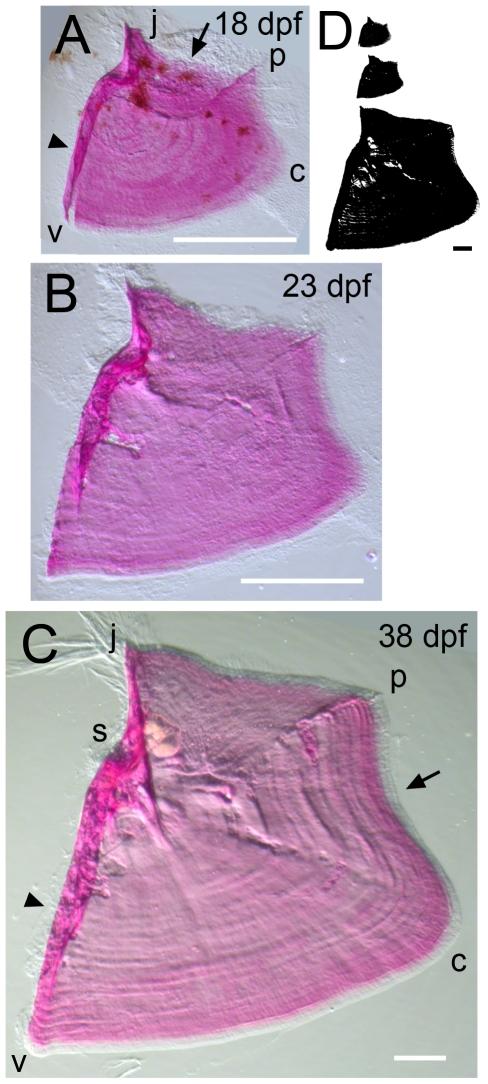
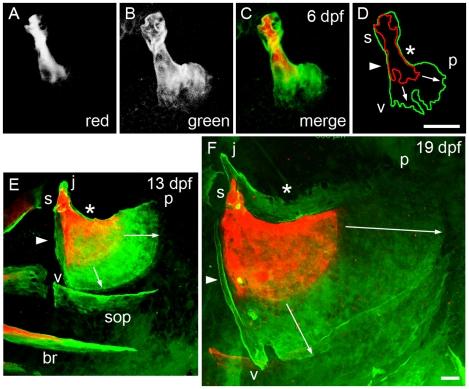
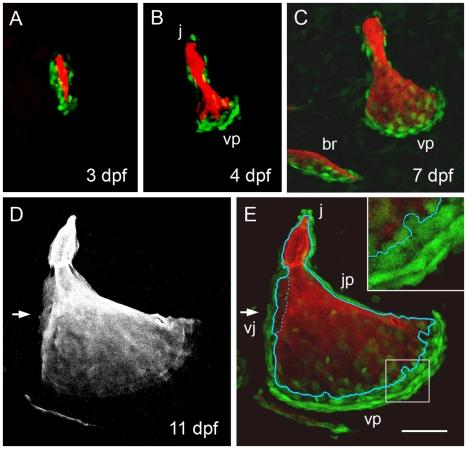
The morphologies of individual bones are crucial for their functions within the skeleton, and vary markedly during evolution. Recent studies have begun to reveal the detailed molecular genetic pathways that underlie skeletal morphogenesis. On the other hand, understanding of the process of morphogenesis itself has not kept pace with the molecular work. We examined, through an extended period of development in zebrafish, how a prominent craniofacial bone, the opercle (Op), attains its adult morphology. Using high-resolution confocal imaging of the vitally stained Op in live larvae, we show that the bone initially appears as a simple linear spicule, or spur, with a characteristic position and orientation, and lined by osteoblasts that we visualize by transgenic labeling. The Op then undergoes a stereotyped sequence of shape transitions, most notably during the larval period occurring through three weeks postfertilization. New shapes arise, and the bone grows in size, as a consequence of anisotropic addition of new mineralized bone matrix along specific regions of the pre-existing bone surfaces. We find that two modes of matrix addition, spurs and veils, are primarily associated with change in shape, whereas a third mode, incremental banding, largely accounts for growth in size. Furthermore, morphometric analyses show that shape development and growth follow different trajectories, suggesting separate control of bone shape and size. New osteoblast arrangements are associated with new patterns of matrix outgrowth, and we propose that fine developmental regulation of osteoblast position is a critical determinant of the spatiotemporal pattern of morphogenesis.
个体骨骼的形态对于其在骨骼中的功能至关重要,并且在进化过程中差异显著。最近的研究开始揭示骨骼形态发生的详细分子遗传途径。另一方面,对形态发生过程本身的理解并没有跟上分子研究的步伐。我们通过对斑马鱼的延长发育期进行研究,来探讨一种突出的颅面骨骼——颚骨(Op)如何获得其成年形态。我们通过对活幼虫的 Op 进行高分辨率共聚焦成像,发现该骨骼最初呈现出一种简单的线性刺突或刺,具有特征性的位置和方向,并由我们通过转基因标记可视化的成骨细胞排列。然后,Op 经历了一系列定型的形状转变,特别是在胚胎孵化后三周的幼虫期。新的形状出现,骨骼大小增加,这是由于新矿化骨基质在现有骨表面的特定区域以各向异性的方式添加的结果。我们发现两种基质添加模式,刺突和面纱,主要与形状变化有关,而第三种模式,增量带,主要与大小增长有关。此外,形态计量分析表明,形状发育和生长遵循不同的轨迹,表明骨骼形状和大小的控制是分开的。新的成骨细胞排列与基质向外生长的新模式相关,我们提出精细的成骨细胞位置发育调控是形态发生时空模式的关键决定因素。




 Zotero 插件