
Y 染色体证据表明中国三个食管癌高发人群具有共同的祖先。
Y-chromosome evidence for common ancestry of three Chinese populations with a high risk of esophageal cancer.
机构信息
The Key Immunopathology Laboratory of Guangdong Province, Department of Pathology, Shantou University Medical College, Shantou, Guangdong, China.
出版信息
PLoS One. 2010 Jun 15;5(6):e11118. doi: 10.1371/journal.pone.0011118.
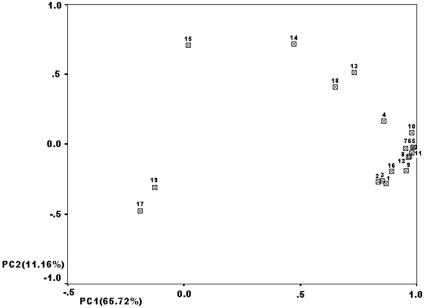
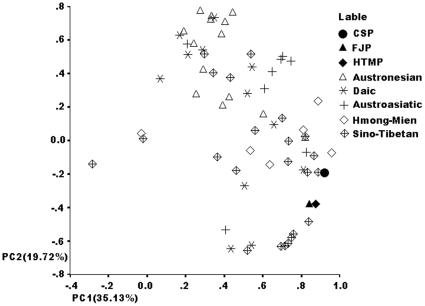
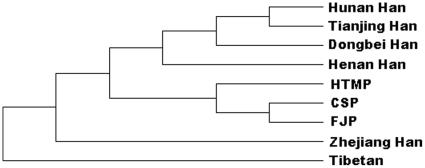
High rates of esophageal cancer (EC) are found in people of the Henan Taihang Mountain, Fujian Minnan, and Chaoshan regions of China. Historical records describe great waves of populations migrating from north-central China (the Henan and Shanxi Hans) through coastal Fujian Province to the Chaoshan plain. Although these regions are geographically distant, we hypothesized that EC high-risk populations in these three areas could share a common ancestry. Accordingly, we used 16 East Asian-specific Y-chromosome biallelic markers (single nucleotide polymorphisms; Y-SNPs) and six Y-chromosome short tandem repeat (Y-STR) loci to infer the origin of the EC high-risk Chaoshan population (CSP) and the genetic relationship between the CSP and the EC high-risk Henan Taihang Mountain population (HTMP) and Fujian population (FJP). The predominant haplogroups in these three populations are O3*, O3e*, and O3e1, with no significant difference between the populations in the frequency of these genotypes. Frequency distribution and principal component analysis revealed that the CSP is closely related to the HTMP and FJP, even though the former is geographically nearer to other populations (Guangfu and Hakka clans). The FJP is between the CSP and HTMP in the principal component plot. The CSP, FJP and HTMP are more closely related to Chinese Hans than to minorities, except Manchu Chinese, and are descendants of Sino-Tibetans, not Baiyues. Correlation analysis, hierarchical clustering analysis, and phylogenetic analysis (neighbor-joining tree) all support close genetic relatedness among the CSP, FJP and HTMP. The network for haplogroup O3 (including O3*, O3e* and O3e1) showed that the HTMP have highest STR haplotype diversity, suggesting that the HTMP may be a progenitor population for the CSP and FJP. These findings support the potentially important role of shared ancestry in understanding more about the genetic susceptibility in EC etiology in high-risk populations and have implications for determining the molecular basis of this disease.
在中国的河南太行山、福建闽南和潮汕地区,食管癌(EC)的发病率很高。历史记载描述了从中部地区(河南和山西汉族)大量人口通过沿海福建省迁移到潮汕平原的浪潮。尽管这些地区在地理位置上相距甚远,但我们假设这三个地区的 EC 高危人群可能有共同的祖先。因此,我们使用了 16 个东亚特异性 Y 染色体双等位基因标记(单核苷酸多态性;Y-SNPs)和 6 个 Y 染色体短串联重复(Y-STR)位点来推断 EC 高危潮汕人群(CSP)的起源以及 CSP 与 EC 高危河南太行山人群(HTMP)和福建人群(FJP)之间的遗传关系。这三个群体中主要的单倍群是 O3*、O3e* 和 O3e1,这些基因型的群体频率没有显著差异。频率分布和主成分分析表明,CSP 与 HTMP 和 FJP 密切相关,尽管前者在地理位置上更接近其他群体(广府和客家族群)。在主成分图中,FJP 位于 CSP 和 HTMP 之间。CSP、FJP 和 HTMP 与汉族的关系比与少数民族(除满族)的关系更密切,它们是藏-汉人的后裔,而不是白族。相关分析、层次聚类分析和系统发育分析(邻接法树)均支持 CSP、FJP 和 HTMP 之间的密切遗传关系。O3 单倍群(包括 O3*、O3e* 和 O3e1)的网络表明,HTMP 的 STR 单倍型多样性最高,这表明 HTMP 可能是 CSP 和 FJP 的祖先生存群体。这些发现支持了共同祖先在理解高危人群中 EC 病因学遗传易感性方面的重要作用,并对确定该疾病的分子基础具有重要意义。




 Zotero 插件