
中国潮汕地区一个食管癌和贲门癌高发区患者的父系背景
Patrilineal background of esophageal cancer and gastric cardia cancer patients in a Chaoshan high-risk area in China.
作者信息
Liu Shuhui, Huang Bo, Huang Haihua, Li Xiaoyun, Chen Guangcan, Zhang Guohong, Lin Wengting, Guo Dan, Wang Jie, Yu Zefeng, Liu Xi, Su Min
机构信息
Institute of Clinical Pathology & Department of Pathology, Guangdong Provincial Key Laboratory of Infectious Diseases and Molecular Immunopathology, Shantou University Medical College, Shantou, Guangdong, China.
出版信息
PLoS One. 2013 Dec 10;8(12):e81670. doi: 10.1371/journal.pone.0081670. eCollection 2013.
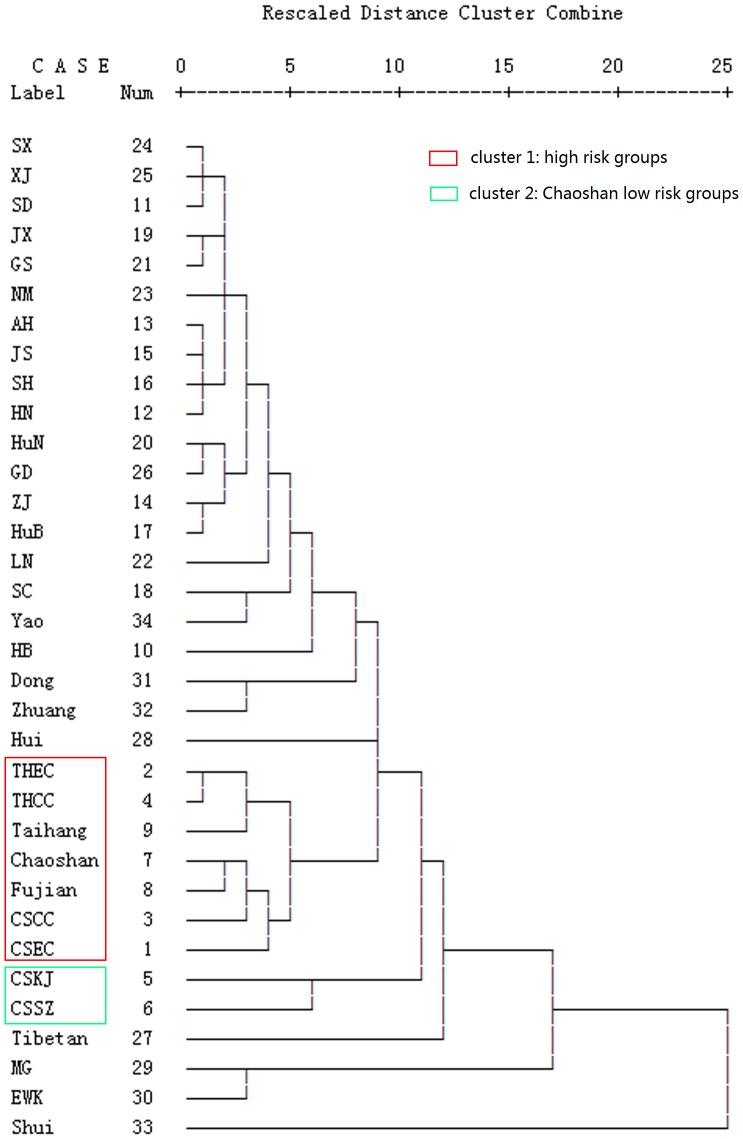
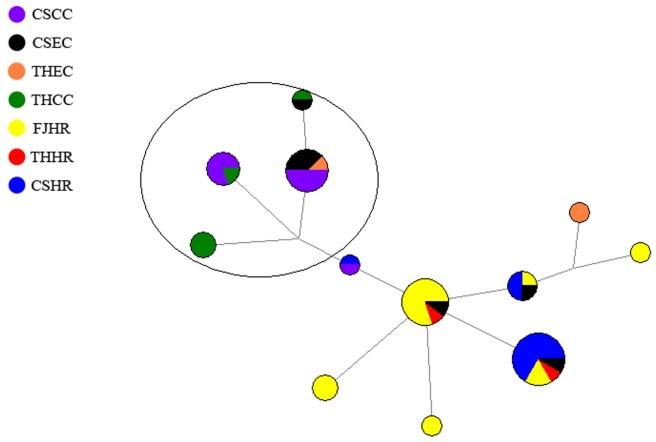
The Taihang Mountain range of north-central China, the Southern region area of Fujian province, and the Chaoshan plain of Guangdong province are 3 major regions in China well known for their high incidence of esophageal cancer (EC). These areas also exhibit high incidences of gastric cardia cancer (GCC). The ancestors of the Chaoshanese, now the major inhabitants in the Chaoshan plain, were from north-central China. We hypothesized that EC and GCC patients in Chaoshan areas share a common ancestry with Taihang Mountain patients. We analyzed 16 East Asian-specific Y-chromosome biallelic markers (single nucleotide polymorphisms; Y-SNPs) and 6 Y-chromosome short tandem repeat (Y-STR) loci in 72 EC and 48 GCC patients from Chaoshan and 49 EC and 63 GCC patients from the Taihang Mountain range. We also compared data for 32 Chaoshan Hakka people and 24 members of the aboriginal She minority who live near the Chaoshan area. Analysis was by frequency distribution and principal component, correlation and hierarchical cluster analysis of Y-SNP. Chaoshan patients were closely related to Taihang Mountain patients, even though they are geographically distant. Y-STR analysis revealed that the 4 patient groups were more closely related with each other than with other groups. Network analysis of the haplogroup O3a3c1-M117 showed a high degree of patient-specific substructure. We suggest that EC and GCC patients from these 2 areas share a similar patrilineal genetic background, which may play an important role in the genetic factor of EC and GCC in these populations.
中国中北部的太行山脉、福建省南部地区以及广东省的潮汕平原是中国食管癌(EC)高发的3个主要地区。这些地区的贲门癌(GCC)发病率也很高。潮汕平原的主要居民潮汕人的祖先来自中国中北部。我们推测,潮汕地区的EC和GCC患者与太行山脉地区的患者有着共同的祖先。我们分析了来自潮汕的72例EC患者和48例GCC患者以及来自太行山脉的49例EC患者和63例GCC患者的16个东亚特异性Y染色体双等位基因标记(单核苷酸多态性;Y-SNPs)和6个Y染色体短串联重复序列(Y-STR)位点。我们还比较了32名潮汕客家人和24名居住在潮汕地区附近的原住民畲族成员的数据。分析采用Y-SNP的频率分布、主成分分析、相关性分析和层次聚类分析。潮汕患者与太行山脉地区的患者密切相关,尽管他们在地理上相距遥远。Y-STR分析显示,这4组患者彼此之间的关系比与其他组更密切。单倍群O3a3c1-M117的网络分析显示出高度的患者特异性亚结构。我们认为,这两个地区的EC和GCC患者具有相似的父系遗传背景,这可能在这些人群中EC和GCC的遗传因素中起重要作用。



 Zotero 插件