
肽酰精氨酸脱亚氨酶 2(PAD2)在犬乳腺上皮细胞组蛋白瓜氨酸化中的潜在作用。
Potential role for peptidylarginine deiminase 2 (PAD2) in citrullination of canine mammary epithelial cell histones.
机构信息
J.A. Baker Institute for Animal Health, College of Veterinary Medicine, Cornell University, Ithaca, New York, United States of America.
出版信息
PLoS One. 2010 Jul 26;5(7):e11768. doi: 10.1371/journal.pone.0011768.
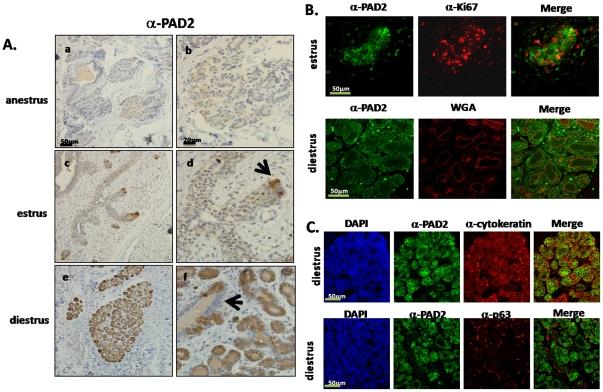
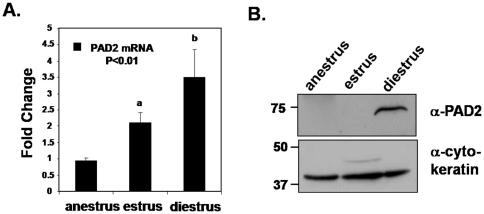
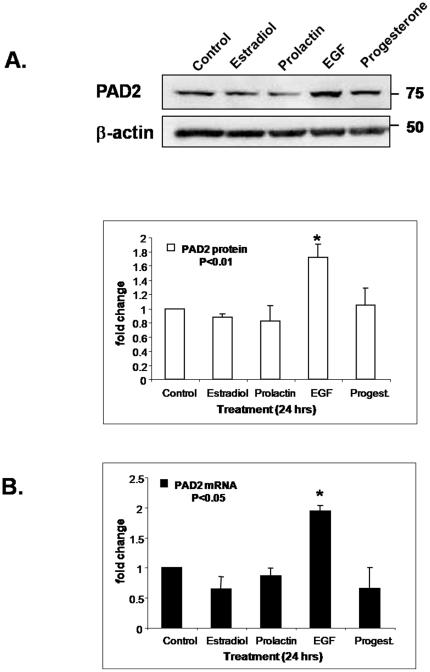
Peptidylarginine Deiminases (PADs) convert arginine residues on substrate proteins to citrulline. Previous reports have documented that PAD2 expression and activity varies across the estrous cycle in the rodent uterus and pituitary gland, however, the expression and function of PAD2 in mammary tissue has not been previously reported. To gain more insight into potential reproductive roles for PAD2, in this study we evaluated PAD2 expression and localization throughout the estrous cycle in canine mammary tissue and then identified possible PAD2 enzymatic targets. Immunohistochemical and immunofluorescence analysis found PAD2 expression is low in anestrus, limited to a distinct, yet sparse, subset of epithelial cells within ductal alveoli during estrus/early diestrus, and encompasses the entire epithelium of the mammary duct in late diestrus. At the subcellular level, PAD2 is expressed in the cytoplasm, and to a lesser extent, the nucleus of these epithelial cells. Surprisingly, stimulation of canine mammary tumor cells (CMT25) shows that EGF, but not estrogen or progesterone, upregulates PAD2 transcription and translation suggesting EGF regulation of PAD2 and possibly citrullination in vivo. To identify potential PAD2 targets, anti-pan citrulline western blots were performed and results showed that citrullination activity is limited to diestrus with histones appearing to represent major enzymatic targets. Use of site-specific anti-citrullinated histone antibodies found that the N-terminus of histone H3, but not H4, appears to be the primary target of PAD activity in mammary epithelium. This observation supports the hypothesis that PAD2 may play a regulatory role in the expression of lactation related genes via histone citrullination during diestrus.
肽基精氨酸脱亚氨酶(PADs)将靶蛋白上的精氨酸残基转化为瓜氨酸。先前的报告记录了 PAD2 的表达和活性在啮齿动物子宫和垂体的发情周期中发生变化,然而,PAD2 在乳腺组织中的表达和功能尚未被报道。为了更深入地了解 PAD2 在生殖中的潜在作用,在本研究中,我们评估了犬乳腺组织发情周期中 PAD2 的表达和定位,然后确定了可能的 PAD2 酶切靶点。免疫组织化学和免疫荧光分析发现,PAD2 在安静期表达水平较低,在发情期/早期发情期仅限于导管肺泡中独特而稀疏的上皮细胞亚群,在晚期发情期则涵盖乳腺导管的整个上皮。在亚细胞水平上,PAD2 表达于细胞质中,在这些上皮细胞的核中表达较少。令人惊讶的是,犬乳腺肿瘤细胞(CMT25)的刺激显示,EGF 而非雌激素或孕激素可上调 PAD2 的转录和翻译,表明 EGF 对 PAD2 和体内可能的瓜氨酸化的调节作用。为了鉴定潜在的 PAD2 靶点,进行了抗泛瓜氨酸western blot 分析,结果表明瓜氨酸化活性仅限于发情期,组蛋白似乎是主要的酶切靶点。使用特异性抗瓜氨酸化组蛋白抗体发现,组蛋白 H3 的 N 端而不是 H4 的 N 端似乎是乳腺上皮中 PAD 活性的主要靶标。这一观察结果支持了以下假设,即 PAD2 可能通过在发情期通过组蛋白瓜氨酸化来调节与泌乳相关基因的表达,从而发挥调节作用。

 Zotero 插件