
外显子组测序鉴定出 MLL2 突变是歌舞伎综合征的一个病因。
Exome sequencing identifies MLL2 mutations as a cause of Kabuki syndrome.
机构信息
Department of Genome Sciences, University of Washington, Seattle, Washington, USA.
出版信息
Nat Genet. 2010 Sep;42(9):790-3. doi: 10.1038/ng.646. Epub 2010 Aug 15.
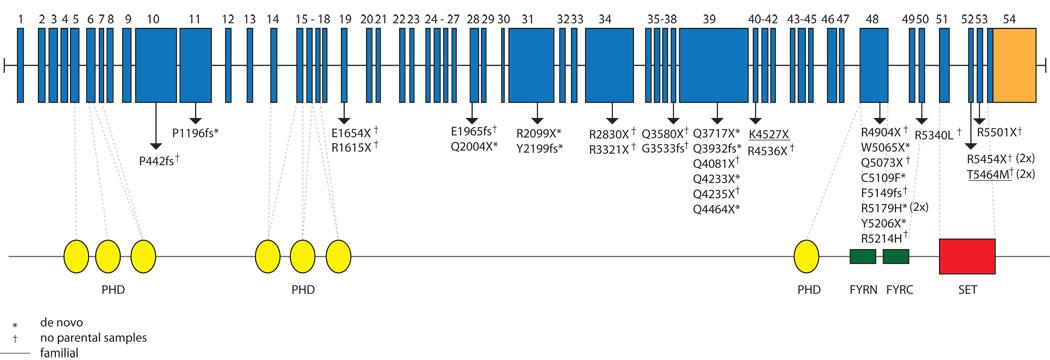
We demonstrate the successful application of exome sequencing to discover a gene for an autosomal dominant disorder, Kabuki syndrome (OMIM%147920). We subjected the exomes of ten unrelated probands to massively parallel sequencing. After filtering against existing SNP databases, there was no compelling candidate gene containing previously unknown variants in all affected individuals. Less stringent filtering criteria allowed for the presence of modest genetic heterogeneity or missing data but also identified multiple candidate genes. However, genotypic and phenotypic stratification highlighted MLL2, which encodes a Trithorax-group histone methyltransferase: seven probands had newly identified nonsense or frameshift mutations in this gene. Follow-up Sanger sequencing detected MLL2 mutations in two of the three remaining individuals with Kabuki syndrome (cases) and in 26 of 43 additional cases. In families where parental DNA was available, the mutation was confirmed to be de novo (n = 12) or transmitted (n = 2) in concordance with phenotype. Our results strongly suggest that mutations in MLL2 are a major cause of Kabuki syndrome.
我们成功地应用外显子组测序来发现一种常染色体显性疾病——歌舞伎综合征(OMIM%147920)的致病基因。我们对 10 名无亲缘关系的先证者的外显子组进行了大规模平行测序。在与现有 SNP 数据库进行过滤后,在所有受影响的个体中均未发现包含先前未知变异的强制性候选基因。放宽过滤标准允许存在适度的遗传异质性或缺失数据,但也确定了多个候选基因。然而,基因型和表型分层突出了 MLL2,它编码一个 Trithorax 组组蛋白甲基转移酶:七个先证者在该基因中发现了新的无意义或移码突变。随后的 Sanger 测序在另外 43 个病例中的 2 个和 3 个剩余的歌舞伎综合征病例中的 2 个中检测到 MLL2 突变。在有父母 DNA 可用的家庭中,该突变被确认为与表型一致的新生突变(n=12)或传递突变(n=2)。我们的研究结果强烈表明,MLL2 突变是歌舞伎综合征的主要原因。
 Zotero 插件